
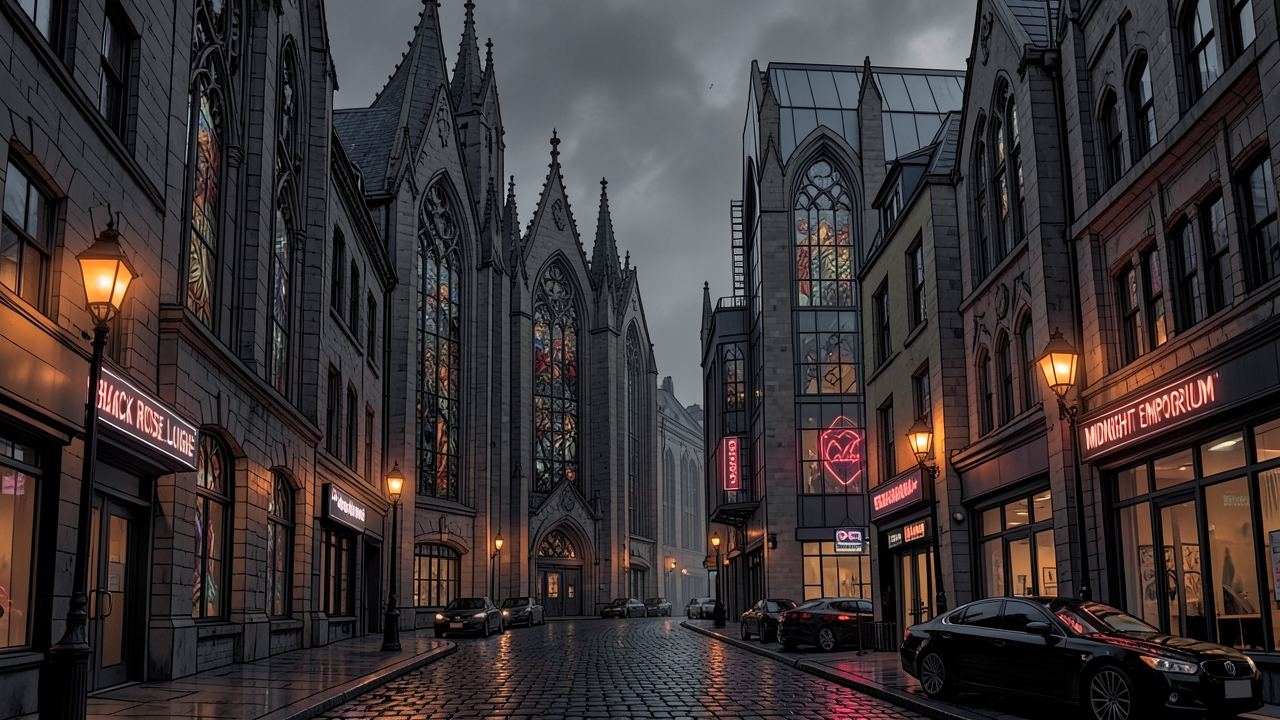
Does the chill that seeps through your windowpane at 3 AM carry the same weight as it did for the last inhabitant of a crumbling manor? The architecture of fear changes. The howl of a wolf becomes the shriek of subway brakes; the shadowed corridor transforms into the flickering hallway of a concrete high-rise. To write a modern gothic urban setting in 2026 is to understand that the soul of the genre is not in the creaking floorboard, but in the profound, isolating unease of being adrift in a system too vast to comprehend.
The Translocated Architecture of Fear
The classic Gothic manor, as seen in works like The Mysteries of Udolpho, functioned as a living organism. It held secrets, decay, and history in its very walls. Today, that organism is the city itself. The urban landscape is not a backdrop; it is a character—indifferent, labyrinthine, and pulsing with a life of its own that dwarfs our own. Our task is not to abandon the core tenets of Gothic—isolation, decay, and psychological turmoil—but to find their new, potent analogues in the world of glass, steel, and fiber optics.
Isolation in the Crowd
Isolation is no longer merely geographical; it is profoundly social and digital. In Shirley Jackson’s The Haunting of Hill House, the house preys upon Eleanor’s loneliness. In a modern gothic urban setting, the protagonist can be surrounded by millions yet utterly alone. This is the dread of the anonymous crowd, the isolation of a thousand unread emails, the paralysis of a social media feed that broadcasts connection while fostering comparison. The haunted room is now the studio apartment with a single, unblinking smart speaker. As Literary Hub notes, contemporary Gothic often explores the “uncanny valley of the social, where proximity amplifies absence.”
Decay in the New and the Digital
Decay in the 2026 urban setting is both subtle and systemic. It’s the “hauntology” of a gentrified neighborhood, where the ghosts of past communities linger in the unchanged facades of new boutiques. It is the failing infrastructure of a smart home—the fridge that records your eating habits, the lock that glitches, the digital voice assistant that misinterprets a whispered plea for help. Think of the digital decay in Tana French’s The Searcher, where the protagonist’s quiet digital detox in rural Ireland becomes a tense exercise in disconnection. In the city, disconnection is a vulnerability. Decay is not just rot; it is the corrosion of trust in the systems we build around ourselves.
For deeper insight into haunting as a narrative device, explore our analysis of haunting literary techniques.
Crafting the Atmosphere: Techniques for the Modern Writer
Atmosphere is the Gothic writer’s primary tool. In a modern gothic urban setting, this atmosphere is built not from ivy and candlelight, but from artificiality, surveillance, and sensory overload. Here’s how to master it:
The Sensory Palette of the City
Replace the scent of damp stone and old roses with the ozone tang of the subway tunnel, the cloying sweetness of a fast-food court, or the sterile antiseptic smell of a new high-rise lobby. Use sound as a weapon: the oppressive hum of ventilation systems, the sudden, jarring silence when a power grid fails, the muffled thump of a neighbor’s bass through thin walls. Visuals should play with unnatural light—the green glow of an exit sign in total darkness, the strobe of a passing train, the blue pallor of a phone screen on a face in a dark room.
The Uncanny in the Mundane
Freud defined the uncanny as something familiar yet strangely alien. An empty playground at night. A face you recognize from a missing persons poster on a digital billboard. The automated voice in an elevator that says “Going up” to a car descending. This technique is your bridge from the ordinary to the dreadful. As in the works of [Haruki Murakami](https://www.poetryfoundation.org/poets/haruki-murakami) ([no follow](https://www.poetryfoundation.org/poets/haruki-murakami)), where the mundane slips sideways into the surreal, your story should make the reader side-eye their own environment. The digital space is a prime territory for this: a social media profile that updates after the person’s death, a navigation app directing you to an address that doesn’t exist.
Psychological Turmoil and the Digital Self
The Gothic mind is a fractured mind. In 2026, the fracture often occurs across the digital divide. Consider a character whose online persona—confident, curated, successful—is diametrically opposed to their crumbling reality. This duality is a rich source of torment. Gillian Flynn’s Gone Girl masterfully wielded the performance of identity in a media-saturated world. Update this for the era of deepfakes and algorithmic profiles. The horror arises when the curated self begins to feel more “real” than the physical self, or when an external force threatens to expose the fracture.
Our guide to building internal character conflict delves further into this psychological terrain.
Common Pitfalls in the Urban Gothic
Transposing the genre is not without its snares. Avoid these common missteps:
1. Over-reliance on Technology as Monster. The glitching smart home is a setting, not the story. The true terror is the human response to the loss of control. As in Daphne du Maurier’s Rebecca, the house (Manderley) is an expression of Rebecca’s pervasive personality, not the villain itself.
2. Forgetting the Human Core. The most terrifying subway tunnel is the one you are trapped in, alone, having a panic attack. Ground the cosmic dread of the city in intimate, human-scale fears: fear of surveillance, of obsolescence, of being truly known, of being utterly lost.
3. Neglecting the Poetics of Place. Describe the peeling paint on the fire escape. Describe the unique, grimy pattern of the subway tile. Specificity breeds believability. The more real the setting feels, the more invasive its eventual corruption becomes.
A Case Study: The Luminous Void
The elevator in Apex Tower did not have floors. It had coordinates in a private server. Elena pressed “PH,” and the doors hissed shut on a lobby smelling of new carpet and absence. Her phone lost signal three floors up. The only sound was the mechanical sigh of the cab and a faint, high-frequency whine she’d started to associate with the building’s “smart” climate control.
Her apartment was a panoramic glass box, twenty-two stories above the city’s amber glow. The view was magnificent, a circuit board of light. Yet, for the third night in a row, the motion sensor in the hallway outside her door triggered at 2:17 AM. Each time, she checked the security feed on her tablet. Each time, the hallway was empty. But the log insisted: “Motion Detected – Sector 7B.” The door was Sector 7B. She was Sector 7A. Something was standing on the other side, close enough to trigger the sensor, but invisible to the lens.
She began to doubt the feed. Then she began to doubt her eyes. The city lights outside sometimes seemed to rearrange themselves when she blinked. The voice-activated assistant, Aria, would occasionally respond to a question she hadn’t asked. “I’m sorry, I didn’t catch that,” it would chime into the silence, its synthetic tone sweetly menacing. Tonight, she sat frozen on her couch, watching the empty, motion-triggered hallway on her screen. The dread was not of a ghost. It was of the system itself—the lights, the locks, the very air she breathed—deciding to watch her in a new, more intimate way. The void beyond the glass was not empty. It was luminous, attentive, and it had her address.
The Echo in the Concrete
The Gothic spirit endures because fear is adaptive. It changes shape to fit its container. The crumbling manor spoke to fears of hereditary decay and social imprisonment. The modern gothic urban setting of 2026 speaks to our new terrors: systemic invisibility, digital hauntings, and the isolation of the interconnected world. By mastering the art of translocation—mapping the ancient dread onto new, electric architecture—you do not merely update a genre. You reveal the timeless anxieties of your era, wrapped in the fresh, cold packaging of a world that is both intimately known and profoundly alien.
So, when the smart bulb flickers overhead, casting a shadow that doesn’t quite match your own, will you dismiss it as a glitch… or will you wonder what has learned to live in the wiring of your world?