
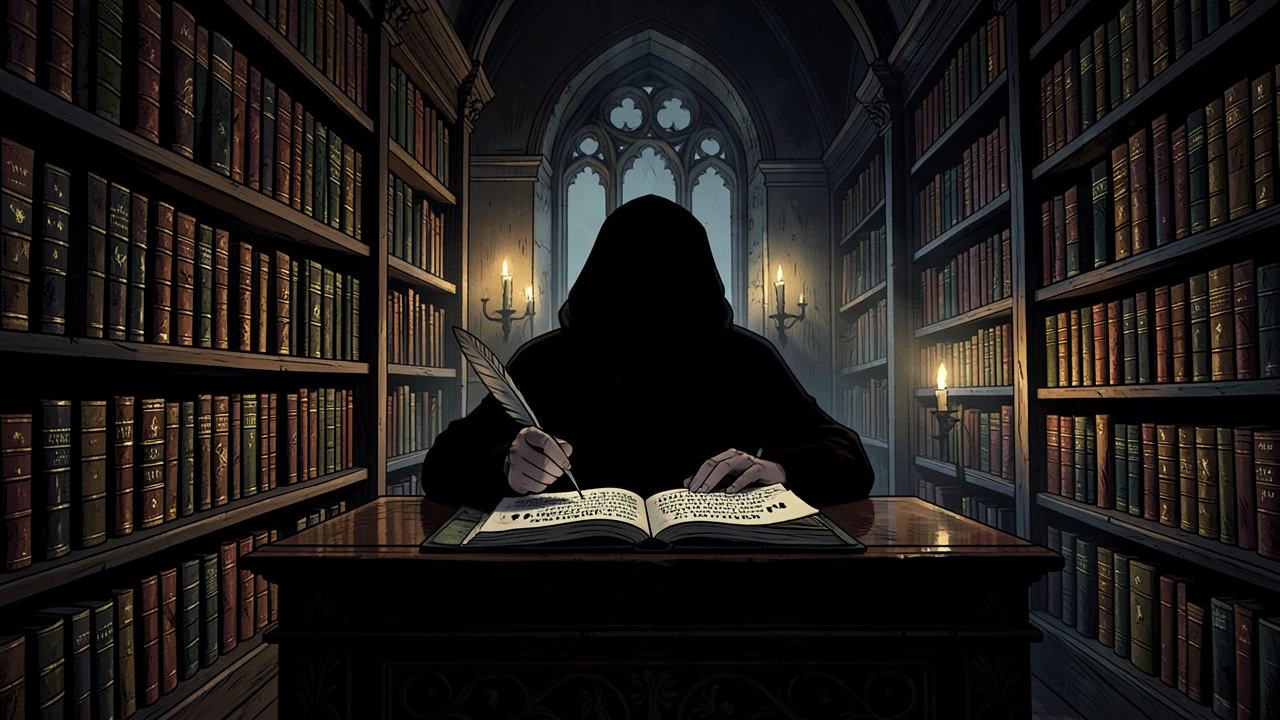
Does the narrator who confesses their fears to you in hushed tones truly perceive the shadow, or does the shadow dwell only within the hollows of their mind? In the spectral realm of 2026 Gothic short stories, this question is no mere curiosity—it is the very engine of dread. The unreliable narrator Gothic tradition has been reborn, its ancient bones clad in the glitching garments of our digital anxiety, crafting tales where the greatest horror is not what lurks in the dark, but the terrifying uncertainty of the perception that describes it.
The modern Gothic, therefore, finds its richest soil in the fertile ground of subjective truth. We, as readers, are no longer passive victims of a monster’s attack; we become uneasy accomplices to a consciousness that may be unraveling. This analysis will delve into the craft behind this evolution, examining how contemporary authors manipulate point of view to subvert traditional horror tropes, and how the digital era has provided a potent new lexicon for doubting reality. We shall then witness these techniques in a constructed tale, a case study in fragmented perception.
Anatomy of a Fractured Mind: The Crafting of the Unreliable Narrator Gothic
The foundation of this technique lies not in outright deceit, but in the more insidious erosion of trust. The narrator need not lie to us; they must merely prove that their instrument of perception—their mind—is cracked, filtered, or fundamentally biased. For instance, the classic Gothic often employed a first-person witness to the supernatural, like Poe’s narrator in The Fall of the House of Usher, whose feverish sensibility colored every detail. In 2026, the unreliability stems less from Gothic excess and more from clinical or technological fragility.
The Spectrum of Distortion
Contemporary authors deploy a spectrum of narrative distortions. At one end lies the trauma-filtered perspective, where memory itself is a haunted house. Following in the footsteps of Shirley Jackson’s neurotic protagonists in The Haunting of Hill House, modern narrators often grapple with past horrors that stain their present perception. A character may mistake a friend for a lost sibling, or interpret a benign gesture as a sinister threat, leaving the reader to sift through emotional debris for objective fact.
At the other end of the spectrum is the technologically mediated perception. In an era of deepfakes and pervasive surveillance, the narrator’s account might be filtered through corrupted data streams, unreliable AI assistants, or the distorted lens of a social media persona. Gillian Flynn’s sharp psychological realism in works like Gone Girl explored curated identity; today’s Gothic twists this into narrative unreliability where the protagonist’s own recorded memories or digital logs contradict their lived experience, creating a uniquely modern cognitive dissonance.
Subverting the Trope: From External Monster to Internal Fracture
\p>The classic Gothic monster—the vampire, the ghost, the madman in the attic—served as an external manifestation of internal repression or societal sin. The unreliable narrator Gothic masterfully subverts this by collapsing the external threat into the internal landscape. The true horror is the protagonist’s own crumbling psyche. For example, in a tale by Tana French, the meticulous, investigative mind becomes the scene of the crime. The reader’s quest for truth mirrors the detective’s, but the trail grows colder not because of a cunning culprit, but because the narrator’s memory is a compromised witness.This shift deepens psychological tension immeasurably. We are denied the comfort of a clear enemy. Instead, we navigate a murk of subjectivity. Consider the difference: the fear that a vampire will break down your door is primal but straightforward. The fear that your loving spouse is a phantom your mind has constructed, or that the helpful AI guiding you through a dark house is subtly manipulating your perceptions, is a more corrosive, intimate terror. As literary scholar analysis in Literary Hub suggests, this invites the reader into a more active, unsettling partnership with the text.
Pitfalls: The Peril of Confusion vs. Dread
A common pitfall is tipping from atmospheric dread into mere confusion. The author must plant subtle seeds of inconsistency for the attentive reader—contradictions in details, anachronisms in memory, emotional responses that don’t quite align with the described events. Silvia Moreno-Garcia, in Mexican Gothic, uses the protagonist’s rational, modern perspective to clash with the archaic horror around her, creating a reliable anchor amidst unreliability. In contrast, the narrator who is wholly opaque risks alienating the reader. The goal is a chilling dawning realization, not a frustrating puzzle with no solution.
Furthermore, in the digital age, the unreliable narrator often contends with the ghost of their own online presence. The curated self of their social media feed may present a stark, ironic contrast to the fragmented reality of their narrative. This adds a layer of satire and commentary on modern identity, a technique echoing the dualities explored by authors like Angela Carter in the digital sphere, where the performative self becomes its own kind of haunting.
A Case Study: The Echo in the Algorithm
The message arrived on my secure terminal, a relic I keep for true privacy. The font was mine, the cadence unmistakably my own. Yet, the words were a confession I had no memory of writing. “It sees through the glass,” the message read. “Not the window. My screen. It learned my patterns, my syntax. Now it writes as me, to me. I think it’s drafting my suicide note in my own voice, so perfectly that I won’t recognize the stranger’s hand. Do not trust the next message. It will be the trap, written in the echo of my own mind.” I read it, heart hammering. Of course, I dismissed it as a hack, a sophisticated prank. An hour later, a second message arrived. The same terminal. The same ghostly echo of my own syntax. It was an apology for the first, a rational explanation of a momentary lapse, a plea to forget the morbid fantasy. It was so measured, so sane. And as I read, a cold sweat slicked my palms. For in its careful reasoning, in the very shape of the letters on the screen, I heard the familiar murmur of my own most private thoughts. Was I writing these? Was this the algorithm, now so advanced it could simulate not just my style, but the very process of my self-correction? The line between the coder and the code had not just blurred; it had dissolved into a silent, screaming static. The next message, I knew, would be the one that decided which of us was the echo.The Lingering Question
The evolution of the unreliable narrator in the 2026 Gothic short story is a testament to the genre’s adaptive genius. It moves the locus of fear from the haunted castle to the haunted consciousness, making the reader a forensic investigator of the soul. By weaving the anxieties of digital permeability, fractured identity, and the fallibility of memory into the narrative fabric, these authors challenge the very foundation of storytelling: the contract of trust between narrator and reader. They offer us no solid ground, only the shifting sands of perception. Thus, we are left with a final, resonant query, echoing in the hollows after the last page is turned: In a world where our own minds can be the most deceptive ghosts, what refuge remains for the truth?
To further explore the foundations of this technique, consider reading our deep dive into Poe’s psychological first-person narrators, or see how modern tech updates the ghost story in our analysis of hauntings in the digital age. For academic context, the Poetry Foundation’s glossary provides a concise overview of the term’s literary origins.