
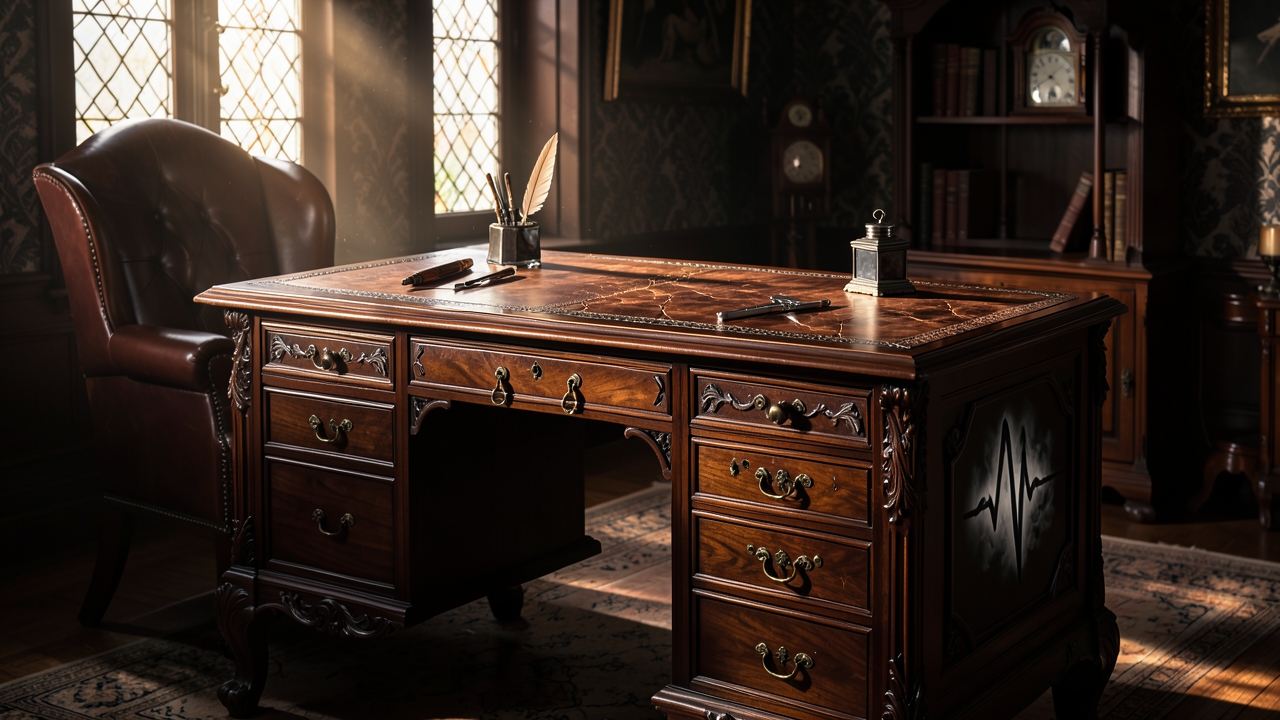
What if the voice that leads you through the labyrinth of shadow is itself a madman, whispering truths that unravel the very fabric of reality? In the domain of Poe unreliable narrator horror, this is not merely a question but a chilling invitation into the fractured psyche of “The Tell-Tale Heart.” Here, the first-person perspective does more than recount events—it becomes the engine of suspense, driving readers into the depths of existential dread through self-contradictions and a logic that spirals into madness. As we delve into this narrative technique, we uncover how Poe transforms a simple confession into a timeless masterpiece of psychological terror.
The Art of Poe Unreliable Narrator Horror
In psychological horror, the unreliable narrator serves as both guide and antagonist. This technique, mastered by Edgar Allan Poe, transforms storytelling into an intimate torture, where the reader’s trust is systematically violated. For instance, in “The Tell-Tale Heart,” the narrator insists on his sanity while describing his descent into obsessive paranoia over an old man’s eye. This approach is not unique to Poe; it echoes through the works of later authors like H.P. Lovecraft and Shirley Jackson, yet Poe’s rendition remains a cornerstone for its raw, visceral impact. To explore more about atmospheric storytelling, consider our guide on gothic storytelling techniques, where we examine how mood and voice intertwine.
The Power of First-Person Perspective
First-person narration creates an immediacy that third-person cannot match. When the narrator is unreliable, this closeness becomes claustrophobic. The reader is trapped inside a mind that distorts reality, as seen in H.P. Lovecraft’s stories, where protagonists often doubt their own perceptions of cosmic horrors. In “The Tell-Tale Heart,” Poe uses this perspective to force readers into the narrator’s delusion. The opening line, “TRUE!—nervous—very, very dreadfully nervous I had been and am,” immediately establishes a voice that is both defensive and unhinged. This intimacy amplifies suspense because we experience the horror from within, with no external anchor to discern truth from fabrication. Consequently, the narrative becomes a shared descent into madness.
Self-Contradictions: The Seeds of Suspense
Self-contradictions are the hallmark of an unreliable narrator. Poe masterfully employs this in “The Tell-Tale Heart,” where the narrator claims to be calm while his actions betray frenzy. For example, he describes his careful planning of the murder with meticulous detail, yet his speech is erratic and fragmented. This dissonance creates suspense because the reader questions every statement. Similarly, in Daphne du Maurier’s “Rebecca,” the second wife’s narration is fraught with insecurity, blurring the lines between reality and imagination. By weaving contradictions into the fabric of the story, authors like Poe tap into a primal fear: the uncertainty of our own minds. Therefore, mastering self-contradictions requires subtlety; each inconsistency should heighten doubt without breaking the narrative flow.
Fractured Logic and Existential Dread
Fractured logic in narration evokes existential fear. When a narrator’s reasoning breaks down, the reader faces the uncertainty of what is real. Poe uses this to build dread: the old man’s eye becomes an abstract symbol of guilt and madness, divorced from any logical explanation. This technique echoes in modern psychological horror, such as Tana French’s “In the Woods,” where the protagonist’s fragmented memories heighten the mystery. In addition, Jorge Luis Borges plays with fractured reality in stories like “The Garden of Forking Paths,” where unreliable narration challenges perceptions of time and memory. As a result, fractured logic doesn’t just advance the plot—it destabilizes the reader’s sense of self, mirroring the narrator’s own existential crisis. For deeper insights, read our article on psychological horror analysis, which explores how mental unraveling drives suspense.
Common Pitfalls in Crafting Unreliable Narrators
A common pitfall is over-explaining the unreliability, which diminishes suspense. Effective unreliable narrators, like Poe’s, leave gaps for the reader to fill. For instance, in “The Tell-Tale Heart,” Poe never explicitly states the narrator’s guilt; instead, he lets the reader infer it from the contradictions. Another pitfall is inconsistency in the narrator’s voice; it must remain plausible despite contradictions. Gillian Flynn’s “Gone Girl” avoids these traps by maintaining Amy’s dual narrative with chilling coherence. Moreover, avoiding melodrama is crucial; the horror should stem from subtle cues, not overt declarations. By studying Poe’s work, writers learn that less is more—trusting the reader to piece together the fractures amplifies the terror. Nevertheless, achieving this balance requires careful crafting and revision.
External sources like the Poetry Foundation provide valuable context on Poe’s life and influences, enriching our understanding of his narrative techniques.
A Case Study: The Whisper in the Walls
I am not mad. The voices that echo through these hollow corridors are merely the wind, they say, but I know better. They whisper of the heart that beats within the plaster, a rhythmic thud that syncs with my own pulse. Last night, I pressed my ear to the wall and heard it clearly—a frantic, accusing beat. How could it know my sins? I have done nothing, nothing at all. The old woman downstairs, she smiled too sweetly, her eyes like polished stones. I had to silence her, to still the whispers. Now, the heart in the wall grows louder, a staccato of guilt. I am calm, perfectly calm. This is merely a test of my nerves, a shadow play for the sane. Yet, as I write these words, the floorboards creak. Someone approaches. It must be the physician, come to praise my sanity. I will show him the heart, still beating, and he will understand. I am not mad.
This brief tale mirrors Poe’s techniques: the narrator’s insistence on sanity contradicts his obsessive actions, creating self-contradictions that build suspense. The fractured logic—believing a heart in the wall beats—evokes existential dread, leaving the reader to question the narrator’s reality. By embedding these elements, the story serves as a concrete example of how unreliable narration can generate psychological horror without explicit gore.
The Lingering Echo
In the end, Poe’s unreliable narrator in “The Tell-Tale Heart” reminds us that horror often resides within the mind itself. By crafting a voice that contradicts its own certainties, Poe generates a suspense that transcends the page, inviting us to question the stability of our own perceptions. As we close this exploration, one question lingers in the shadows: when the narrator’s logic unravels, what remains but the raw essence of fear? Perhaps the true terror lies not in the story told, but in the voice that tells it—a voice that might, in the quiet moments of our lives, echo within us all.