
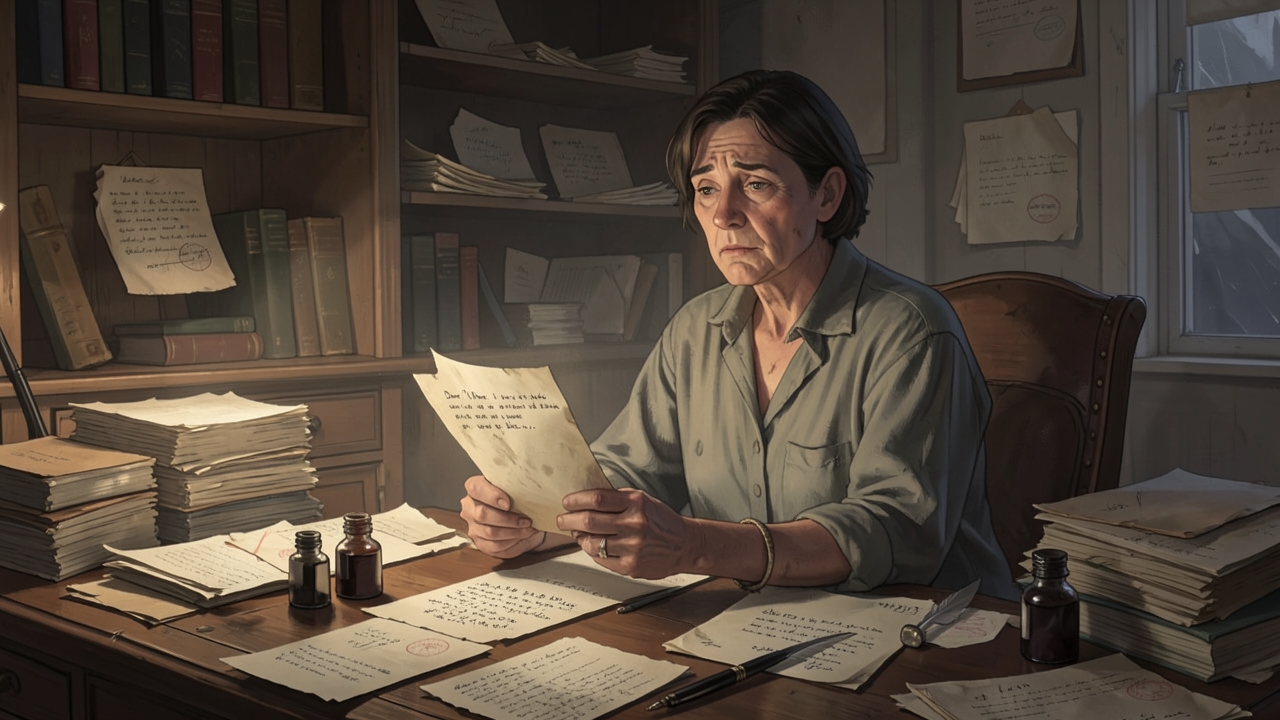
Have you ever held a letter you knew you could never send? Its words, forged in the crucible of private agony or ecstasy, exist in a state of perpetual suspension—a ghost of intent. In the realm of storytelling, what if we, as architects of souls, could harness this potent, unfinished artifact? The art of unsent letters character writing is not merely a narrative trick; it is a séance, a method for summoning the unvarnished truth of a character onto the page. It bypasses the polished performance of dialogue and the analytical filter of narration, laying bare the raw id.
The Anatomy of the Unsent: Why This Craft is Crucial
Direct exposition is a well-lit corridor; an unsent letter is a hidden cellar. While a character might tell a friend, “I’m fine,” their unsent letter to a lost parent screams, “The silence where you should be is the loudest thing in my house.” This tool is powerful because it operates without an audience. There is no social calculus, no fear of judgment or consequence. Therefore, the writer accesses a character’s core motivations—their fears, regrets, and desires—in their purest, most distorted form.
Consider Edgar Allan Poe’s The Raven. While not a letter, the narrator’s internal monologue performs a similar function—a private, spiraling address to a loss that cannot be answered. An unsent letter formalizes this internal address. It is a concrete object, a vessel for the intangible. It possesses weight, scent, and texture. As a result, it grounds abstract emotions in the physical world, making them palpable for the reader.
The Anatomy of a Confession
To master this craft, one must understand the anatomy of a confession. An unsent letter often contains three key layers:
- The Opening Salvo: The initial, often polite or formal address, which represents the social mask the character is attempting to don, even in private. (“Dear Mother,”)
- The Fracture: Where the mask cracks. The language shifts. Syntax may become disjointed. Raw, unfiltered thoughts bleed through. This is the heart of the revelation. (“I thought writing would bring you closer. It only gives me more room to describe the distance.”)
- The Unresolved Close: The letter may trail off, switch to a desperate plea, or end with a formal sign-off that belies the chaos within. It underscores the letter’s futility and the character’s entrapment. (“Yours, in perpetual waiting, Eleanor”)
For example, in Tana French’s In the Woods, the past is a constant, unsent letter from the protagonist’s childhood self. Its influence shapes every action, demonstrating how unsaid things can dictate the present narrative as powerfully as any spoken vow.
Crafting Shadows: Techniques for Unsent Letters
How does one weave this shadowed thread into the tapestry of a story? The letter must serve the narrative, not stall it. It should be a key, not a cage. Here are techniques to ensure its effectiveness:
1. Use it as a Dramatic Revelation
The discovery of an unsent letter can be a pivotal plot point. However, the true power lies in what it reveals about the discoverer, not just the writer. How does the finder’s perception shift? Does it absolve, condemn, or simply deepen the mystery? In Shirley Jackson’s We Have Always Lived in the Castle, the hidden history of the family is akin to a series of unsent, buried letters. Their unearthing is an act of violent revelation.
2. Let it Contrast with Public Persona
This is the most potent technique. A character who is stoic and reserved in dialogue may write with hysterical, poetic anguish. A charismatic leader’s private correspondence might be riddled with doubt and self-loathing. This dissonance creates immediate depth and intrigue. Gillian Flynn excels at this; her characters in Gone Girl curate public identities while their private journals (a close cousin to unsent letters) reveal monstrous, calculating depths.
3. Embed it Within the Narrative Fabric
Don’t dump the entire letter. Instead, weave fragments into the narrative. A character might catch sight of a phrase from the letter, triggering a memory. Or they might clutch the unsealed envelope in a moment of stress. For instance, as a result, the letter becomes a recurring motif, a palimpsest of emotion that the story gradually deciphers.
Common Pitfalls in Unsent Letters Character Writing
However, this tool can be mishandled. A letter that is too on-the-nose can feel melodramatic. Conversely, one that is too vague loses its impact. Here is what to avoid:
The Exposition Dump
Avoid using the letter to clumsily summarize backstory. A character should not write, “As you know, after Father died in 1998…” The letter should be fueled by present emotion, which incidentally sheds light on the past. It is a product of feeling, not a factual report.
The Thematic Spokesperson
Do not let the letter voice the story’s theme directly. It should not state, “It seems we are all prisoners of memory.” Instead, show that through the character’s specific, personal fixation. The theme should emerge from the character’s particular pain, not from a philosophical aside.
Forgetting the Physical Object
The letter is a thing. Does it have coffee stains? A tear blotch? Is the handwriting shaky or precise? Is it folded neatly or crumpled? Furthermore, where is it hidden? In a Bible, under a mattress, in the bottom of a locked drawer? These details speak volumes about the character’s relationship to their own hidden thoughts.
A Case Study: The Widow’s Ledger
The following is an original short story vignette demonstrating the techniques discussed. It focuses on the discovery of unsent letters and their effect on the discoverer. After the burial, they gave me her desk. Not her things—the sisters took those for charity—but the desk itself, a heavy oak behemoth that smelled of lemon oil and secrets. I brought it to my apartment. For a week, I simply ran my hands over its surface. Then, last night, I found the false bottom in the right-hand drawer. Beneath it lay a stack of envelopes, addressed to me. The postmark was always our town, but they were never stamped. Never sent. I opened the first. “My Dearest Thomas,” it began in her familiar, looping script. “Today you learned to ride your bicycle. I watched from the window, my hands so tight on the sill I left marks. I wanted to run out and steady you, but I knew the scrape of your knee was a lesson you needed. It is a terrible thing, to love someone whose growing must involve your own irrelevance. Forgive me for not hugging the wound.” It was dated 1987. I was seven. The last memory I had of her that day was her telling me to stop crying. I read them all through the night. The letters were a secret cartography of her heart. She had written to me after every small death we shared: the loss of my first tooth, my graduation, my wedding day. “You looked so happy. I have never been so certain of my own failure.” They were not words of love as I knew them—not the packed lunches, the laundered shirts. These were the words of a woman who felt love as a profound, terrifying inadequacy. She had sent me the functional, capable mother. The one who grieved for me in private, in ink, on paper she could burn but never did. This morning, I sat at her desk. I took out a sheet of her stationery, the one with the faint blue cornflowers. I addressed it to her. I began to write. “Mother, I found your letters. I do not know if I am writing this to forgive you or to finally let you down.” The words came easily. For the first time, we were truly corresponding.The Echo in the Silence
The unsent letter is the ultimate dramatic irony. The reader becomes the sole witness to a truth meant for no one. It is a whisper captured in amber. By mastering the craft of unsent letters character writing, you grant your characters a voice more authentic than any they use in dialogue. You allow them to confess their sins to the void, and in doing so, you reveal the beautiful, terrible architecture of their souls to us.
Therefore, I ask you: what is the letter your protagonist has hidden, not from the other characters in your story, but from the very narrative itself? What sealed truth, once discovered, would cause the entire carefully constructed world to fracture?
For further exploration of atmospheric writing, consider our guide on crafting gothic atmosphere, or delve into unraveling complex character motivation.
This exploration of psychological depth echoes the chilling intimacy found in the works of Edgar Allan Poe, whose characters are forever trapped in the amber of their own obsessions.