
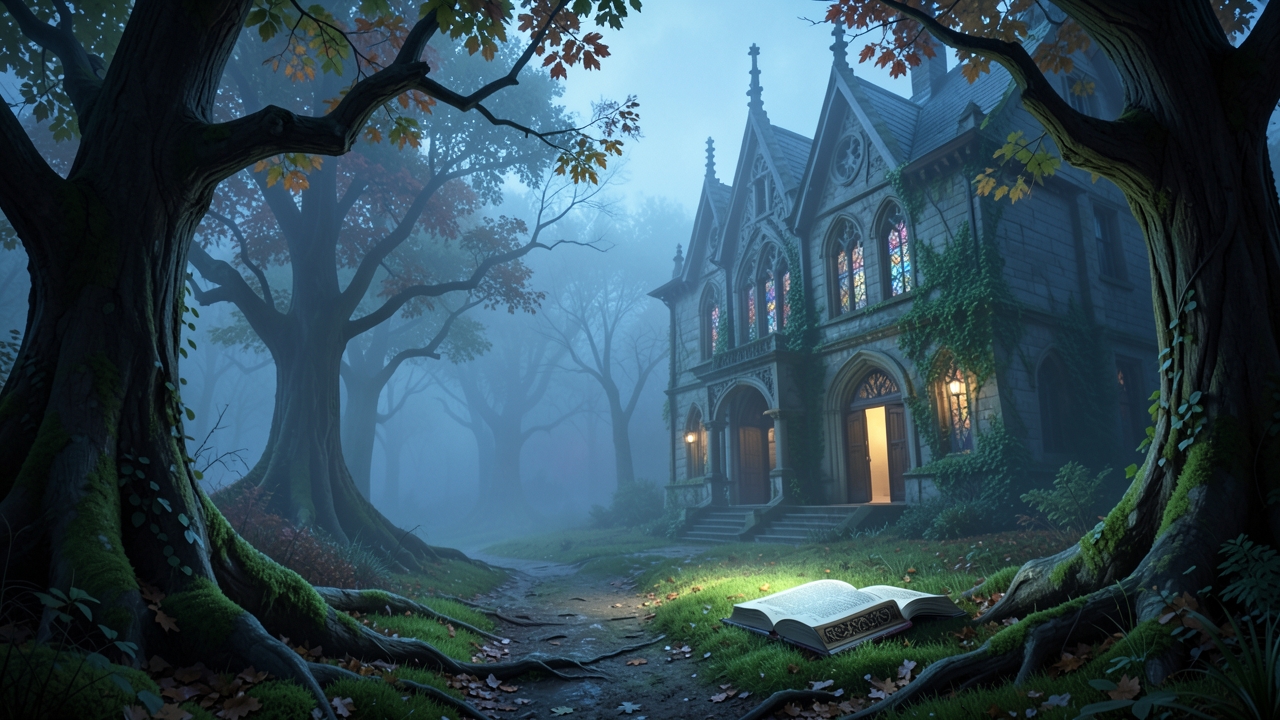
Does the house breathe? Or does it merely exhale the dust of centuries, its every creak a syllable in a long, mad monologue? In the shadowed annals of contemporary Gothic fiction, the most profound horror often emanates not from a specter in the hallway, but from the hallway itself. The Gothic house as character is no mere backdrop; it is a sentient antagonist, a psychological landscape made manifest, its decaying walls and hollow rooms actively participating in the protagonist’s unraveling. It whispers. It watches. It waits.
The Anatomy of a Haunted Architecture
To craft a setting that truly breathes, one must move beyond simple description. The effective literary house is an extension of the mind—of both the character who inhabits it and the author who conjures it. For example, in Shirley Jackson’s The Haunting of Hill House, the house is famously introduced as a presence that is “not sane.” Jackson doesn’t just describe its angles; she attributes intention to them. The house’s “vile, diseased imagining” actively seeks to absorb its inhabitants. This is the core principle: the structure must possess a will, a hunger, or a memory.
Crafting Sentient Spaces: Techniques for the Writer
First, employ pathetic fallacy with surgical precision. A house shouldn’t just be old; its decay should mirror an internal state. A water stain becomes a weeping eye. A sagging floor is a weary sigh. In Tana French’s The Searcher, the isolated farmhouse is less a building than a physical manifestation of its owner’s entrenched, defensive history, its very stones radiating a weary, watchful suspicion.
Second, utilize sensory dominance. A Gothic house as character speaks in a language of subtle assault: the persistent chill that defies the fireplace, the scent of damp earth and forgotten linen that clings to the lungs, the floorboard that groans a familiar complaint at 3 a.m. As a result, the protagonist’s senses are colonized. Their reality is defined by the house’s vocabulary of dread.
Third, map the geography of memory. Each room can represent a different facet of the past or a layer of the psyche. The sealed attic holds repressed truths. The cellar is the subconscious, dark and primal. In Silvia Moreno-Garcia’s Mexican Gothic, the decaying High Place mansion is a physical archive of a toxic, parasitic family history, its mold and mildew a biological manifestation of decay passed down through generations.
Contemporary Manifestations: The House Shapes the Descent
Modern authors have deepened this trope, making the house’s influence more insidious. Consider the recent trend where the house doesn’t just haunt; it teaches. In T. Kingfisher’s The Hollow Places, the protagonist, running a museum of oddities, finds her home developing an impossible corridor to a world of “Other.” The house here is an active guide—or a trap—leading her from curiosity to terror. It reconfigures reality itself.
Furthermore, the house often functions as a psychological prison or therapist. In Carmen Maria Machado’s In the Dream House, the titular house becomes a recurring, labyrinthine motif for a toxic relationship. Each “chapter” of abuse is set within a shifting architectural space that is simultaneously a haven and a torture chamber. Consequently, the house becomes the memory of trauma, a loop one cannot exit. For a deeper dive into this technique, see our article on Psychological Traps in Horror Writing.
Even in lighter Gothic tales, like those inspired by Daphne du Maurier’s Rebecca, the house Manderley remains the true ghost. Its perfection, its standards, its very layout enforce the new bride’s insignificance. The Gothic house as character thus perpetuates a legacy, demanding conformity or destroying those who cannot comply. This aligns with the literary analysis found on Literary Hub, which often explores setting as a dominant narrative force.
Common Pitfalls: The Lifeless Mansion
How does this technique fail? First, through passive description. Listing architectural features without connecting them to mood or emotion creates a blueprint, not a character. Second, through lack of agency. If the house’s state never affects the plot or the character’s choices, it remains a backdrop. The house must have consequences. A door that locks on its own is an action; a room that changes size is an assault.
Finally, writers must avoid cliché without purpose. A dripping faucet isn’t inherently Gothic. But if that faucet begins to drip blood, or if its rhythm syncs with the protagonist’s panicked heartbeat, it transcends trope. As Poe demonstrated in “The Fall of the House of Usher,” the house is the family, its fissure the fissure in the bloodline. The collapse of the structure is the final, inevitable confession.
For more on crafting enduring Gothic atmospheres, explore our guide on Crafting Gothic Atmosphere.
The Gallery of Echoes — A Case Study
The house at the end of Widows’ Lane did not simply stand; it crouched. Elara felt this as she turned the key in the rusted lock. The air inside was thick, not with dust, but with a silence so profound it had texture, like velvet laid over a scream. It was the silence of held breath.
She had inherited it from an aunt she’d never met. The solicitor’s letter spoke of a “peculiar legacy.” Now she understood. The hallway stretched before her, longer than any blueprint allowed. Portraits lined the walls, their subjects’ eyes following not her body, but the hollow space behind it, as if waiting for something else to fill it. A draft, cold and deliberate, slithered around her ankles, urging her not forward, but deeper, toward the grand staircase that coiled like a spine.
In the library, books leaned together in conspiratorial huddles. As she ran a finger along a leather spine, a volume on the highest shelf slid forward and fell, not to the floor, but onto the desk, opening itself to a page marked with a single, fresh fingerprint. The house was curating its own introduction. Later, in the parlor, the fireplace roared to life without a spark, the flames casting shadows that danced in a rhythm of warning, a choreography of dread. The house was not showing her its rooms. It was showing her its memories. And in the reflection of the polished, dark wood of the mantel, for a fleeting second, she saw not her own face, but the grinning skull of the architect who had designed his own tomb into its very foundation.
Elara understood then. This was not an inheritance of property, but of presence. The house had chosen her. Its silence was a question, its architecture a demand, its very decay a form of speech. It would speak to her, through her, until the walls and her own mind were indistinguishable, until her breath was just another draft in its endless, hungry halls.
The story above demonstrates the techniques: the house exhibits sensory dominance (velvet silence, slithering draft), agency (lighting the fireplace, presenting the book), and functions as a geography of memory (architect’s grinning skull in the reflection). Elara’s psychological state is directly shaped and revealed by the house’s actions.
The Echo in the Walls
The enduring power of the Gothic house as character lies in its intimacy. It is a horror that cannot be escaped by simply running outside, for it has already colonized the mind. It reflects our deepest fears of inheritance—of history, trauma, and secrets that seep through the plaster. When we read of a house with a will, we are really reading of the human psyche, fractured and externalized, built into stone and timber.
So, the next time you enter a story’s haunted abode, listen not just for ghosts, but to the voice of the house itself. What is it trying to say? And more importantly, as its walls close in and its logic becomes your own, will you have the strength to recognize that its whisper was never a haunting, but a confession? What if the final secret, the one that unravels the protagonist, is written not in blood on the walls, but in the very blueprint of the place they now call home?