
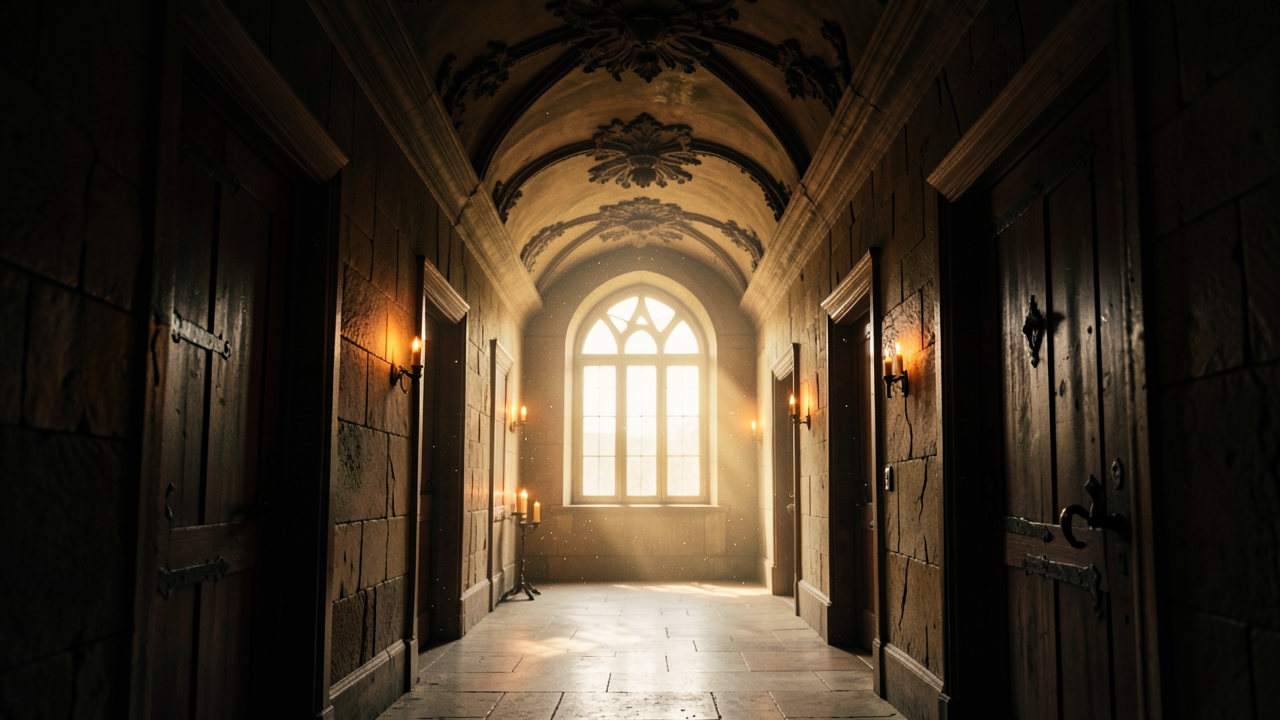
Have you ever stood in a corridor you have walked a thousand times, only to find the door at its end has quietly shifted three feet to the left? The handle is still warm. The boards still creak in their familiar places. Yet something in the architecture has decided, without consulting you, that the room beyond no longer wishes to be entered.
That small, cold wrongness is the beating heart of the sentient house mystery prompt. It is a locked-room puzzle in which the room itself is the locksmith — a crime scene that redraws its own blueprint between the discovery of the body and the arrival of the detective.
Below, we will examine why this prompt unsettles readers more deeply than a simple sealed chamber. We will also trace the craft behind it, and, finally, walk through an original case study — a short, shadowed demonstration of the technique in motion.
The Anatomy of a Sentient House
A house that moves is not merely a haunted house. Haunting implies a presence inside the walls. Here, the walls themselves are the presence. Consequently, the mystery shifts from whodunit to what-is-doing-it-and-why.
Why the Sealed Chamber Still Haunts Us
The locked-room mystery is one of the oldest pleasures in crime fiction. Edgar Allan Poe perfected it in The Murders in the Rue Morgue, where a sealed Parisian apartment becomes a stage for pure logic. Gaston Leroux pushed it further in The Mystery of the Yellow Room, locking his victim inside a room with no exit at all.
In each case, the reader’s delight comes from order restored. The room was never truly sealed. The solution was always hiding in plain sight, waiting to be measured. If you want to review the mechanics of that tradition, our guide to locked-room mystery structure lays out the machinery in detail.
What Changes When the House Wakes
Now imagine the sealed room can unlock itself. Worse, imagine it can move the corridor outside. The puzzle is no longer static — it is a living thing with opinions about who may leave.
Shirley Jackson understood this instinct long before it had a name. In The Haunting of Hill House, she writes that no live organism can continue for long to exist sanely under conditions of absolute reality. The house, therefore, becomes a mind. Similarly, Silvia Moreno-Garcia turns High Place into a damp, breathing organism in Mexican Gothic, where the walls sweat and the mould remembers.
Meanwhile, Jorge Luis Borges gave us the purest architectural nightmare in The Library of Babel: an infinite structure whose geometry is its own argument. A sentient house is simply that library with a grudge.
The Three Rules of Architectural Clueing
Before you write a single shifting hallway, establish three unbreakable rules. They keep your mystery fair and your reader loyal.
- Every shift must be measurable. The house moves doors by inches, not by miracles. A detective can count, pace, and compare.
- The house must have a temperament, not a tantrum. It reacts according to an internal logic — grief, guilt, habit, or devotion.
- One rule must never break. Perhaps the house cannot create space, only redistribute it. Perhaps it cannot lie about the number of rooms.
Crafting the Crime Before You Craft the House
Amateur drafts begin with the house. Professional drafts begin with the murder. Therefore, decide who died, who did it, and how — then let the architecture hide the answer.
The Floor Plan Is a Character
Draw your house on paper. Mark every door, window, stair, and chimney. Then ask a single question: which one of these could be moved without anyone noticing until morning?
Daphne du Maurier performed a version of this in Rebecca. Manderley is not alive, yet it is saturated with memory. The west wing waits. The boathouse remembers. As a result, the house becomes a witness that never testifies aloud.
The Detective Must Map the Impossible
Your sleuth needs a method, and it must be physical. Candle smoke reveals draughts. Chalk lines reveal fresh plaster. Wear patterns on floorboards reveal which doors were used recently.
Tana French uses spatial memory this way in her Dublin Murder Squad novels. Her detectives return to rooms and find them subtly wrong, and that wrongness becomes evidence. In contrast, Gillian Flynn weaponises perception itself — the room was never what you remembered. For more on that device, see our notes on the unreliable narrator.
Clues That Cannot Lie
The house may rearrange rooms, but it cannot falsify physics. Dust settles downward. Rain enters through open windows. Heat rises. Consequently, the detective’s best allies are not testimonies but measurements.
H.P. Lovecraft leaned on this in The Rats in the Walls, where architecture and bloodline conspire beneath a family estate. The horror is not that the house lies. It is that the house tells the truth.
Common Pitfalls of the Sentient House Mystery Prompt
Most drafts of this prompt fail in the same four ways. Recognise them early and your story will hold.
The omnipotent house. If the house can do anything, the mystery dies. Limitation creates dread. Give it one power and one blindness.
The arbitrary shift. A door that moves for no reason is a special effect, not a clue. However, a door that moves every time someone lies is a revelation.
The forgotten timeline. Readers will track every movement. Therefore, timestamp your scenes, even privately. A house that rearranges at dusk behaves differently than one that rearranges in deep night.
The magical ending. If the house did it because it is haunted, you have written a ghost story, not a mystery. The architectural change must always point to a human motive — jealousy, inheritance, escape.
Angela Carter would have delighted in this constraint. In The Bloody Chamber, the supernatural is never an excuse; it is a mirror held up to human appetite. Your house should work the same way. If you want to sharpen the surrounding mood, our essay on gothic atmosphere shows how weather, light, and silence carry the weight.
How to Write It: A Step-by-Step Method
Here is a practical sequence for anyone answering the sentient house mystery prompt this week.
- Choose the crime first. A death, a theft, a disappearance — decided before the house exists.
- Give the house one obsession. Counting. Symmetry. Protecting one room. Never more than one.
- Write the original floor plan. Include it in your notes so you can measure every later shift.
- Stage three shifts. One before the crime, one during, one after. Each must mean something.
- Send in a witness, not a hero. Someone who knows the house well enough to feel the difference.
- Reveal the truth through a measurement. Let geometry, not confession, close the case.
Haruki Murakami uses a gentler version of this in The Wind-Up Bird Chronicle, where a dry well beneath a house becomes a passage between states of being. The architecture does not shout. It waits, and the waiting is the terror.
A Case Study: The House That Counted Doors
Marisol Vane arrived at Halloway Reach at dusk, and the house counted her in. Seven doors from the foyer to the library — she counted them herself, twice, because her brother had raised her to distrust any number that agreed too easily. The eighth door, the one that should have opened onto the conservatory, was simply not there. In its place stood a wall of damp plaster, breathing faintly like a man asleep.
Inside the library, Cecil Halloway lay face down on the carpet with a letter opener in his throat. The windows were nailed shut from within. The single door was locked, and the key rested in the lock on the inside. Marisol did not scream. She took out a candle, lit it, and watched the flame lean — because if the room was sealed, the flame would stand still, and if it moved, something in the walls still breathed.
The flame leaned left. She followed it to the shelving, where a seam of fresh plaster ran floor to ceiling. Behind the shelves, she found a corridor that had no business existing — narrow, warm, and scented with varnish. The house had made it. Therefore, the house had made it possible for someone to leave.
She paced the rooms until she understood the pattern. Halloway had taught the house to count, as he had taught it everything. Each night it tallied the doors. Each time he lied, it added a wall to punish him. On the night he died, he had told his final lie — that he had no heir — and the house, obedient and devout, sealed him inside his own arithmetic. But the house was only the lock. The hand that turned it belonged to the housekeeper, who had learned the counting and learned to lie in a room where lies were bricks.
By morning, Marisol found the eighth door again. It stood exactly where memory insisted it had always been. Nevertheless, she counted the doors as she left — seven in, eight out — and understood that the house had already begun counting her. It would keep the number of her visit in its plaster, the way it kept every other lie, patient as dust, waiting for someone else to walk in and ask.
The Room You Will Never Find Twice
A sentient house does not frighten us because it is supernatural. It frightens us because it confirms something we already suspect: that the places we live in are watching, recording, and quietly deciding who we are. Consequently, the sentient house mystery prompt asks for more than a clever puzzle. It asks for a floor plan that judges.
Write the crime first. Give the house one obsession. Let the detective measure what cannot be confessed. In addition, remember that the finest locked-room stories never end with a door opening. They end with the reader realising the door was never the point.
For further reading on the tradition that shaped it, Literary Hub offers rich essays on the enduring appeal of impossible crimes. Meanwhile, your own hallway is waiting, dim and ordinary, with its door exactly where you left it.
Or is it?