
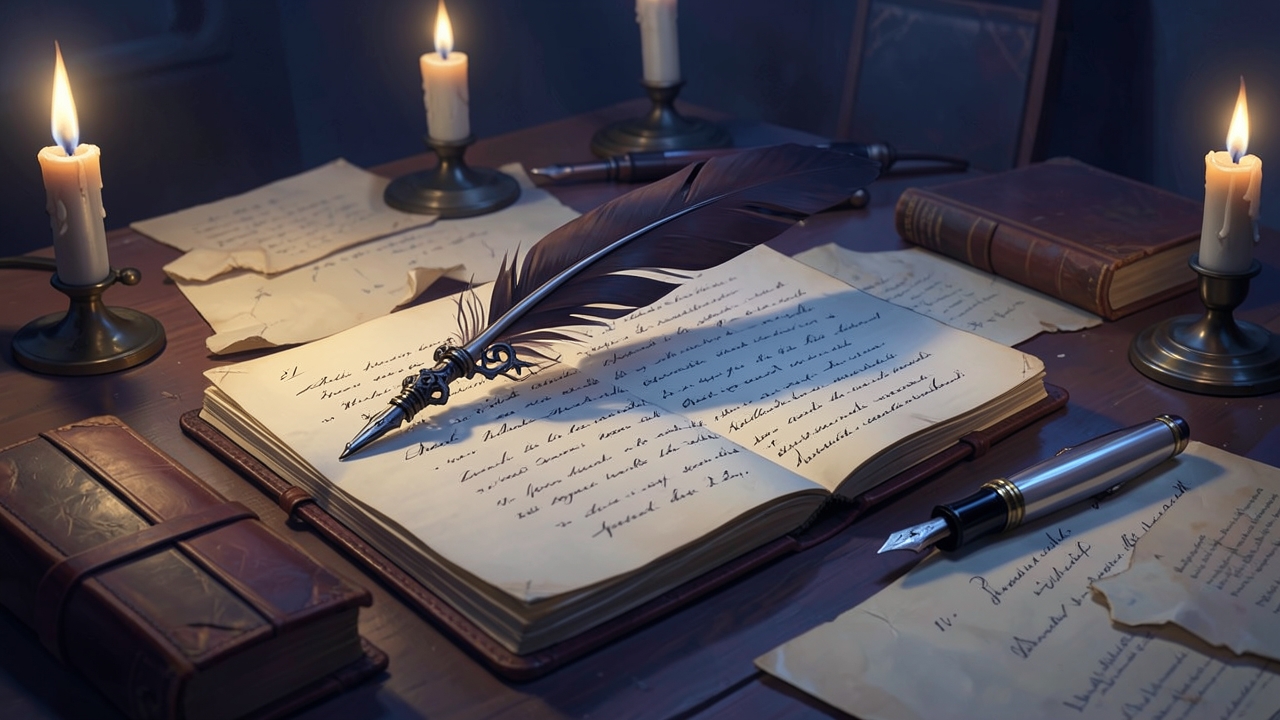
What silence lingers between the words you choose not to write? In the dim corridors of fiction, sometimes the most potent echoes are those left unheard. Strategic omission fiction tension is the art of building suspense not by what you reveal, but by what you deliberately withhold.
This technique moves beyond the familiar adage of \”show, don’t tell\” into realms where shadows craft their own narratives. By mastering the architecture of silence, writers can captivate readers with unspoken dread and uncharted emotional depths.
The Anatomy of Strategic Omission
At its core, strategic omission is the intentional exclusion of key plot points, emotional revelations, or contextual details. This creates gaps that the reader’s imagination must fill, often with more terrifying or poignant results than explicit description.
Consider Edgar Allan Poe’s \”The Tell-Tale Heart.\” The narrator’s guilt is never directly confessed by the victim; instead, it throbs in the beating heart that only he hears. This omission amplifies the psychological tension, making the horror intimate and inescapable. Consequently, readers become complicit in the narrator’s madness, as they piece together what is unsaid.
Why Withholding Information Works
Human minds abhor a vacuum. When writers withhold information, readers instinctively lean in, striving to connect the fragments. This active engagement heightens suspense, as each unspoken detail becomes a specter haunting the narrative’s edges.
For example, H.P. Lovecraft often obscured the true nature of his cosmic horrors. In \”The Call of Cthulhu,\” the monster’s full form is never described, leaving it to the reader’s dread-filled imagination. Therefore, the fear becomes personal and boundless, rooted in the unknown rather than the seen.
In contrast, overt exposition can deflate mystery. When everything is laid bare, the shadows recede, and with them, the tension that binds the reader to the page. However, when done skillfully, omission doesn’t confuse—it clarifies by focusing on emotional resonance over literal detail.
The Psychological Grip of the Unseen
Psychologically, omission taps into our innate fear of the unknown. As readers, we project our own anxieties onto the gaps, making the story more visceral. This is why gothic fiction thrives on shadows; what we imagine in the dark is often worse than any explicit description.
For instance, in Shirley Jackson’s \”The Haunting of Hill House,\” the house’s history is hinted at but never fully explained. Consequently, the house itself becomes a character, its motives obscured, amplifying the protagonist’s (and reader’s) paranoia. Similarly, Angela Carter’s \”The Bloody Chamber\” uses omission to explore taboo themes, leaving moral implications to fester in the reader’s mind.
Techniques for Effective Omission
Mastering strategic omission requires deliberate craft. One technique is the use of an unreliable narrator, whose omissions or distortions reveal character while concealing plot. Daphne du Maurier’s \”Rebecca\” employs this masterfully, as the unnamed narrator’s innocence masks darker truths. Her reluctance to voice suspicions leaves readers questioning reality.
Another method is off-stage action, where critical events occur beyond the reader’s view. Tana French’s \”In the Woods\” withholds the resolution of the protagonist’s childhood trauma, using its absence to fuel the present mystery. This omission creates a parallel tension, as the past haunts the narrative through fragments.
Additionally, ellipsis in dialogue and description can leave emotional undercurrents unspoken. Gillian Flynn’s \”Gone Girl\” reveals truths through strategic gaps in narrative, keeping readers guessing about character motives. For example, Amy’s diary entries omit key events, building suspense through contradiction.
In addition, symbolic omission—where objects or settings imply unstated histories—can deepen thematic layers. Jorge Luis Borges often used this in stories like \”The Garden of Forking Paths,\” where omitted details create labyrinthine possibilities. Therefore, omission becomes a tool for exploring complexity without clutter.
Common Pitfalls to Avoid
However, omission without purpose can confuse rather than engage. If readers feel lost without direction, they may abandon the narrative. Therefore, balance is key—provide enough context to guide the imagination without suffocating it. For example, a mystery must eventually offer clues to avoid frustration.
Furthermore, avoid withholding for shock value alone. The omission should serve character development or thematic depth. In Shirley Jackson’s works, omissions often reflect societal repression, not just plot twists. Consequently, when omission feels arbitrary, it undermines narrative trust.
Moreover, ensure that omissions are consistent with the story’s tone. In gothic fiction, silence is atmospheric; in a fast-paced thriller, it might feel disjointed. Thus, adaptation to genre is crucial. For more insights, explore our article on crafting gothic atmosphere, where we discuss how environment supports omission.
Finally, test your omissions with beta readers. If the gaps feel intentional and intriguing, you’ve succeeded. If they cause disengagement, revise to provide subtle cues. In addition, external resources like Literary Hub’s exploration of omission in fiction offer valuable perspectives from contemporary authors.
Strategic Omission Fiction Tension in Practice
To truly grasp this technique, consider how it integrates with narrative structure. Omission isn’t just about what’s left out; it’s about what’s emphasized through absence. For instance, in Silvia Moreno-Garcia’s \”Mexican Gothic,\” the family’s secrets are revealed in layers, with key horrors withheld until the climax. This builds a slow-burn tension that mirrors the protagonist’s discovery.
Similarly, Haruki Murakami uses omission to create dreamlike states in novels like \”Kafka on the Shore.\” By leaving plot threads unresolved, he invites readers into a contemplative space where ambiguity reigns. Consequently, the story lingers, as readers ponder what was never said.
The Role of Pacing in Omission
Pacing plays a vital role in strategic omission. Withholding too much too early can alienate readers, while revealing too soon reduces suspense. Therefore, orchestrate omissions like musical rests—pauses that heighten the melody. In Edgar Allan Poe’s \”The Fall of the House of Usher,\” the narrator’s gradual realization is paced through omissions that mirror the decaying house.
Moreover, pacing allows for strategic reveals. After a series of omissions, a single revelation can have maximum impact. For example, in du Maurier’s \”Rebecca,\” the truth about Rebecca’s death is revealed late, transforming the narrative. Thus, omission and revelation work in tandem to control emotional flow.
Omission as a Character Device
Characters themselves can embody omission. An enigmatic figure who withholds backstory creates immediate intrigue. Consider the protagonist in \”The Yellow Wallpaper\” by Charlotte Perkins Gilman, whose mental state is revealed through omissions in her journal. Therefore, character psychology becomes intertwined with what is not spoken.
In addition, relationships built on omission—where characters avoid difficult truths—add depth to conflicts. Tana French often uses this in her Dublin Murder Squad series, where detectives’ personal omissions influence investigations. Consequently, the mystery extends beyond the plot into human complexity.
A Case Study: The Whispering Gallery
The gallery stretched ahead, its walls lined with portraits whose eyes seemed to follow with silent judgment. Clara walked alone, her footsteps echoing in the void. She had come to find the truth about her grandmother’s disappearance, but the house itself withheld its secrets.
In the third portrait, a figure stood with its face turned away, just as her grandmother had described in the last letter. Clara reached out, but the moment her fingers touched the frame, a chill swept through the air. A whisper murmured from the shadows, \”You are not ready.\” She spun around, but no one was there.
The absence of an explanation deepened her dread. What did \”not ready\” mean? The question hung like a veil over her thoughts. She pressed on, entering a chamber where a single candle flickered on a stone table. An open book lay there, its pages blank except for one line: \”Silence is the architecture of truth.\”
Clara read the words, but their meaning eluded her. The omission of context left her grasping at straws. Was this a clue, or a warning? The candle sputtered, casting elongated shadows that danced like specters. She felt the weight of unspoken histories pressing in from all sides.
Leaving the chamber, she discovered a hidden door behind a tapestry. Beyond it, a staircase descended into darkness. Clara hesitated, knowing that some truths might never surface. Yet, the tension of the unknown drew her forward, step by silent step. Each creak of the stairs seemed to whisper fragments of her grandmother’s fate, but the full story remained shrouded.
At the bottom, a mirror reflected not her image, but a scene from the past: her grandmother standing where she now stood, looking fearful. The reflection vanished as quickly as it appeared, leaving Clara with more questions than answers. This omission of a clear resolution forced her to confront her own assumptions about truth and silence.
As she ascended back to the gallery, the portraits now seemed to smirk. Clara realized that the house had been teaching her about omission all along—that some gaps are meant to be lived with, not filled. The journey had changed her, not through revelation, but through the echoes of what was never said.
Circling Back to Silence
In the end, strategic omission is not about leaving stories incomplete, but about inviting readers into a partnership of imagination. By mastering this art, writers can construct narratives that linger in the mind like half-remembered dreams. Therefore, as you craft your tales, remember that what you choose not to say might speak louder than any dialogue.
The architecture of silence stands resilient, its shadows ever ready to ensnare the curious heart. In the realm of fiction, tension thrives in the spaces between words, where omission becomes a bridge to deeper engagement.
So, ask yourself: what echoes will you leave in the spaces between your words? For further exploration, consider reading our analysis of unreliable narrators in gothic fiction, a technique that often relies on strategic omission. Additionally, delve into the Poetry Foundation’s resources on short story craft to see how masters wield silence.
Consequently, the next time you write, listen for the silences—they may hold the key to your story’s most haunting power.