
What becomes of a story when certainty is denied to it from the very first line?
The question ending sentences prompt proposes a brutal and elegant answer: every sentence must terminate in a question mark, and every question must deepen the mystery rather than dissolve it. In practice, this single rule of syntax becomes a master key to atmosphere, to voice, and to the architecture of dread. When a narrator can no longer assert, the reader must begin to ask, and the reading becomes an act of excavation rather than consumption.
What follows is an anatomy of that excavation. We will examine why interrogative structure unsettles so effectively, how masters of the genre deploy it, and where writers routinely fall into the trap of making their questions too easy. Then, as with every weekly writing prompt we publish, we will test the theory in the only arena that matters: on the page itself.
Why Must Every Sentence End in a Question?
A period is a closure device. It tells the reader that a thought has arrived, that the ground beneath the sentence is firm enough to stand on. A question mark does the opposite. It hands the reader a blade without a handle, a fragment of glass that cuts in both directions.
Consequently, when an entire narrative is built from interrogatives, the reader never receives footing. The eye keeps hunting for a place to rest, and finds none. This is the formal equivalent of walking through a house at night in which every door has been left ajar.
Consider Edgar Allan Poe’s insistence in The Philosophy of Composition that a short story must produce a single, unified effect. Poe argued that every element of a tale should serve one emotional end. The question ending sentences prompt enforces a version of that same discipline at the level of the individual line. You cannot drift, because the form refuses to let you drift into comfort.
Syntax as Interiority
Interrogative syntax is not merely decorative. It is diagnostic. A mind that cannot stop questioning is a mind in fracture, and the sentence end becomes the site where that fracture shows.
In the works of Shirley Jackson, the everyday is quietly interrogated until it becomes unbearable. In The Haunting of Hill House, the house is described in terms that feel like an accusation more than a description. The reader senses that the narrator is asking the place what it wants, and receiving only her own reflection back.
Similarly, H.P. Lovecraft understood that dread lives in the gap between perception and comprehension. His narrators are perpetually on the edge of naming what they see, and that edge is where the horror gathers. A story in which every line ends in a question reproduces that edge structurally, sentence after sentence.
Rhythm, Breath, and the Sound of Doubt
Read your interrogative sentences aloud. Listen to what happens to the voice.
Most questions rise at the end. The breath lifts, hangs, and refuses to settle. Over the course of a paragraph, this creates an involuntary rhythm of anticipation: the reader’s body keeps bracing for a resolution that never arrives. As a result, physical fatigue and psychological tension begin to fuse.
The lesson for the writer is simple. Do not treat the question mark as punctuation alone. Treat it as a held breath, a pause in which the reader must supply meaning the text withholds from them.
The Question Ending Sentences Prompt: Craft Techniques
A rule that sounds simple is often the hardest to honour. The following techniques will keep your interrogative narrative from collapsing into monotony or confusion.
Vary the Shape of the Question
Not all questions are equal. A rhetorical question carries a different charge from a genuine enquiry, and a question embedded in memory differs again from one grounded in the present.
Therefore, alternate between these shapes deliberately:
- Questions of perception: “Did the shadows in the doorway lengthen, or did the room simply grow smaller?”
- Questions of memory: “Was it yesterday that she last heard the garden gate, or some older afternoon she had agreed to forget?”
- Questions of motive: “Why had he kept the key, when every lock in the house had been changed?”
- Questions of identity: “Who was she when the door closed, and who had she become in the eleven minutes it took to cross the hall?”
- Questions that resist answering: “Could the house have been listening, or was she simply listening to herself?”
When the types rotate, the narrative feels alive. When they repeat, it feels mechanical, and the reader will grow restless within a paragraph.
Escalate, Never Conclude
The most common failure is the question that accidentally solves the puzzle. A writer grows attached to an answer, sneaks it in through a back door, and destroys the very tension the form was built to protect.
Instead, let each question raise the stakes. The first question in a scene should concern the room. The second, the person in it. The third, the memory underneath the person. The fourth, the possibility that the narrator may not be trustworthy at all.
This escalating technique owes much to the architecture of the modern thriller. Writers such as Tana French, in the Irish Murder Squad novels, understand that the reader’s suspicion must always be one step ahead of the prose. In In the Woods, the questions multiply faster than the explanations, and the accumulation itself becomes the plot.
Let Silence Sit Between the Questions
A story composed entirely of questions can exhaust the reader if it never allows a breath. Therefore, insert texture between your interrogatives: a fragment, a single descriptive clause, a moment of sensory detail.
What matters is that the breath never becomes an answer. It remains suspended, atmospheric, unresolved. If you have read our guide to building gothic atmosphere in modern fiction, you will recognise the principle: mood is built in the pauses as much as in the statements.
A silence is, after all, only a question the room refuses to voice aloud.
The Question as Emotional Punctuation
Ask what your narrator is truly afraid of, and then make the questions orbit that fear without ever touching it. Grief, betrayal, and guilt are the deepest wells in the genre. A narrator who questions whether the dead are truly gone is not investigating a fact; they are refusing to accept a feeling.
For that reason, the question ending sentences prompt works best when it is anchored to emotional stakes rather than plot mechanics. The reader will tolerate an unresolved mystery. What they cannot tolerate is an unfeeling one.
Common Pitfalls in the Question Ending Sentences Prompt
Every formal constraint invites its own corruptions. Watch for these.
- The Yes-or-No Trap. Questions that invite a simple binary answer collapse the narrative quickly. Push toward questions that could not be answered in a paragraph, let alone a word.
- Whose Question Is It? If the questions always sound identical, you have lost your narrator. Give them diction, obsessions, and blind spots.
- Mechanical Variety. Varying the syntax for its own sake produces prose that feels like a puzzle rather than a voice. Variety must always serve the character.
- The Hidden Statement. Do not smuggle assertions into subordinate clauses and then punctuate with a question mark. The reader can hear dishonesty.
- Premature Resolution. Once an answer arrives, the spell breaks. Hold the uncertainty to the last line, and beyond it.
Jorge Luis Borges knew this instinctively. In stories such as The Library of Babel and The Garden of Forking Paths, the labyrinth is not the setting but the structure of the sentences themselves. Every corridor opens onto another corridor. Nothing closes, and nothing needs to.
A Case Study: The House That Asked Questions
What follows applies every technique discussed above. Read it aloud. Notice where the questions escalate, where they refuse to answer, and where the questions stop being about the house at all.
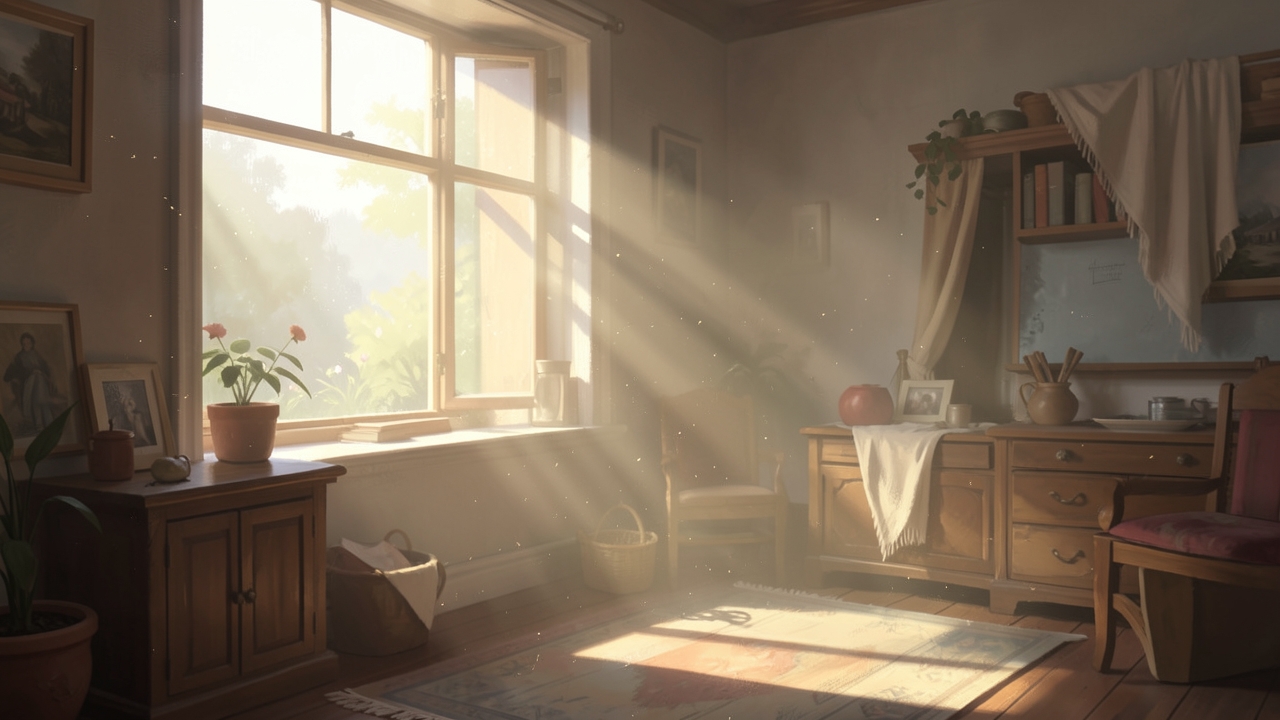
Did the mirror know something the walls did not, that morning in October when the fog pressed its forehead against the glass? Did the woman standing before it count the hairs silvered by grief, or the years unaccounted for? Did she whisper her own name aloud, or only imagine that she had?
Was the house behind her the same house she had entered on the night of her husband’s death, when the clocks all agreed and the roses still held their colour? Did the hall hold its breath as she crossed it, or was that only the wind finding the gaps she had never learned to seal? Did she count the doors, twelve perhaps thirteen, before she stopped counting at all?
Who had set the chair facing the window, and why did it face the yard where the boy used to play? Did she remember the boy’s laugh as a sound, or only as a weather? Had she written his name in the ledger by the door, or had someone else?
Was it a voice that asked, \”Are you going to leave?\” \u2014 or only the house performing a memory of asking? Did she answer aloud, or was the silence her answer all along?
Could one ever leave a place built entirely of questions, or had she become one of them, standing in the hall, still waiting for something to resolve? Would the door ever open inward, or had it been open the whole time, and had she simply refused to walk through it?
What the Prompt Reveals
Notice what the case study does not do. It never states that the woman is guilty, grieving, or trapped. It simply keeps the questions arriving, and lets the reader assemble the guilt themselves.
Meanwhile, the questions grow smaller and more intimate as the piece progresses. They begin with the mirror and end with the self, a descent from observation into complicity. That arc is the real story, hiding beneath the form.
The technique also demonstrates the value of withholding the character’s name. When we do not know who is asking, we begin to wonder whether the questions belong to the narrator, to the house, or to us. If you want to explore that ambiguity further, study how the unreliable narrator works in fractured narrative voices, and borrow their methods for your own questions.
As Poe’s body of work demonstrates again and again, the most durable mysteries are the ones the text never resolves, because the reader carries them home and finishes them alone.
Exercises: Training the Interrogative Voice
Form cannot be mastered by reading alone. Commit yourself to the following drills for a week.
- The One-Question Page: Write a single page in which every sentence ends in a question, but no sentence repeats a previous one’s subject.
- The Escalation Set: Take a mundane scene, such as a woman making tea, and write it so that each successive question reveals a larger dread.
- The Interrogative Interview: Write a conversation between two characters where every line is a question, and no one ever answers directly.
- The Last Question: Write a story whose final sentence is the first one that resolves nothing, and yet feels inevitable.
Share the results with fellow practitioners at Literary Hub, or submit them to our next prompt cycle. The form is difficult. Difficulty is where the craft lives.
The Echo That Never Resolves
We began with a question about stories that refuse certainty. The question ending sentences prompt has shown that a story can be built entirely from what it does not know, and that this ignorance, carefully shaped, becomes the reader’s deepest engagement.
Every period is a door that closes. Every question mark is a corridor that keeps unfolding, dim and airless and infinitely more honest about the human condition. When you strip your prose of assertion, something strange occurs: the character emerges not as a collection of facts, but as a place that keeps asking.
So tell me, writer, when you close your notebook this evening and the questions remain unanswered in the dark: were they ever meant to be solved, or were they always meant to be carried?