
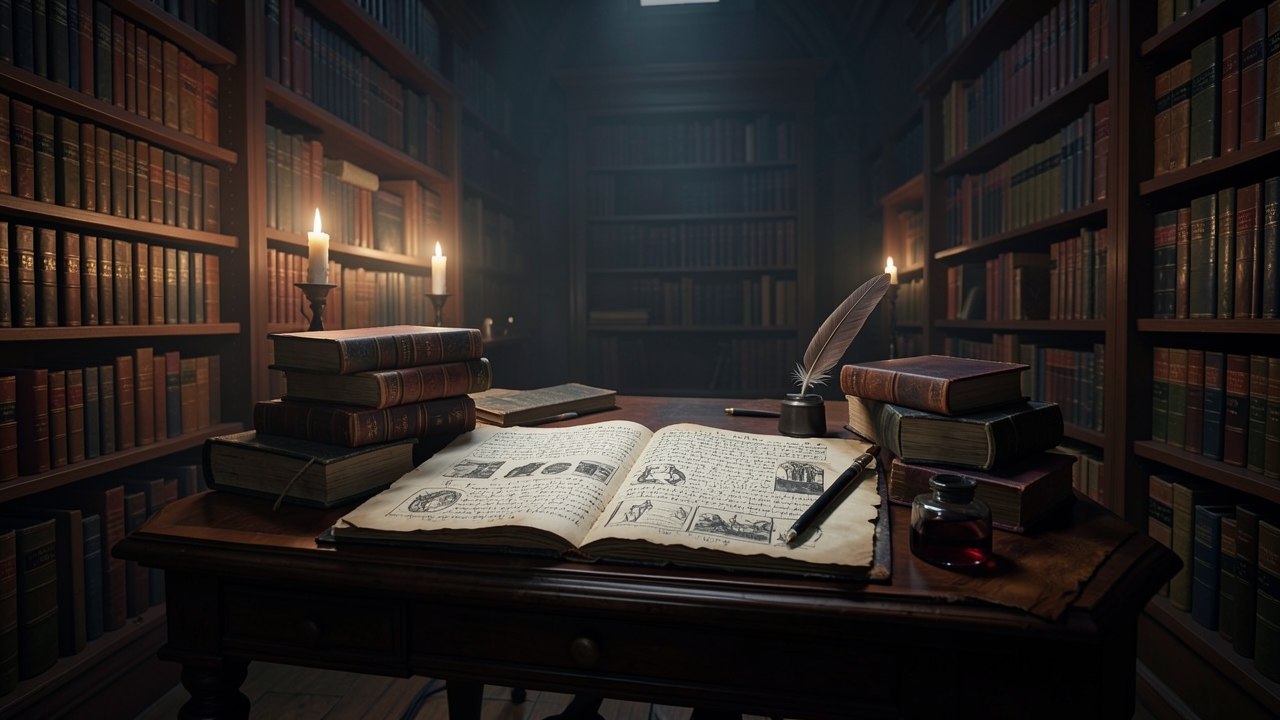
What whispers from the margin of a page when the main text can no longer bear the weight of its own meaning? There is a particular chill in discovering that the true story does not run down the center of the sheet at all. It lurks at the edges, in small type, in the apparatus of scholarship, in the humble footnote narrative technique that scholars treat as decoration and certain novelists treat as a dagger.
Two modern masters understood this intimately. David Foster Wallace, in Infinite Jest, buried whole novels inside his endnotes. W. G. Sebald, in The Rings of Saturn, threaded citations through a walking meditation until the reader could no longer tell whether memory or footnote held the truth. Together, they performed a haunting of the codex form itself.
The Footnote Narrative Technique: A Definition in Shadow
Let us define our phantom before we dissect it. A footnote narrative technique is the deliberate deployment of notes, endnotes, citations, and apparatus as a primary storytelling instrument rather than as scholarly garnish. The note does not merely explain. It interrupts, contradicts, seduces, and doubles the text it pretends to serve.
Classically, the footnote submits to the narrative. It clarifies a date, translates a phrase, credits a source. But in the hands of a master, the hierarchy inverts. The main text becomes the interruption, and the note becomes the mind. Consequently, the reader experiences two speeds of thought at once — the forward pull of plot and the lateral drift of consciousness.
That friction is the point. It is also the dread. For the anxious modern mind does not move in straight lines. It circles. It digresses. It returns to the wound. The footnote, that most bureaucratic of literary organs, turns out to be the only form honest enough to imitate the ache.
The Anatomy of the Digression
Wallace’s Anxious Appendices
Readers of Infinite Jest will recall the ritual. A sentence gathers momentum. Then a small superscript number appears, like a splinter beneath the skin, and the eye must plunge through three hundred pages to the endnotes at the rear. Some notes run three or four pages. Some contain their own sub-narratives, their own jokes, their own griefs.
Wallace admitted the design openly. He wanted the physical act of reading to replicate the exhaustion and the appetite of a consciousness saturated with information. Meanwhile, the notes perform a crucial tonal function. In the main text, Wallace’s prose often strains toward grandeur and system. In the notes, it loosens into confession, pedantry, tenderness, and self-laceration. The appendix is where the author hides his nakedness.
Consider what this teaches the storyteller. The digression is characterization. A narrator who cannot stay on course reveals a self that cannot contain itself. Moreover, Wallace proves that the reader will follow — not despite the interruption, but because of it. The chase after the note becomes a hunt, and every hunter grows possessive of his quarry.
Sebald’s Whispered Apparatus
Where Wallace detonates, Sebald dissolves. The Rings of Saturn follows an unnamed narrator walking the Suffolk coast, and the walk itself barely matters. What matters is the sediment it stirs: silk cultivation in Brescia, the bombing of Rotterdam, Hokusai’s wave, the obliteration of entire industries. The citations arrive without quotation marks, without clear borders, so that borrowed memory and owned memory bleed into one another.
The effect is uncanny. Sebald weaponizes the apparatus of scholarship to launder fiction as fact. We trust the apparatus. We are trained from school to trust the apparatus. And so the gothic creep of his story — its mourning, its complicity, its vanishing populations — enters through a door we have agreed not to question.
This is a lesson worth stealing outright. Authority is atmosphere. The citation is not a shield against emotion; it is a delivery system for emotion, smuggled past the reader’s skepticism in the uniform of a librarian. For a deeper exploration of that unease, see our essay on the enduring tropes of gothic literature, where dread so often arrives dressed as propriety.
The Precedent: Borges, Nabokov, and the Forged Source
Neither writer invented the trick. Jorge Luis Borges built labyrinths from footnotes, fabricated bibliographies, and invented editors who explain what the author omitted. Vladimir Nabokov, in Pale Fire, gave us a mad commentator who devours the poem he supposedly serves. In each case, the apparatus becomes unreliable — and therefore, inevitably, becomes the real narrator.
Follow the lineage and a pattern emerges. Whenever a story cannot bear direct statement — whenever the horror or the longing is too great for the center of the page — it migrates to the margin. The margin is the haunted room of the book. Nobody watches it closely. That is precisely why it is safe for ghosts.
Crafting the Footnote Narrative Technique
So you wish to try the instrument yourself. Good. But handle it as one handles a candle in a corridor of mirrors — slowly, and expecting more flame than you lit.
Give the Note Its Own Voice
The common error is to let the footnote speak in the same register as the chapter. Resist. The note should shift tone: colder, more clinical, or more intimate. Wallace’s notes confess; Sebald’s notes document. Either way, the temperature changes. The reader feels two selves arguing on the page.
Control the Bleed Between Registers
Ambiguity is your ally. Let the boundary between the story and its documentation wobble deliberately. Gillian Flynn builds unreliable interiors from precisely such doubled surfaces; Tana French layers forensic procedure over psychological fracture until procedure itself seems hysterical. When the note and the narrative contradict one another, do not resolve the contradiction. Nurse it.
For guidance on managing that unreliability with precision, our piece on writing the unreliable narrator in gothic fiction traces the mechanics in detail.
Weaponize the Bibliography
Make your sources do narrative labor. A fabricated title can carry an entire subplot. A real title, misattributed or misquoted, produces a delicious wrongness — a flicker in the reader’s peripheral vision. Silvia Moreno-Garcia and Angela Carter both understand that a story’s furniture can lie, and that the lie furnishes dread more efficiently than any adjective.
Weaponize Placement, Too
Endnotes and footnotes are different beasts. Footnotes interrupt in real time; they fracture the sentence before it can complete itself, generating claustrophobia. Endnotes defer; they promise that the true account waits at the back, and so the reader arrives at the last page already dreading the rear matter. Choose your cruelty according to the mood you require.
Shirley Jackson, had she written at book-length digression, would have chosen the footnote — the instant violation. H. P. Lovecraft, with his documentary frame and his archaic scholarship, would have chosen the endnote, the slow accumulation of dreadful apparatus. Neither would have wasted the form on mere accuracy.
Common Pitfalls: When the Note Becomes Noise
Digression without design is only digression. Three failures recur, and each one drains the instrument of its power.
The Joke Note. A note that exists only to amuse becomes a tic. One witty aside opens a door; forty witty asides build a waiting room, and the reader grows restless inside it.
The Redundant Note. If the note explains what the sentence already meant, it apologizes for the form. Apology is the death of atmosphere. A note should add, subtract, or destabilize — never tidy.
The Infinite Regress. Notes referencing notes referencing notes can mesmerize, but they can also dissolve the reader’s loyalty. Sebald keeps his regressions shallow and sorrowful. Wallace risks enormity and earns it through sheer accumulation of feeling. You must decide, honestly, whether your book can carry the weight it adds to its own heels.
There is also a spatial danger. If you write for the screen rather than the page, the footnote narrative technique must be reimagined — as expandable blocks, as marginal glosses, as hyperlink trails. The technology changes the fear. A hyperlink offers escape; a footnote offers only more book. Choose deliberately, and remember that atmosphere in fiction depends as much on constraint as on content.
A Case Study: Marginalia for the Drowned Parish
What follows is an original fragment composed to demonstrate the technique in miniature — a narrator whose scholarship begins to leak, and a set of notes that can no longer be trusted to serve him.1
I came to Holmwick Parish to catalogue what the water had taken, which is to say everything. The church stood to its waist in the tidal reach, and the bell tower leaned as though listening for a sound that had already been made. I photographed the pews. I measured the silt line. I told myself that grief, properly indexed, becomes merely information.
The register was the only survivor. Its last entry, dated the year of the flood, recorded three baptisms and forty-one burials on the same afternoon, in a hand so steady it frightened me.2 I copied it twice. That night, in the room above the inn, I found a third copy already written in my own handwriting, and I could not remember the writing of it.
On the fourth day I stopped naming the dead aloud. It seemed to me that the parish was not drowned at all but merely patient, and that my cataloguing served not as mourning but as summoning. The gulls had gone quiet. The water at the tower’s base had risen precisely one inch each evening, always one inch, as though following a schedule.
I am writing this from the vestry. The lamp is good. The pages are dry, and the count of them is wrong. In the morning I will walk the silt line again and record what I find, because recording is the only prayer I know, and because someone must carry the names out of the water, and because I have begun to suspect that the someone is not, in any strict sense, a living man.
1. The narrator introduces the apparatus in the first sentence, borrowing scholarly authority before the reader can object. From this point forward, every claim he makes arrives already contaminated by the promise of annotation. 2. Here the note conceals what the narrative cannot state: that the register describes a single catastrophic afternoon in which the parish died and the narrator, somehow, was present. The reader’s suspicion does the emotional work the sentence refuses to do. A final note — omitted, as you have already begun to suspect — would name the narrator from the register itself.
The Margin as Haunted Room
Wallace and Sebald arrived at the same apparition by different corridors. One exploded the footnote into confession; the other quieted it into elegy. Both discovered that scholarship’s furniture, rearranged with intent, becomes a theater of consciousness — anxious, digressive, starving for detail, incapable of rest.
The lesson for the storyteller is not merely technical. It is ontological. A book is not one voice but a conspiracy of voices, and the margin has always been where the suppressed testimony accumulates. To write there is to admit that the center cannot hold — that meaning, like a coastal parish, is always partly underwater.
So I ask you, as you close this page and open your own manuscript: when your narrator swears he has told you everything, whose handwriting will be found in the margin?