
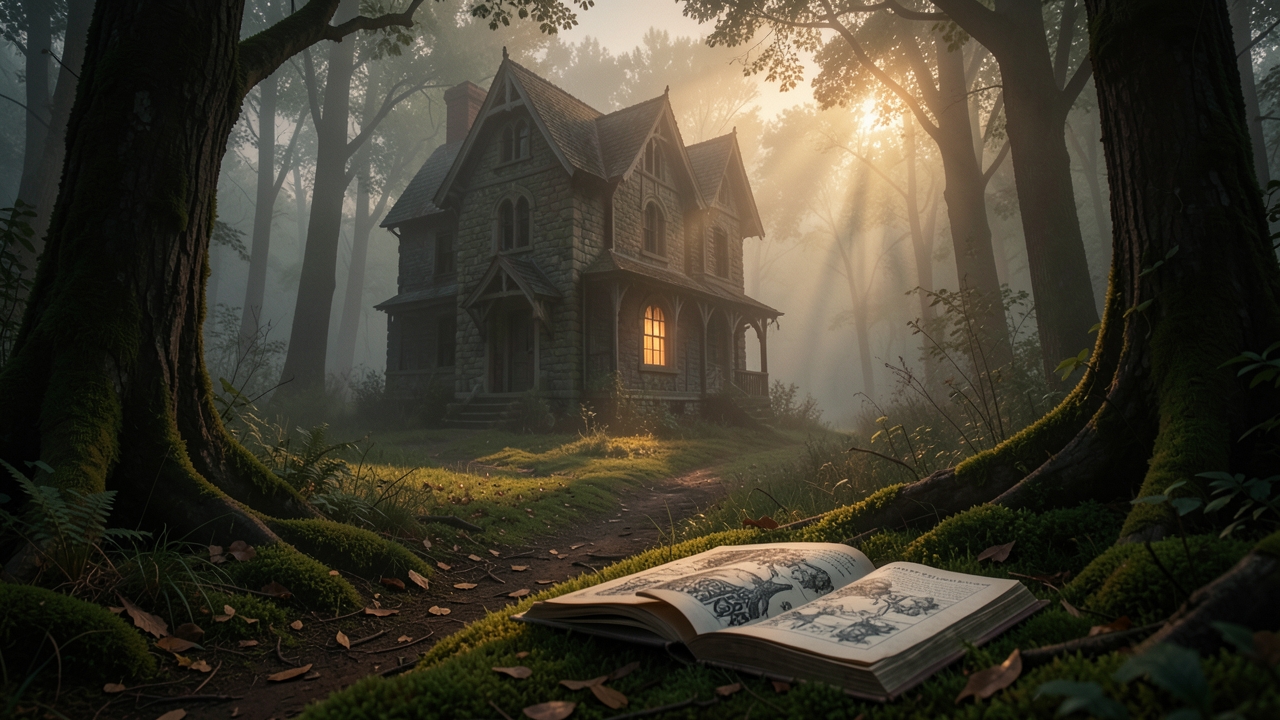
What happens to a story when the walls feel more alive than the people inside them? Consider the moment you first read Edgar Allan Poe’s The Fall of the House of Usher. You met Roderick Usher, yes. Yet the figure you could not stop watching was the house itself \- its fissure, its fungus, its vacant eyrel windows staring like hollow sockets. The building did not wait to be described. It introduced itself.
This is the central enchantment of the gothic setting as character: architecture that absorbs interior life and radiates it back as dread. In this essay, I will trace how the technique works, examine two towering examples, and hand you a set of craft tools for designing spaces that behave like antagonists rather than backdrops.
Why the House Steals the Protagonist’s Role
Interiority is the hardest thing a writer must render. A character’s grief, shame, or unraveling mind resists direct statement. Named plainly, it bores us. Named through metaphor, it convinces us. Therefore, the gothic tradition transfers psychological weather onto physical space. The mind keeps its privacy. The house confesses for it.
Poe understood this with ruthless clarity. In his 1839 tale, the narrator senses an “insufferable gloom” before he can name a single symptom in Roderick. The atmosphere arrives first. The diagnosis follows. Meanwhile, Poe builds a formal argument for fusion: the tarn \- a dark, pestilent lake \- mirrors the house, which mirrors Roderick’s diseased sensibility. By the final collapse, you cannot say where the man ends and the masonry begins. That ambiguity is the point.
The Anatomy of Occupied Space
A setting becomes a character when it acquires three specific organs. First, volition: it appears to want something. Second, memory: it retains the marks of prior events. Third, agency: it acts upon the protagonist and changes the plot.
Remove any one of these and the illusion collapses. A merely atmospheric house \- cobwebs, dripping taps, a portrait with unsettling eyes \- is furniture, not a figure. It decorates. It does not decide.
Shirley Jackson’s The Haunting of Hill House supplies all three organs with surgical precision. Hill House “was not sane,” she writes in one of the most famous opening paragraphs in American fiction. It “stood by itself against its hills.” Notice the grammar. The house receives the adjective reserved for minds. It performs an action \- standing \- that we usually attribute to defiance, not to construction.
The Exterior-Interior Fold
Gothic architecture externalizes what characters repress. A cracked facade signals a fractured self. An overgrown garden suggests appetite that has outgrown restraint. A staircase descending into darkness literalizes descent into the unconscious.
Jorge Luis Borges pushes this further in The House of Asterion. The labyrinth is not a place the Minotaur inhabits. It is the Minotaur’s own mind, expanded into corridors without end. Consequently, the setting ceases to be a container and becomes a symptom. For a superb study of this technique’s roots, the Poetry Foundation’s archive of Poe rewards slow reading.
Jackson’s Blueprint: Designing a House That Wants
Jackson performed a deliberate experiment. She asked whether a house could be frightening without ever explaining why. Hill House offers no ghost with a grievance, no chain-clanking specter. It offers wrong angles, a nursery with forbidden doors, and a pounding at night that arrives exactly when Elena needs it most.
That last detail holds the entire method. The house responds to the protagonist’s loneliness. It does not haunt her. It answers her. Therefore, the architecture becomes a mirror with motives \- and a mirror with motives is far more terrifying than a monster.
Consider the room shapes. Jackson made the house’s original architect insist on ninety-degree angles, yet the corners somehow refuse to meet correctly. This is a masterstroke of craft. The setting becomes unreliable, exactly as a traumatized narrator becomes unreliable. As a result, the reader’s perception destabilizes in step with Elena’s.
Motif, Repetition, and the Grammar of Return
Character is revealed through repeated behavior under pressure. The same is true of a place. Jackson returns to the same rooms, the same doors, the same cold spot on the wall. Repetition builds recognition, and recognition builds attachment. Eventually, the reader begins to anticipate what the house will do \- which is precisely how we read a human antagonist.
Gillian Flynn applies a related logic in Dark Places, where a childhood farmhouse functions as an archive of violence. The building remembers what the surviving protagonist would rather forget. Meanwhile, Silvia Moreno-Garcia’s Mexican Gothic turns a decaying mansion into a literal parasitic organism, fusing the house’s rot with the family’s colonial rot.
Craft Takeaways: Building a House That Behaves
Theory without technique is mere fog. Below are practical principles for writers designing a gothic setting as character.
1. Give the Space a Verb
Describe what your house does, not only what it looks like. It leans. It contracts. It opens a door that was bolted. It swallows sound. Active verbs grant volition. Compare “The corridor was narrow” with “The corridor narrowed behind her as she passed.” The second sentence has an appetite.
2. Withhold a Room
Nothing creates dread faster than denial. In Charlotte Perkins Gilman’s The Yellow Wallpaper, the sealed nursery becomes the story’s engine precisely because it is off-limits. Withholding converts architecture into narrative pressure. Consequently, your reader will invent horrors more vivid than any you could supply.
3. Let Description Be Causal
Delete every descriptive detail that changes nothing. If the cracked mirror does not alter a decision, a relationship, or the plot’s direction, it is ornament. Poe never lingers on a surface without consequence. His fungus on the stones is not texture. It is prophecy.
4. Match the Architecture to the Wound
Design each room as a physical analogue of a specific psychic injury. Daphne du Maurier’s Rebecca achieves this through Manderley, where the empty breakfast room speaks louder than any living rival. The house embodies absence. Absence is the protagonist’s wound. Therefore, setting and psychology lock together like a bolt sliding home.
5. Let the House Win a Round
An antagonist that never scores is a decoration. Your house should produce at least one irreversible consequence \- a locked exit, a vanished object, a message written in dust. In Angela Carter’s The Bloody Chamber, the castle’s architecture of wealth and isolation actively imprisons the bride. Space becomes complicit, which is worse than hostile.
6. Beware the Purple Pitfall
The most common failure is overwriting. When every adjective howls, nothing whispers. Gothic prose draws its power from restraint \- long, calm sentences punctured by one wrong detail. H.P. Lovecraft understood this in The Colour Out of Space, where the horror is an unfamiliar hue in a mundane New England pond. Specificity frightens; adjectives exhaust.
For further reading on sustaining atmosphere across an entire narrative, see our guide to writing gothic atmosphere and our companion piece on showing psychological horror without exposition.
A Case Study: The House That Kept Count
The following original flash piece demonstrates the principles above: a house given verbs, withheld rooms, and a motive that mirrors the protagonist’s grief. Read it twice \- once for dread, once for craft.
The house had been counting before Margot arrived. She understood this on the third morning, when she woke to find the upstairs hallway one step longer than the night before. Not wider. Not taller. Longer, by exactly the distance a body takes to fall.
She told herself it was the light. October light lies. It stretches a corridor into a throat. Yet she measured with her heel \- nine boards at the landing on Tuesday, ten on Wednesday \- and the arithmetic did not care about her explanations.
Margot had come to empty the place after her mother’s death, and emptiness, she discovered, was not a state the house permitted. Doors she had opened stood shut by afternoon. The nursery, which the estate agent had called “a lovely bonus,” remained cool to the touch and slightly ajar and never, under any pressure of her shoulder, opened further. She stopped pushing. Something in her was grateful for the refusal.
On the fifth night, the pounding came. It began in the far wall behind the wallpaper, a rhythm of four, then four again, then a fifth blow that arrived late, the way a heartbeat stumbles. Margot stood in the dark hall and listened, and the house listened back, and she understood at last that it was not imitating her mother. It was rehearsing her.
By morning the hallway had grown another board. Margot did not measure it. She went downstairs, set the kettle on the stove, and chose, for the first time in eleven days, not to leave.
Notice what the house does here. It counts. It refuses. It pounds. Each verb is a choice, and each choice exerts pressure on Margot’s decisions. Her final act \- staying \- is a character turn produced entirely by architecture. The setting did the antagonist’s work.
The Threshold as Moral Test
Every doorway in a gothic story is a question. Crossing it should cost something. Murakami’s dry well in The Wind-Up Bird Chronicle functions exactly this way \- a vertical threshold that demands the protagonist surrender ordinary logic before granting descent into the subconscious.
Tana French uses the threshold similarly in The Likeness, where a crumbling estate draws a detective across a boundary of identity. The building does not force her. It invites. And invitation, in gothic fiction, is the most dangerous form of violence.
A Final Drafting Checklist
Before you submit, interrogate your setting with these questions.
- Does my setting perform at least one action that changes the plot?
- Have I withheld one room, door, or passage from the reader?
- Does each architectural detail mirror a specific character wound?
- Has my house produced one irreversible consequence?
- Can I describe my setting in three verbs rather than three adjectives?
If you cannot answer yes to at least four, your space is still scenery. Return to the drafting table. Let it want something.
As critics have long observed, Jackson’s genius was refusing to resolve whether Hill House was haunted or merely perceived as such. That unresolved seam is where craft lives. It invites the reader to finish the story alone, in the dark, in their own house, where the walls are already listening.
Closing: The Room You Are Writing From
We began with a question about walls that feel more alive than people. The answer is not trickery. It is empathy turned outward \- the writer’s willingness to let a place carry what a character cannot say aloud. Poe gave a house a crack. Jackson gave hers an angle that refused to close. Both gave us permission to make architecture breathe.
So before you write your next scene, look around the room you are writing from. Note the hum of the pipes, the door that sticks, the corner the lamp cannot reach. Somewhere in that space is a want waiting to be named.
When your house finally speaks, will you have the nerve to let it answer?