
What happens when a writer refuses to weep on the page?
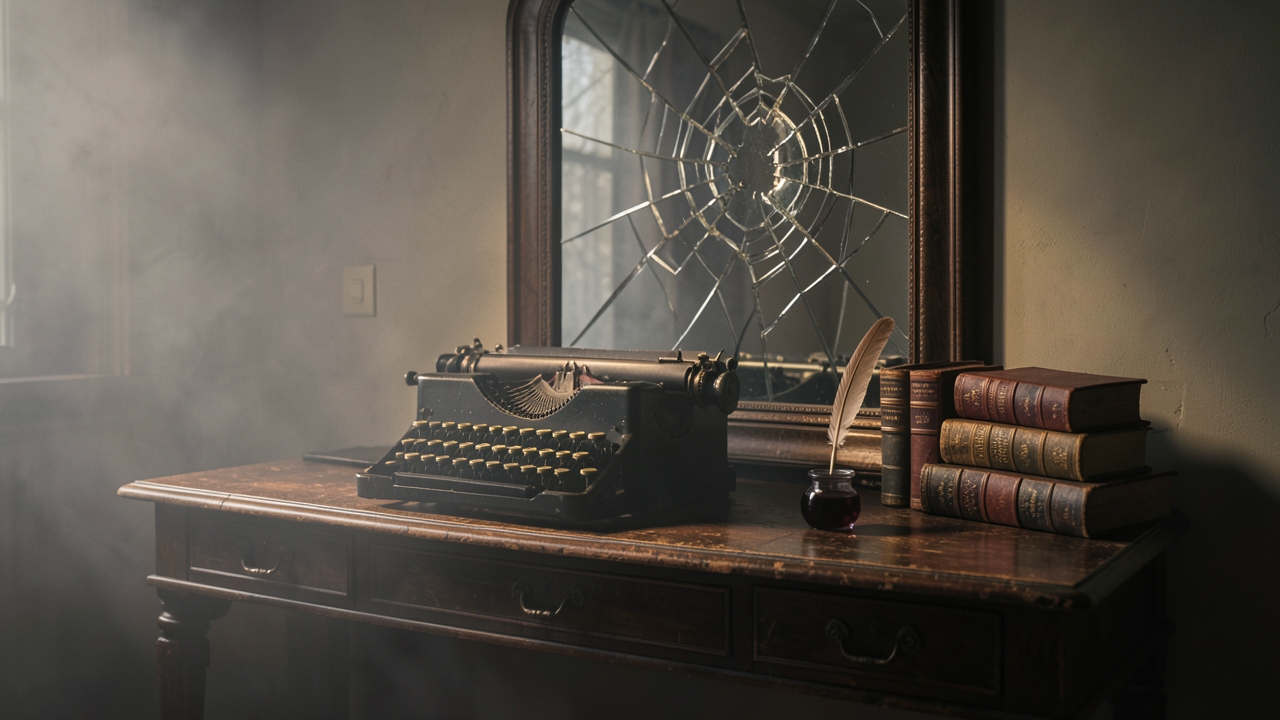
She builds a glass wall instead. You press your face against it. You see everything clearly—but you cannot feel the temperature of the room.
This is the central paradox of the Joan Didion essay style: a voice so controlled it appears cold, so precise it seems to exclude the heart entirely. Yet beneath that glacial surface churns grief so vast it threatened to dissolve the woman who carried it.
Today, we dissect the mask. We examine how Didion transformed autobiography into something that looked like journalism, analysis, even taxonomy. And we ask what every serious writer can learn from her terrifying act of concealment.
The Architecture of Detachment
Didion did not invent emotional restraint in nonfiction. However, she perfected it into an architecture no other essayist has replicated.
Consider the opening of The White Album (1979): “We tell ourselves stories in order to live.” No personal pronoun beyond the royal “we.” No confession. Just a pronouncement, cold and absolute, as if plucked from a philosophy text.
Yet that sentence is autobiography disguised as epistemology. Didion wrote it after a year of nervous breakdowns, migraines, hallucinations, and psychiatric hospitalization. The “we” hides the “I” with surgical precision.
Technique One: The Analytical Pivot
The Didion move—the signature gesture of her craft—arrives moments after emotional catastrophe. She states something devastating, then pivots immediately to analysis.
In The Year of Magical Thinking, she writes about her husband John Dunne’s death and then, within pages, begins cataloging the medical terminology of cardiac arrest. She moves from the corpse to the vocabulary.
This pivot does something remarkable. It tells the reader: the feeling is too large for direct statement, so observe it from a distance instead. The grief becomes an object of study rather than an experience of suffering.
Compare this to the gothic tradition of emotional excess, where feeling amplifies until the atmosphere itself trembles. Didion does the opposite. She subtracts until nothing remains but the essential skeleton of fact.
Technique Two: Objects as Emotional Proxies
Didion never tells you she is sad. Instead, she hands you an object.
In her essays, grief lives in the shoes in the closet. It inhabits the unanswered letters. It hides in the canceled flight reservations and the credit card receipts that prove a person still existed. She writes about Dunne’s shoes and the impossibility of giving them away—and the reader understands the devastation without Didion ever naming it directly.
This technique draws power from restraint. In addition, it demands extraordinary precision. Every object must carry the emotional weight that language refuses to carry.
The White Album and the Fractured Self
The White Album remains the masterwork of the Joan Didion essay style precisely because its subject is disintegration—and the narrator refuses to admit she is the one disintegrating.
The collection opens with a clinical inventory of symptoms: “My doctors told me it was possible that some of the episodes which had been diagnosed as neurological were psychological.” She writes about herself in the third person, through medical proxy, as though she were a case study submitted for peer review.
The Case Study Disguise
Throughout the collection, Didion writes about Jim Morrison, the Black Panthers, the Doors recording sessions, and California wildfires with the same detached, cataloging gaze she applies to her own psychiatric records.
This is her deepest trick. By treating cultural chaos and personal chaos with identical analytical distance, she erases the boundary between the two. The reader cannot separate the external world from the internal one—because Didion’s prose will not permit it.
Meanwhile, the emotional content accumulates like sediment. No single sentence overwhelms. But the cumulative weight—paragraph after paragraph of restraint—produces an effect far more devastating than any direct confession could achieve.
Silence as Structural Element
Didion uses silence the way a composer uses rests. The gaps in her essays are not empty—they are loaded.
When she writes about her daughter’s illness in The Year of Magical Thinking, the sections about Quintana Roo are separated by white space. She does not connect the dots. She lets the reader do it.
This technique mirrors what unreliable narrators achieve in fiction: the reader senses something the narrator will not say. Didion’s reliability as a reporter makes her silence even more unnerving. We trust her completely—and still, we feel the absence.
How Grief Masked Itself as Analysis
Consider what Didion lost. Her daughter Quintana died in 2016. Her husband John died in 2003. Her brother Quintana died before both. Her parents were gone. Her sense of California—of place, of identity—had crumbled decades earlier.
And yet the essays never collapse into elegy.
The Joan Didion essay style treats grief the way a forensic scientist treats a crime scene: with method, measurement, and deliberate emotional quarantine. She establishes the facts. She notes the anomalies. She declines to speculate about meaning.
The Cost of Control
Didion herself acknowledged the danger. In The Year of Magical Thinking, she describes her own refusal to accept her husband’s death as a kind of madness. “Magical thinking” is her term for the belief that the impossible might reverse itself.
But the control in her prose is also a form of magical thinking. If the sentences remain disciplined, perhaps the grief will remain manageable. If the analysis is rigorous enough, perhaps the loss will resolve into something intelligible.
It never does. That is the horror. And that is why the essays endure.
What Didion Teaches Us About Restraint
Her technique offers three actionable lessons for writers of nonfiction and memoir.
First: emotional exposure must be calibrated, not eliminated. Didion does not hide everything. She selects a few devastating details—the shoes, the cancelled reservations, the unanswered phone call—and lets those carry the weight.
Second: analytical distance creates a contract with the reader. When the narrator refuses to collapse, the reader leans in. Restraint is not coldness. It is an invitation.
Third: objects outlast emotions. Feelings fade in memory. But a pair of shoes in a closet remains vivid forever. Anchor your grief in the tangible.
Comparing Masks: Didion Among the Masters
Didion’s approach stands in sharp contrast to her contemporaries.
Nora Ephron wore her pain as sharp wit. David Sedaris mines discomfort for comedy. Meanwhile, Didion’s mask is made of glass—transparent, but cold.
In fiction, we see parallels. Gothic writers like Shirley Jackson concealed personal torment behind the mechanics of haunted houses. Lovecraft buried cosmic grief beneath adjectives. But Didion performed her surgery in daylight, with no metaphor to hide behind.
As the Poetry Foundation observes in its literary histories, the boundary between confession and craft has always been contested terrain. Didion’s genius was to declare that the border did not exist—that all personal writing is, at some level, an act of disguise.
A Case Study: The Room at the End of the Hallway
The following original piece demonstrates the Didion technique: analysis as grief, objects as emotional proxies, and controlled exposure in place of confession.
I keep the door closed.
This is not a decision I made. It happened the way weather happens—gradually, then all at once. The door has been closed for two years, three months, and some number of days I have stopped counting accurately.
Inside the room: his reading glasses. A paperback of Borges, spine cracked to the page where the labyrinth begins. A jacket he wore in November, the one with the elbow patch I stitched myself and then pretended not to have stitched.
My friends tell me I should open the door. Grief counselors call this “avoidance.” The medical literature classifies it as “complicated bereavement response.” I appreciate the terminology. It gives the sensation a shelf to sit on.
What the literature does not explain: the door is not locked. Nothing prevents me from opening it. My hand has touched the handle four times. Each time, I withdrew it, the way one withdraws from a stove—instinct overriding intention.
Last Tuesday, I opened it. For eleven seconds.
The glasses were where I left them. The book was open to the same page. The jacket hung on the chair with its sleeves arranged as though someone had just stepped out of it.
I closed the door.
I am told this is not a story about loss. It is a story about a door.
I am not certain they are different.
Writing Behind the Glass
The Joan Didion essay style is not a template. It is a warning.
It warns that the feelings we refuse to examine will not disappear. They will simply find other places to live—inside our objects, inside our syntax, inside the careful architecture of our sentences.
Didion showed us that analysis is not the enemy of emotion. It is emotion’s disguise. And sometimes, the disguise is the only thing that allows survival.
As Literary Hub has noted in retrospectives on her work, Didion’s restraint was never about suppression. It was about respect—for the magnitude of what had happened, and for the reader’s capacity to meet it halfway.
Closing Reflections
We began with a question about weeping on the page.
Didion’s answer, lived across six decades of essays, was this: grief is too large for direct statement. It requires a vessel—a glass wall, a case study, a closed door. The vessel does not diminish the grief. It makes the grief survivable.
So ask yourself, as you sit before the blank page: what are you hiding behind your analysis? And what might happen if you opened the door—just for eleven seconds?