
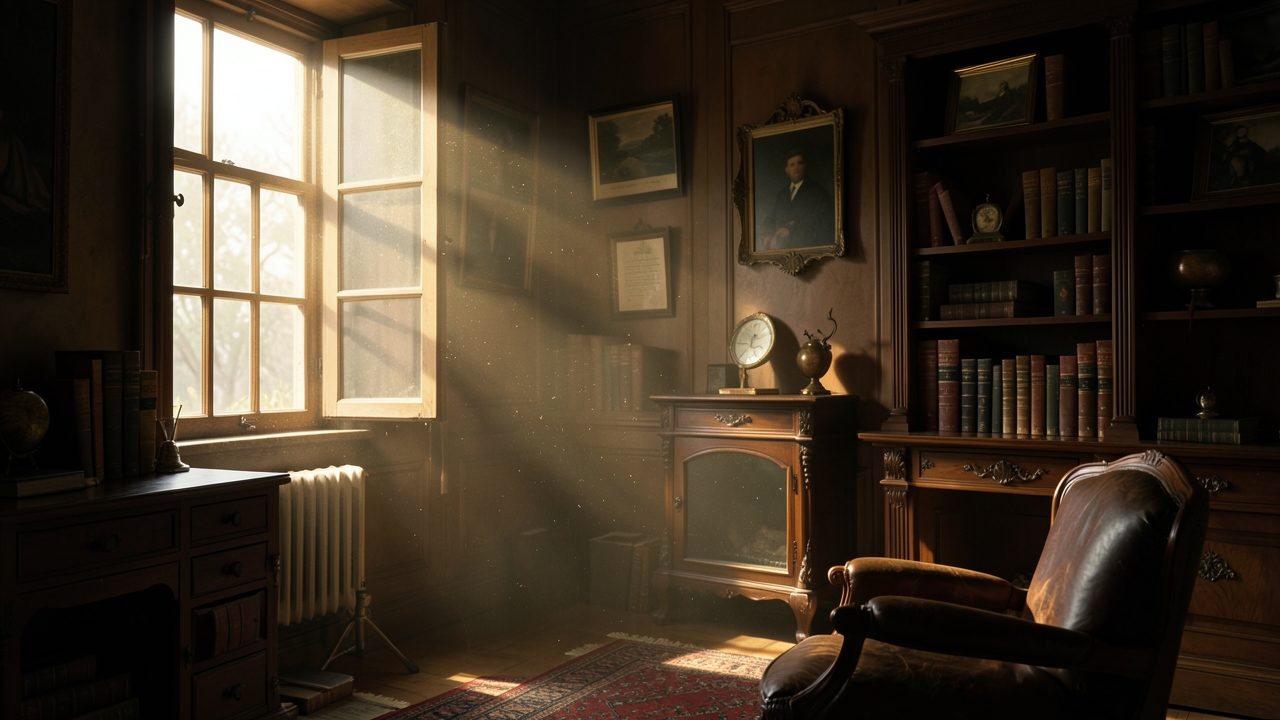
What if the room itself had taken a dislike to your protagonist?
Not in the sentimental sense. Not as backdrop dressed in adjectives. I mean the heat pressing a thumb against the skull. The damp climbing the trouser leg. The plaster next door breathing in time with the pulse. In that case, the room could hurt someone.
This essay offers a set of setting writing prompts built on one hard principle: the environment must obstruct, not decorate. Below, five weekly prompts force a heatwave, a flooded basement, a paper-thin wall, and two further confined spaces to behave as antagonists. Each prompt names its own rules. Break one, and the scene dies of politeness.
Before the prompts, however, a short anatomy of the failure. Because most writers do not lack imagination. They lack pressure.
The Theory: Why Setting Writing Prompts Fail When the Room Is Polite
A polite room answers every question. It supplies light, air, and a chair. Yet protagonists rarely transform inside polite rooms. They transform when the environment refuses to cooperate. Therefore the first duty of a scene is refusal.
Consider Edgar Allan Poe’s The Fall of the House of Usher. There is no villain with a knife. There is only architecture: the fissure in the façade, the vault, the tarn that mirrors the house and then swallows it. Roderick Usher is defeated by a building that mirrors him and finally entombs him. You can read the full account over at the Poetry Foundation.
In a previous essay on building gothic atmosphere without purple prose, we traced how mood becomes credible only when it costs the character something. The same law governs every effective use of place in fiction. Atmosphere that costs nothing is merely weather reportage.
The Anatomy of an Antagonistic Setting
An environment becomes an antagonist the moment it acquires four organs. Remove any one, and it reverts to wallpaper.
Motive. What does this place want? The flooded basement wants the body submerged. The heatwave wants the mind dulled by three p.m. Motive need not be supernatural. A motive is simply a direction of pressure the space applies.
A clock. Resistance without a deadline is scenery. Therefore every prompt below embeds a timer: rising water, failing light, a neighbour returning, a tide cutting the road. The clock converts description into jeopardy.
Resistance with cost. The room must exact a price for passage. Bruised ribs on a low beam. Soaked boots. A whispered answer the wrong person overhears. Cost is the hinge on which atmosphere becomes conflict.
Memory. The best locations remember the protagonist. A house that has seen them before behaves differently. Meanwhile the reader senses recurrence, and recurrence breeds dread.
Atmosphere as Conflict: What the Masters Do
Daphne du Maurier’s Manderley does not merely impress. It edits the new bride out of existence, rearranging rooms, wardrobe, and servants until she is a ghost in her own marriage. The house wins before the plot does.
Shirley Jackson opens The Haunting of Hill House with a sentence of pure agency: Hill House, not sane, stood by its own will for eighty years. Consequently every character inside is already losing. The house has volunteered.
Tana French turns the Dublin mountains into an accomplice in In the Woods, where the forest is both crime scene and psychological wound. Likewise, Silvia Moreno-Garcia’s Mexican Gothic treats the decaying mansion as a feeding organism. Meanwhile Gillian Flynn lets the Ozark lake and the wrong house do the villain’s work in Gone Girl.
Even beyond horror, the pattern holds. Haruki Murakami’s well in The Wind-Up Bird Chronicle is a throat the world swallows you through. Jorge Luis Borges writes labyrinths that function as plots rather than places. And Angela Carter’s castles in The Bloody Chamber actively bargain with the women who enter them. For a wider survey, see this Literary Hub collection on place as character.
Four Common Pitfalls
The mood-ring room. Sad scene, rain. Angry scene, wind. This is decoration wearing a plot costume. Avoid it. Instead, let the weather contradict the emotion at least once per story.
The setting that solves the problem. If the room rescues the protagonist, the room has become a deus ex machina. Antagonistic spaces may be escaped, but never conveniently.
The double-purpose paragraph. Writers often describe a room once, then again for tension. Therefore the description reads twice and lands zero times. Describe only what the character must touch, fear, or trip over.
Cruelty without stakes. A hostile room with no deadline is a bad day, not a story. Attach a cost and a clock. In addition, make the protagonist’s goal physically incompatible with the space, so that progress requires damage.
Five Setting Writing Prompts That Make the Room the Antagonist
Each of these weekly setting writing prompts ships with fixed rules. Treat them as law for one week of drafting. Write 800 to 1,200 words. Do not move the scene to a friendlier location.
Week One: The Heatwave That Will Not Break
Your protagonist is trapped indoors during a record heatwave. The windows are painted shut. The air conditioner died at dawn. A package must be signed for before dusk.
Rules. Temperature rises one degree per scene. Water is finite and measured. Any decision must be made before the light fails. No character may leave the building.
What it teaches. Sensory narrowing. As heat advances, detail collapses: sound dulls, vision whites, patience thins. Therefore prose shortens naturally. This prompt trains you to make sentence length mirror physiological decline.
Week Two: The Flooded Basement
Storm water has broken through. The object your protagonist needs, a deed, a tape, a body, sits underwater at the far end. The only exit is a slick wooden stair. The breaker has not tripped.
Rules. Water rises one inch per minute. The object must be retrieved by hand. The bulb flickers on a fixed rhythm. If the protagonist leaves, the object is lost permanently.
What it teaches. Physical stakes and moral arithmetic. The setting forces a choice between safety and purpose. Consequently the reader stops asking what happens next and starts asking what the character can afford to lose.