
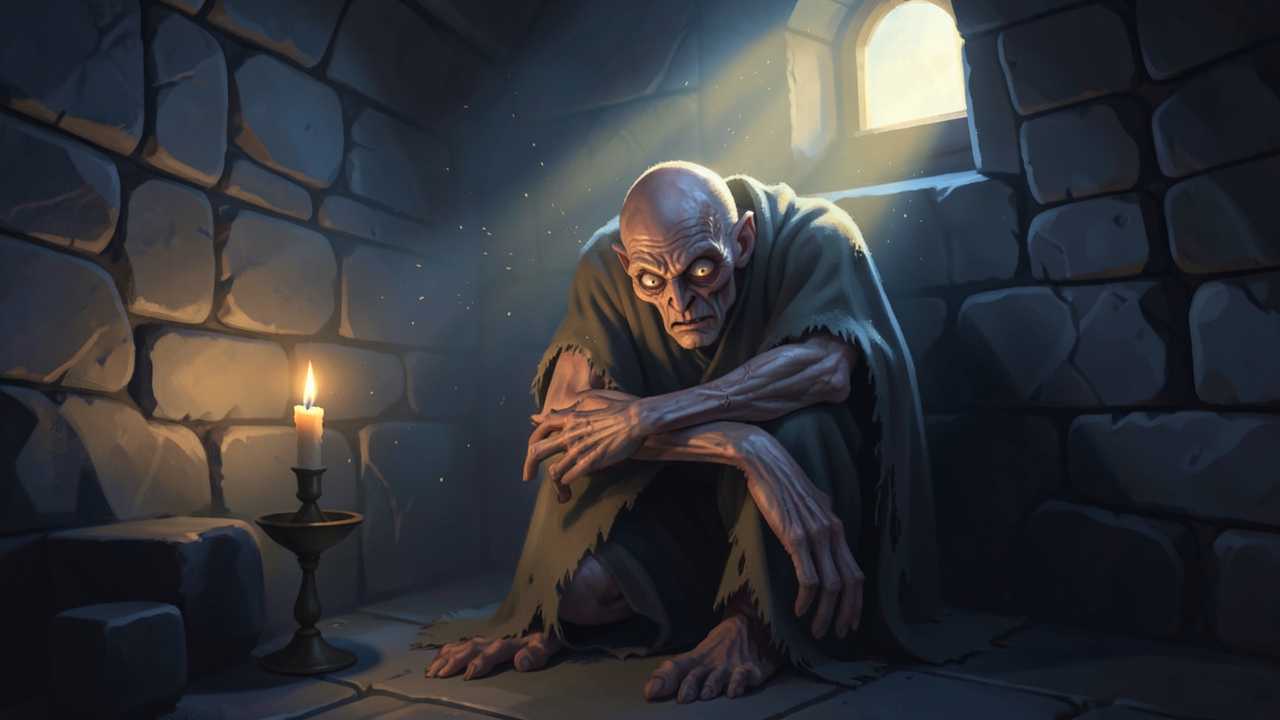
What if the thing in the dark is the one trembling? Hold that question for a breath, as you would hold a candle at a cellar door. Most horror begins with a hand at the throat. The rarer, finer horror begins with a hand that shakes.
This week’s exercise is a fearful monster writing prompt with a small cruelty baked into it. You will take the predator — the shape beneath the bed, the voice in the well, the thing that has never needed a name — and place it in the vulnerable position. Then you will write the scene in under 800 words.
The constraint is not decoration. It is the cage that keeps the beast honest. Below you will find the craft behind the reversal, the pitfalls that spoil it, and a short case study to show the technique with its teeth bared.
The Anatomy of a Fearful Monster Writing Prompt
Horror runs on an asymmetry of power. One figure advances; another retreats. The reversal does not remove the monster from the story. It simply repositions the monster inside the geography of dread.
Therefore, the fear must be earned, not announced. A creature that merely says it is frightened is a costume. A creature whose body betrays it is a wound. For a deeper map of this terrain, see our notes on the anatomy of gothic dread.
Inverting the Predator’s Gaze
Shirley Jackson understood this better than almost anyone. In The Haunting of Hill House, the house is not merely haunted. It is needy, and neediness is a kind of fear. Eleanor’s dread and the house’s hunger become two halves of one heartbeat.
Likewise, Mary Shelley’s creature in Frankenstein is monstrous precisely because he is articulate about his terror. He is hunted, cold, and starving for language. His eloquence makes him unbearable to look at. That is the mechanism you are borrowing.
When you invert the gaze, the reader’s loyalty fractures. Adrian, the pursuer, becomes the weather. The monster becomes the window. In contrast to the usual chase, the reader now watches from inside the hunted thing.
Fear Has a Body, and Bodies Betray It
Lovecraft’s The Outsider ends with a mirror, not a murder. The horror arrives when the narrator reaches toward companionship and touches glass. The dread is physiological. He feels his own face like a stranger’s hand.
Consequently, give your monster a physiology. Let it notice its own pulse. Let it discover, mid-scene, that its hand is shaking. That small discovery does more work than a page of explanation.
The Empathy Trap
Angela Carter’s The Bloody Chamber turns the beast into a husband and the bride into a negotiator. Silvia Moreno-Garcia does something similar in Mexican Gothic, where the house is a predator and the heroine’s fear is the only honest thing in it.
Meanwhile, Gillian Flynn and Tana French show that interiority is a scalpel. Once we hear the predator think, we cannot unhear it. Empathy arrives as a trap, and the reader walks in willingly. If you want to deepen this craft, our guide to unreliable narrators explores how limited perception manufactures fear.
Crafting the Reversal: Techniques That Bite
Technique separates a gimmick from a haunting. The following methods will keep your monster’s fear legible without ever making it pitiable.
Give the Monster a Physiology It Cannot Govern
Fear lives in the involuntary. Write the swallow, the held breath, the sudden stillness. Avoid the word afraid. Instead, show the creature counting exits it no longer has.
For example, an old thing that has waited ninety years might measure fear by the sound of a fourth step groaning. In addition, let the body fail in small ways. A tremor. A loosening grip. A voice that cracks on a word it has never used.
Shift the Sensory Register
Predators are usually described through sight and appetite. Fear, on the other hand, is heard and felt. Move the scene into sound and temperature. Let the monster know the approaching child by the change in air pressure.
Poe’s The Tell-Tale Heart works because the terror is auditory, not visual. The narrator hears what he cannot bear to hear. Your monster should be similarly besieged by a sense it cannot switch off. Read the poem that taught modern horror its rhythm at the Poetry Foundation.
Let the Monster Speak — and Let It Fail
Dialogue from a frightened monster should be broken. Give it a vocabulary built from eavesdropping. Then strip that vocabulary away at the worst moment. Daphne du Maurier’s menace is always more terrifying when it refuses to explain itself.
Nevertheless, restraint matters. One fractured plea is devastating. Six pages of confession is a therapy session with fangs glued on.
Common Pitfalls That Defang the Scene
The reversal is delicate. Most drafts fail in one of four ways, and each failure is repairable once you see it.
The apologetic monster. If the creature becomes cute, the horror evaporates. Keep it dangerous. It may be afraid and still capable of ruin.
The explained fear. If you diagnose the dread, you have cured it. Borges never explains his labyrinths, and they endure because of that silence.
The saintly human. Do not let the child become an angel. The human should remain partly unreadable, partly capable. Otherwise you have simply swapped costumes.
The bloated word count. Overwriting is the most common fracture. Every clause you add is another candle lit in a room that needed shadow.
Why Eight Hundred Words Is a Cage That Sharpens the Fangs
Compression is the point. Under 800 words, you cannot hide behind atmosphere alone. You must choose the one image that carries the horror and let the rest stay dark.
Haruki Murakami’s short fiction often ends before the explanation arrives, and the omission hums for days. Borges builds entire infinities in six pages. Poe tightens the screw with a single repeated sound. For more exercises in this vein, browse our collection of gothic horror writing prompts.
Moreover, brevity forces the reversal to be structural rather than decorative. In 800 words, the turn arrives fast, lands hard, and leaves the reader nowhere to stand. The craft essays at Literary Hub echo this discipline again and again.
A Case Study: The Thing Beneath the Stair
Here is the prompt executed in miniature. Note the physiology, the auditory register, and the refusal to explain. Note also that the monster remains monstrous throughout.
It had lived beneath the stair for ninety-one years, and in that time it had learned the house the way a tongue learns a broken tooth. It knew the fourth step that groaned. It knew the pipe that sighed at midnight and the precise weight of a foot that meant someone was listening. It knew, above all, the sound of the child coming down.
The child was seven. The child was small and warm and made of the terrible noise that children make — the singing, the running, the endless questions. For decades the thing beneath the stair had been the answer to those questions. Now it pressed its long back against the plaster and tried to be nothing at all.
Tonight the child stopped at the top of the stair. The thing felt the pause before it heard it, the way a spider feels a fly’s intention. Then the boards began to creak — not the ordinary creaking of a settling house, but a slow and deliberate descent. Something in the dark began to shape a word it had never learned to say. Please.
It had no mouth for that word. It had a mouth for other things. That was the joke the dark had played, and the joke had stopped being funny some years ago. So it swallowed the word and listened instead.
The child reached the bottom step. The hall lamp threw a bar of yellow across the floor, and in that bar the thing saw its own hand — grey, many-jointed, older than the house — and saw that the hand was shaking. It had never noticed this before. It had never needed to notice.
Then the child said, in a voice of enormous and terrible kindness, “I know you are there.” And the thing beneath the stair, which had frightened four generations into silence, discovered the last thing it had left to feel. It curled itself small. It waited for the light.
The Lesson in the Trembling
Sympathy is a scalpel, not a sedative. The fearful monster writing prompt does not ask you to forgive the predator. It asks you to give the predator a nervous system, and then to watch what the reader does with it.
Consequently, the exercise teaches three things at once. It teaches restraint, because the word count will not permit indulgence. It teaches perspective, because a gaze reversed changes the moral temperature of a scene. And it teaches the oldest lesson of the gothic: that dread is a mirror, and the mirror is always occupied.
So write the scene. Set your monster in the cold of an open doorway and let it shake. Give it a hand it cannot steady and a word it cannot finish. Then close the page and leave the light where it falls.
And when the last line settles into silence, ask yourself the question the exercise was built to ask. If the thing in the dark is the one afraid — who, then, has been standing in the light all along?