
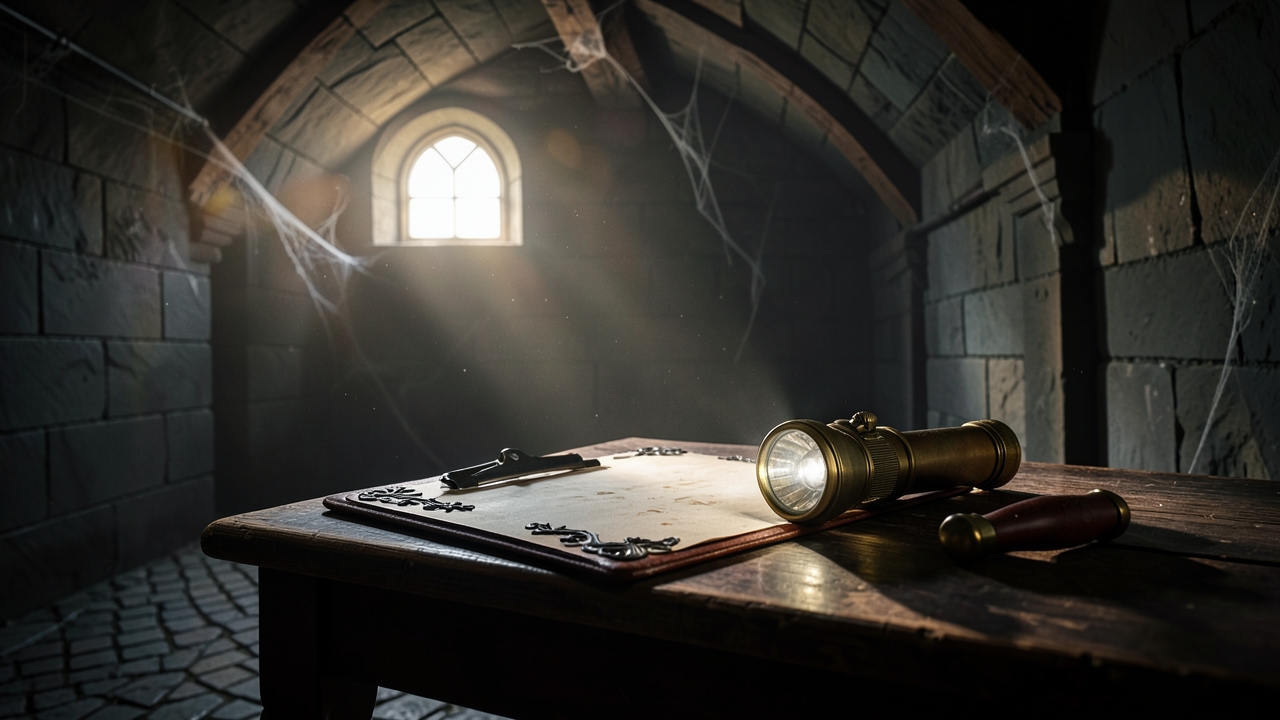
Does the house groan, or does the contract merely specify that it must? That is the question this week’s exercise dares you to answer — from inside a clipboard rather than a scream.
This haunted house writing prompt asks you to filter the supernatural through the eyes of a pest control worker. Not a psychic. Not a trembling heroine in a nightgown. A technician with a spray wand, a laminated license, and two hundred jobs behind him. He has seen rot, rats, and ruin in equal measure. Therefore, he is the last person you would expect to be afraid — and the most devastating when he finally is.
The angle subverts horror cliché on purpose. Instead of melodrama, you generate dread through clinical detail. The result can be sharper than any howl.
The Anatomy of a Haunted House Writing Prompt That Works
Every useful prompt carries three organs: a constraint, a voice, and a wound. Remove any one and the exercise collapses into a writing-group warm-up.
Strip the Adjectives, Keep the Evidence
The horror cliché leans on adjectives. Eerie. Blood-curdling. Unsettling. Meanwhile, a good narrator leans on nouns and measurements. The difference between “a terrifying hallway” and “a hallway eleven feet long, with linoleum lifting at the seams” is the difference between telling and showing.
Shirley Jackson understood this. In The Haunting of Hill House, the house is never called evil. It is called “not sane” — and then described as a structure that leans inward. The horror lives in geometry, not vocabulary. For more on this principle, read our guide to showing rather than telling in fiction.
Professional Detachment as Narrative Voice
Detachment is not the absence of feeling. It is feeling placed under glass. Your pest controller narrates in the register of a work order: dates, species, severity, recommendations. Consequently, every crack in that composure reads like a fissure in a dam.
Use the language of procedure. “Treated baseboards.” “Confirmed entry point.” “No sign of activity.” The reader waits for the sentence where the language fails. When it arrives, it lands without a raised voice.
Crafting Clinical Dread: Techniques for the Prompt
Specificity Over Spectacle
Dread grows in specifics. A ghost is vague. A ghost that leaves a perfect rectangle of undisturbed dust inside an otherwise footmarked crawlspace is precise — and far worse. Therefore, inventory the anomaly. Give it dimensions, timestamps, and a part number if you can.
Consider the restraint of Tana French in In the Woods. Her narrator reports what can be reported and admits what cannot. The gap between the two becomes the haunting. We have written elsewhere about the unreliable narrator and how omission does more damage than invention.
The Inventory as Incantation
A list, rendered rhythmically, becomes a spell. Poe knew it. His catalogs in “Ligeia” and “The Fall of the House of Usher” pile detail upon detail until the reader drowns in texture. You can borrow the technique for receipts: chemical names, trap counts, hours logged.
Meanwhile, let one item on the list be impossible. Three gallons of repellent applied. Four traps set. Five recovered. Arithmetic that refuses to close will unsettle a careful reader faster than any shadow on the stair. For atmospheric pacing around such reveals, see our notes on building gothic atmosphere.
Where the Humor Curdles
Working-class narration carries dry humor. Use it — then let it curdle. The joke about the homeowner’s cat is funny until the technician realizes there is no cat, has never been a cat, yet the food dish is emptied nightly. Comic rhythm sets a cadence. Dread then breaks the cadence.
This is the Gillian Flynn method in reverse. Flynn weaponizes cynicism toward people; you will weaponize it toward a building. In either case, the armor of sass is what makes the eventual puncture painful.
Common Pitfalls to Avoid
First, do not let the narrator become a secret theologian. A man who quotes scripture on page two has already broken character. Second, avoid the sudden pivot into purple prose. If the final paragraph suddenly sings, you have betrayed the voice you built. Third, never explain the haunting fully. Borges and Haruki Murakami both demonstrate that an unexplained mechanism retains its charge; an explained one deflates.
Finally, resist the jump scare. On the page, it rarely survives a second reading. The residue of a well-kept secret lasts far longer.
What the Masters Teach Us About Restraint
Daphne du Maurier’s Rebecca is haunted by a woman who never speaks. Angela Carter’s The Bloody Chamber dresses monstrosity in silk and still lets the reader infer the wound. Meanwhile, Silvia Moreno-Garcia’s Mexican Gothic turns a decaying mansion into an argument about lineage — all rendered in tactile, almost forensic description.
The lesson is consistent. Supernatural power is proportional to authorial restraint. As Poe argued in his essay on composition, the closer the tone drifts toward unity of effect, the more indelible the impression. You can read more of that thinking at the Poetry Foundation’s Poe archive.
A Case Study: The Dry Rot Survey
Job 4417. Victorian, two-story, unoccupied. Client reports scratching inside the west wall and a smell “like wet pennies.” I have heard worse descriptions from better clients.
I start in the basement, where every house tells the truth. The joists are sound. The vapor barrier is intact. There is a water stain on the north foundation measuring roughly nineteen inches across, and around it the concrete has darkened in a shape I cannot name but have seen before — the same shape, in fact, as the stain I documented at Job 3982, and at 4106 before that. Different cities. Different decades. Same outline. I photograph it, note “possible efflorescence,” and move on.
Entry points: three. Rodent, rodent, and something else. The third hole is seven inches high and cut clean, not gnawed. I measure it twice. On the second measurement it is six inches. I do not measure it a third time. Instead I bait the perimeter, four stations at twenty-foot intervals, and I log the serials: 88-04, 88-05, 88-06, and 88-07.
At the truck I reconcile the inventory. Four stations out, three back. The missing one is 88-07, the unit I placed nearest the west wall. I write “station displaced — possible animal interference” because the report has a checkbox for it and I need the checkbox more than I need the truth. The smell of wet pennies follows me up the drive. It rides in the cab with me for two miles and then, without any change in speed or road, simply stops.
The client calls Thursday to cancel the follow-up. She has sold the property. I ask to whom, and she says the previous owners never really left, which I file under idle talk until I pull the folder and find that every owner since 1911 has listed the same address for correspondence: this basement, this wall, this stain. I close the file. I mark the job complete. At home that night I find a station under my kitchen sink, serial 88-07, dry, unopened, still warm.
The Closing Bell
Notice what the model story refuses to do. It never uses the word ghost. It never raises its voice. It measures, logs, and files — and yet the arithmetic will not resolve. That is the whole engine of this haunted house writing prompt: dread built from paperwork rather than from shrieking.
So pick up the clipboard. Describe the stain. Count the traps. Let the numbers misbehave quietly in the margin, like something scratching behind the plaster of the page — and ask yourself, when the inventory refuses to reconcile, who exactly is the report meant to protect?