
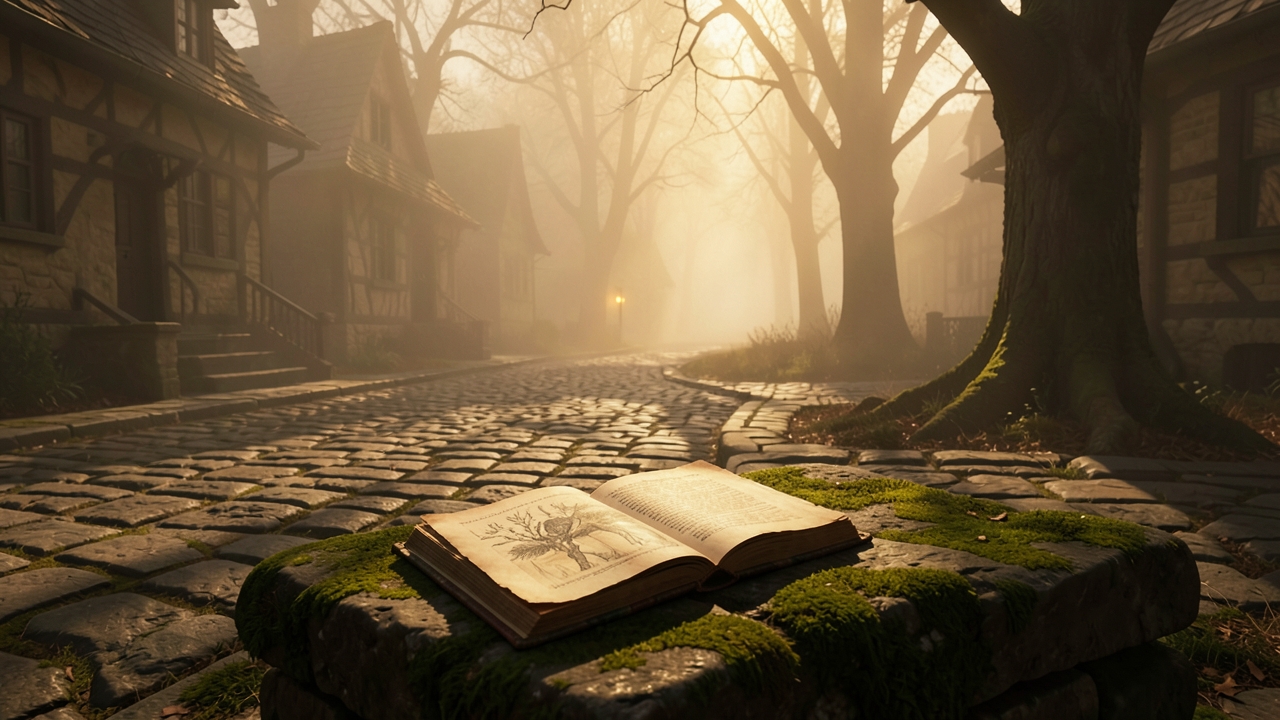
What lingers longer: the snarl of claws in the dark, or the sound of neighbours chatting on a warm morning while children gather smooth stones? Shirley Jackson The Lottery, first published in The New Yorker in 1948, chose the second path. It remains one of the most dissected stories in American fiction because it refuses the supernatural entirely. Instead, it weaponizes the mundane. Sunshine, gossip, worn-out traditions — these become the instruments of dread. For a deeper look at the author herself, see the Poetry Foundation’s profile of Shirley Jackson.
This essay examines how Jackson builds that dread, technique by technique. You will learn how ordinary detail can be sharpened into a blade. You will see how pacing and dialogue do the work that ghosts usually do. Finally, an original micro-fiction piece demonstrates the method in practice.
The Domestic Engine of Shirley Jackson The Lottery
Horror usually announces itself. A creaking door. A shape at the window. Jackson does the opposite. She opens with a square, a pile of boxes, and children quietly gathering stones. Nothing is out of place. Yet everything is. That inversion is the story’s engine.
Specificity Before Spectacle
Jackson anchors us in objects before she ever hints at violence. The slips of paper. The black box, splintered and faded. The three-legged stool. Each item is specific and physical. Therefore the reader’s body registers the scene before the mind registers the threat.
This is the first lesson: name real things. Vague unease floats. Concrete detail weighs. Compare the effect with H.P. Lovecraft’s abyssal geometries in works like The Call of Cthulhu; Lovecraft overwhelms with scale, while Jackson pinches with precision. For more on this principle, read our piece on crafting gothic atmosphere from ordinary rooms.
The Choreography of Ordinary Time
Notice the clockwork of the village morning. The boys collect stones. The girls talk. Adults arrive slowly, “dropping into place.” Routine is destiny here. Consequently, the reader begins to trust the world’s stability — which is precisely what Jackson intends to betray.
Technique: sequence your scenes the way a workday sequences itself. Wake, dress, travel, gather. Ritual violence feels most obscene when it interrupts a schedule rather than a sanctuary. Shirley Jackson The Lottery is, at heart, a story about a calendar entry nobody questions.
Warmth as Misdirection
The day is hot. Flowers are blooming. Grass is rich green. Jackson floods the page with sensory comfort. Meanwhile, the black box sits in the centre like a bruise no one mentions. In addition, this contrast forces the reader to police their own assumptions. We think: surely nothing terrible happens on such a beautiful day. Then it does.
Daphne du Maurier employs a cousin of this trick in Rebecca, where Manderley’s beauty masks rot beneath the furniture. Gillian Flynn, too, uses suburban gloss as camouflage in Gone Girl. The lesson is portable: let the setting promise safety while the structure promises ruin.
Ritual Language Hiding in Gossip
Dialogue in this story sounds like small talk. “Hadn’t they done away with it years ago?” one villager asks, about the original ritual of a chant and a cheer. The phrasing is chatty, even bored. Yet the subject is killing. Meanwhile, formal ceremony leaks into casual speech: “Come, father,” “All set?”
Therefore the horror lives in tone, not in plot. The characters are not frightened because they are not the victims — yet. That ordinariness is far more disturbing than screaming ever would be. If you want the mechanics behind such tonal control, see building tension in short fiction without jump scares.
Common Pitfalls: Signalling Dread Too Early
Writers often betray their twist by over-seasoning the setup. Adverbs like “ominously” and “darkly,” a sudden minor key in the prose, a character who feels “a chill down their spine” — these announce the blade before it falls. Consequently, the blade becomes decoration.
Jackson’s discipline forbids that temptation. For the first two thirds of the story, nothing on the page is frightening. Nothing needs to be. Another pitfall: explaining the village’s cruelty through backstory. Shirley Jackson The Lottery offers no history lesson, because explanation would domesticate the horror a second time. Silence preserves it.
Pacing, Pivot, and the Art of the Late Reveal
Jackson’s great structural move is delayed identification. The reader assembles meaning slowly: boxes, names in a hat, a list of families. Only at the end do the stones find their purpose. The reveal works because the reader has already colluded with the village — we watched, we waited, we assumed civility.
Compare this with Shirley Jackson’s own later novel The Haunting of Hill House, where dread accrues through ambiguity, or with Tana French’s slow-burn moral entanglements in In the Woods. In each case, information arrives late and unevenly. As a result, the reader becomes an active conspirator rather than a passive witness.
The practical rule: withhold the noun that names the horror until the final moment. Let the verbs and objects mislead. Let the reader’s own imagination supply the courtesy of an innocent reading — and then take it away. For a study of that technique across genres, explore unreliable narrators and misleading framing.
The Final Sentence as a Locked Door
The story closes with a villager’s cry to do it again, next year. No reflection follows. No punishment arrives. Consequently the reader is expelled mid-shudder. The ending does not resolve the dread; it annualises it. That is the difference between a shock and a haunting. A shock ends. A haunting returns.
A Case Study: The Weeding
The following original piece applies the principles above: sunlit specificity, chatty ritual language, a late reveal, and a closing sentence that refuses comfort.
The morning the gardens were chosen, the light came in low and gold over the allotments, and the kettle on Mrs. Pell’s stove began to sing before six. Children chased a loose dog along the fence line. Someone had cut rhubarb already; the smell of it, tart and green, hung over the sheds. Mr. Alder arrived with the wheelbarrow and the long envelope, and he set it on the picnic table with the solemnity a man reserves for a birthday cake. “All set?” he asked. Everyone nodded. It was a lovely day for weeding.
They drew names from the tin, as they always did. There had been talk in the spring, over tea at the post office, that the weeding was old-fashioned. But nobody could say who would do it otherwise, and so the talk ended where talk always ended, in the sugar bowl. Mrs. Pell tucked a stray hair behind her ear and found her name written in Mr. Alder’s careful hand. “Oh,” she said pleasantly, “better me than the Hendersons, they’ve only just put in beans.” Laughter moved through the circle like wind through a hedge. The sun climbed. The dog slept.
They walked to her plot together, the whole village, and the children went ahead collecting stones that sat warm in their palms. Mrs. Pell knelt. She found a dandelion root deep in the soil and tugged, and someone said, “That’s a good one,” and she laughed, because it was, because the root came up whole and the earth released it with a small dark sigh. The stones waited in a neat heap at the edge of the bed, the way spare bulbs wait in a drawer. Mr. Alder checked his watch. The kettle had long since gone quiet.
Afterward the rows looked tidy. Nobody spoke of it on the path home. Mrs. Pell’s gloves lay folded on the bench, and her daughter picked them up, and the daughter’s daughter was taught, that same evening, how to sort the smooth ones from the rough. Because the beds must be cleared, Mr. Alder said, or they will choke everything. And it was summer, and the hedges shone, and next year there would be weeding again.
The Question That Echoes Past the Last Line
Jackson understood something most writers learn too late: dread is not produced by monsters but by consent. A sunlit village that agrees to its own cruelty is more frightening than any phantom, because it has an address. It has neighbours. It has a schedule.
So place your horror in a kitchen. Let it arrive with the post, wearing an apron, borrowing sugar. Withhold the noun. Trust the stones. And then ask yourself — if the brightest, most ordinary scene you can imagine turned out to be a ritual, how many pages would your reader need before they noticed?