
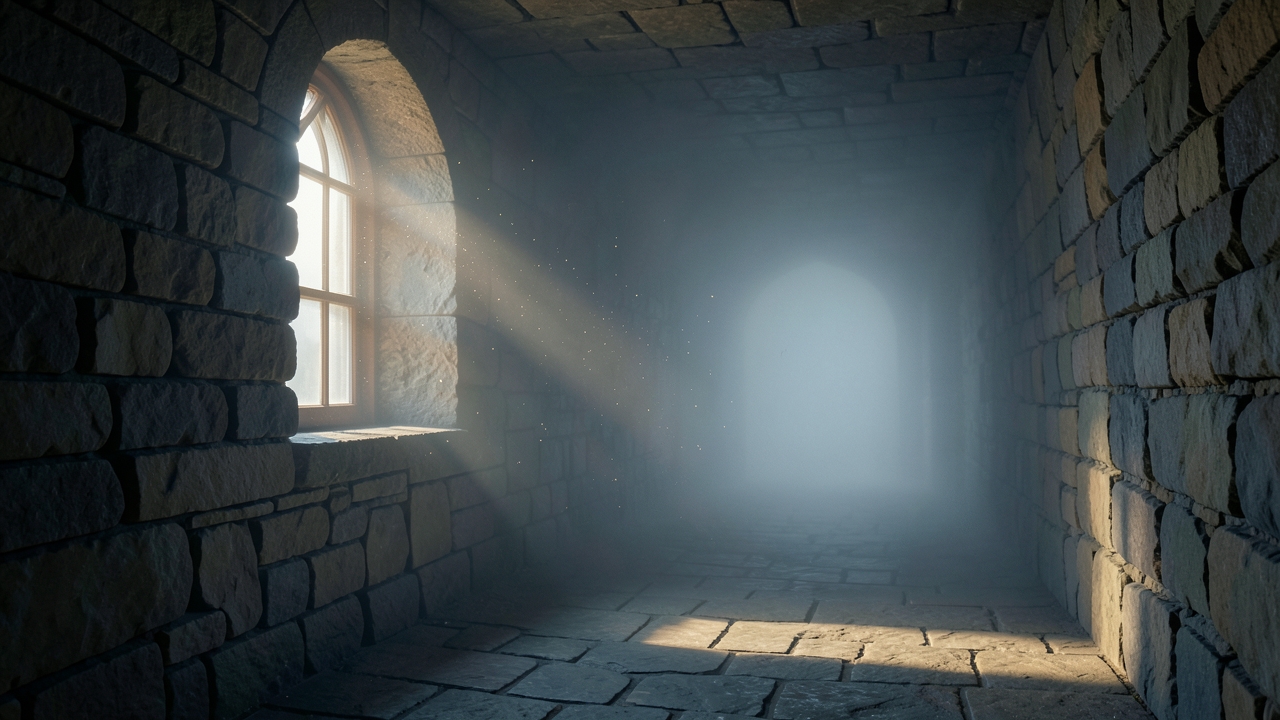
What if the door does not slam behind you, but simply refuses to remain a door? That quiet impossibility is where this week’s craft invitation begins. What follows are confinement writing prompts — seven spaces that actively resist exit — paired with a brief study of why that resistance grips a reader by the throat.
The haunted house has grown tired of itself. Everyone owns one. Yet a house that merely watches is not the same as a house that argues. This collection concerns settings with intention: a corridor that unspools, a fog that erases the road it came from, a stairwell that keeps count. The difference matters enormously. Therefore, before we descend into the seven prompts, we should examine the machinery beneath them.
Why Confinement Writing Prompts Forge Unbreakable Tension
Tension is not produced by danger. It is produced by the nearness of escape. A threat in an open field is an adventure; the same threat in a room with one door is a nightmare. As a result, confinement converts fear into arithmetic — the reader constantly counting exits, resources, minutes. That arithmetic never stops working in the background of a scene.
Consider Edgar Allan Poe’s The Pit and the Pendulum. Nothing supernatural occurs. The machinery is metal and gravity. What makes it unbearable is that the walls move. The space itself has opinion. Poe understood, as few have, that architecture can be an antagonist without ever gaining a face. For more on the man behind that instinct, see the Poetry Foundation’s portrait of Poe.
The Anatomy of a Space That Resists
Not every locked door qualifies. A resisting setting needs three organs.
First, a promised exit. The reader must believe escape is possible. Shirley Jackson’s The Haunting of Hill House works because the front door is never bolted. The horror is that leaving changes nothing. In contrast, a sealed room simply removes the question — and with it, much of the dread.
Second, a rule the space obeys. Even irrational architecture must be consistently irrational. The looping hallways of Mark Z. Danielewski’s house, or the repeating corridors in Tana French’s The Likeness, derive power from pattern. The reader learns the rule alongside the character, then dreads what the rule implies.
Third, a cost of testing. Each attempt to leave must extract something: time, hope, a memory, a name. Without cost, retrying becomes free, and free retries are dull. Meanwhile, Charlotte Perkins Gilman’s The Yellow Wallpaper charges every attempt with sanity itself. The room keeps receipts.
Crafting the Threshold: Four Working Techniques
Once the anatomy is set, technique decides whether the confinement sings or merely constricts.
Enumerate the space. Give landings numbers, doors letters, windows faces. Confinement becomes visceral when it can be counted. Lovecraft’s narrators constantly inventory dimensions and angles; the catalogue itself becomes claustrophobic. Consequently, counting is one of the cheapest, most effective tools you own.
Let the exit deform rather than disappear. A door that vanishes is a trick. A door that remains and turns traitor — opening onto where you started, as in Borges’ garden of forking paths — is a philosophy. Daphne du Maurier mastered this in Rebecca: Manderley is never locked, yet no one truly departs it.
Alternate compression with air. Give the character one breath of relief — a window, a signal, a kind stranger — then take it back. The contrast sharpens the pressure. Gillian Flynn uses this rhythm relentlessly: hope arrives, hope is compromised, hope is revealed as bait.
Make the space read the character. The strongest confinement is personalized. In Silvia Moreno-Garcia’s Mexican Gothic, the house does not trap everyone equally; it selects. A room that responds to a specific guilt will always outperform a room that traps a generic tourist. If you want more on layering dread into place itself, read our notes on gothic setting ideas.
Common Pitfalls That Break the Spell
Three failures recur, and each is avoidable.
The first is explained mystery. Writers often unlock the room in chapter ten with a circuit breaker or a hidden latch. Explanation deflates confinement; it converts dread into maintenance. Keep at least one exit permanently unexplained.
The second is passive victims. A character who sits and waits is a prop. Give them a project: mapping, bargaining, lying, experimenting. Haruki Murakami’s protagonists seldom panic; they cook, they listen to records, they investigate. Their competence makes the enclosure more frightening, not less.
The third is atmosphere without incident. Fog alone is weather. Fog that eats the sound of a passing car is an event. Therefore, every descriptive paragraph should smuggle in one small change the character cannot account for. For techniques on making description carry plot weight, see our guide to building suspense in fiction.
7 Confinement Writing Prompts: Spaces That Refuse the Exit
Each prompt below names a space, states its rule, and prices its exit. Use them whole, or crack them open and take the mechanism alone.
1. The Ninth Floor Hotel
A night porter works a hotel with eight guest floors. The lift offers a ninth. Press it, and you arrive at a corridor identical to your own — same carpet, same yawning sconces — except every room number ends in nine. Rule: the floor cannot be left by descending. Cost of testing: each failed attempt erases one memory of the world outside. Write the moment he recognises his own handwriting on a door he has never touched.
2. The Town Behind the Fog Line
A driver takes the coast road through dense fog and emerges into a village that does not appear on any map. The fog is behind him. The road ahead is clear — and yet, when he drives it, the village reappears ahead of him, politely, as though it had been waiting. Rule: distance resets; direction does not. Cost: the fuel gauge declines with every loop while the tank remains full. Write the first local who offers him directions he has already refused.
3. The Apartment with a Solid Front Door
A woman returns from work to find her front door has become a wall — plastered, painted, indistinguishable from the hallway. Neighbours knock and receive no answer. To them, her flat has never existed. Rule: the exit is socially erased rather than physically sealed. Cost: each day, one person outside forgets her name. Write the scene in which she watches her sister walk past with groceries and no glance.
4. The Museum After Closing
A security guard begins his shift in a natural history museum and finds the galleries have extended. New wings branch where the loading bay used to be. The exhibits are his own belongings, displayed under glass with typed labels. Rule: the building grows inward, toward him. Cost: removing an item from a case seals the nearest exit permanently. Write the label that reads: specimen, still convinced of departure.
5. The Train Without a Terminus
Passengers board a sleeper service at dusk. By morning, the timetable shows only intermediate stops. The train is moving; the landscape is not. Stations slide past the windows occupied by the same passengers who boarded. Rule: motion without arrival. Cost: conversation loops — every dialogue the character has already spoken returns to him, word for word, from a stranger’s mouth. Write the moment he hears his own proposal of marriage through the partition.
6. The House That Restores Its Order
A family inherits a house whose rooms rearrange overnight — but only to undo what was taken. A book moved downstairs returns. A locked bedroom door, forced open, appears sealed the next morning with the frame unmarked. Rule: entropy is reversed only in favour of the house. Cost: anything the characters destroy regrows wrong — a broken clock that ticks backwards, a mirror that offers an older reflection. Write the child who begins leaving gifts in each room to see what the house will do with kindness.
7. The Ward Where Discharge Papers Dissolve
A patient is healthy. The doctors agree. The paperwork is signed each morning and is illegible by evening, the ink spreading into grey water. Corridors lengthen whenever he walks toward the exit, so that the distance he covers equals the distance he began with. Rule: bureaucracy as architecture. Cost: each dissolved form takes a day from the calendar he remembers. Write the orderly who quietly keeps the originals in his locker — and what he wants in return.
A Case Study: The Stairwell That Counts
Here is one confinement writing prompts scenario worked to completion. Notice the enumeration, the deforming exit, the cost levied per attempt, and the single unexplained rule that survives the final line.
The stairwell began with thirteen landings, and Marta knew this because she had counted them on the way up — one hand trailing the rail, torchlight sliding over each numbered plate, her breath making small weather against the concrete.
On the descent there were fourteen. She stopped at the plate marked 14, a brass oval that had not existed an hour ago, and listened. Below her, water moved through a pipe with the patience of a clock. She turned and climbed. The stairwell offered her fifteen on the next attempt, and then sixteen, as if the building were politely extending a dinner invitation she had already declined.
The fire door on the eighth landing opened onto the eighth landing, seen from a slightly different angle, the dust arranged into the same drift twice. She walked it three times. Each time her own footprints waited for her, already old, and the corridor sighed shut behind her with no sound of mechanism at all.
By the fifth hour she understood the arithmetic, and wished she had not. The stairwell was not adding floors; it was subtracting exits. Every landing she surrendered, the building folded somewhere behind her, and the space where a door had stood became a wall with an honest face. She wrote in her survey book, in the small square hand her father had taught her: the structure refuses egress. Then she underlined refuses twice.
She sat on the plate marked 13, which was now the only landing she had ever known, and allowed herself one full minute of being a woman who would go home. The minute passed. Above her, softly, came the scrape of a heel on concrete — someone descending toward her, unhurried, with the confidence of a thing that had done this many times. Marta looked up at the numbered plate in her torchlight and understood at last that it had never been thirteen. She had simply been counting from the wrong end.
The Door That Remains
Return, for a moment, to where we began. The haunted house watches; the confined house replies. Everything in between — the numbering, the deformed threshold, the escalating price of each attempt — serves that single reply. If you take nothing else from these confinement writing prompts, take this: never seal the door. Leave it standing, ordinary and open, and make the act of walking through it cost more each time. That is where the quiet lives. And when the last character finally steps through unharmed, will the reader feel relief — or the colder suspicion that they were permitted to leave because the room was finished with them?