
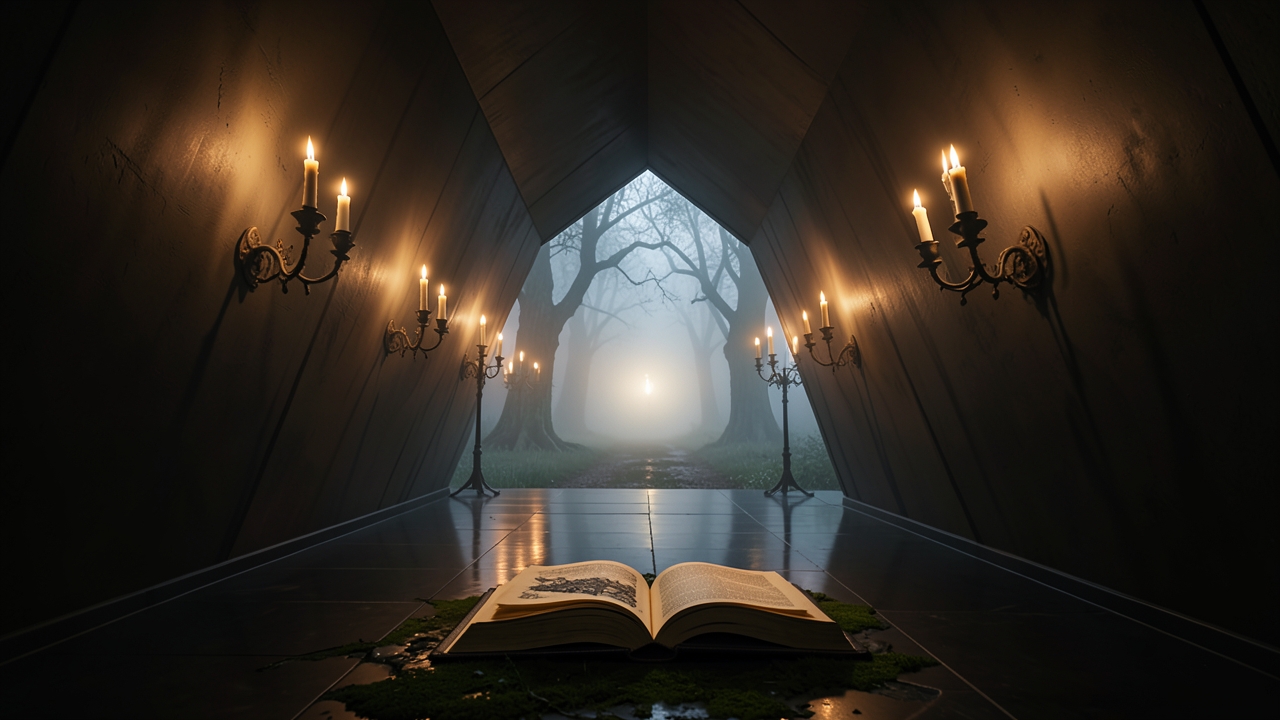
What if the ghost never needed to appear? In the Shirley Jackson Hill House horror, the most terrifying presence is not a spectre but a floor plan. Jackson built dread from corridors, doorways, and angles that refuse to resolve. Therefore the reader learns to fear the room before fearing anything inside it.
Published in 1959, The Haunting of Hill House remains a study in restraint. Four people enter a house. Very little visibly happens. Yet the novel endures as one of the purest haunted house stories ever written. The reason is architectural. Jackson understood that space can wound a mind more efficiently than any monster.
This essay examines that machinery. We will dissect how Jackson uses spatial description as a substitute for explicit supernatural events. Then we will extract techniques any short story writer can deploy to make setting do the frightening. Finally, an original tale will demonstrate the method in motion.
The Shirley Jackson Hill House Horror That Never Screams
Jackson’s novel obeys a strict economy. The house slams doors, chills rooms, and writes on a wall. Yet no apparition ever strides the corridor. Consequently, the dread never exhausts itself. An event ends; a room simply continues to exist.
This is where the Shirley Jackson Hill House horror separates itself from ordinary ghost stories. The threat has no schedule. It cannot be waited out. It does not arrive at midnight and depart at dawn. It is simply there at three in the afternoon, when you are trying to read.
The Anatomy of Spatial Dread
Spatial dread arises from a precise mechanism: the reader is shown a space, then shown that the space does not obey. First, establish normality with confident, concrete detail. Then violate a single assumption. The violation must be small enough to remain deniable and large enough to itch.
Edgar Allan Poe practised this in “The Fall of the House of Usher.” The fissure in the mansion’s facade is never explained. It merely widens. Meanwhile, Roderick Usher’s mind mirrors the crack. Therefore the house becomes a diagnosis rather than a backdrop. Jackson applies the same principle with colder precision.
For the writer, the actionable lesson is simple. Describe a room in three sentences. Make the first accurate. Make the second intimate. Make the third wrong by one degree. Then stop. Silence after a dissonance is where fear settles. For more on this rhythm, see our guide to building gothic atmosphere in fiction.
Corridors, Doorways, and the Grammar of Threshold
A corridor is a sentence. A doorway is a full stop that could still become a comma. Jackson stretches her hallways until the walk itself becomes an ordeal. Doors do not align. The wallpaper pattern continues past where it should stop. Consequently, movement through the house feels like translation rather than travel.
Thresholds carry built-in anxiety. To cross one is to accept an offer. Daphne du Maurier exploited this at Manderley, where every doorway leads deeper into a marriage the narrator cannot escape. Tana French does similar work in The Likeness, using rooms that hold people the way amber holds insects. In each case, the architecture makes a decision for the character.
Try this exercise. Write two hundred words in which a character crosses three rooms. No dialogue. No interior monologue. Only what the body notices: the drop of a stair, the give of a board, the cold brass of a latch. Force the reader to walk. Watch how quickly they begin to dread the next room.
Wrong Angles: When Geometry Lies
Hill House’s famous wrongness is never dramatized. It is stated. The house is not quite right. No line is quite straight. Jackson refuses to specify which line. As a result, the reader’s imagination supplies the deviation, and imagination is always more exacting than prose.
This is the uncanny at work: the familiar rendered slightly foreign. Shirley Jackson used the same strategy in “The Lottery,” where a village picnic conceals a stoning. The horror lives in the gap between what is said and what is meant. One wrong detail in an otherwise correct room produces the identical fracture.
Gillian Flynn’s Sharp Objects applies the technique domestically. The childhood house in Wind Gap accumulates small wrongnesses — a mother’s arrangements, a sister’s absence — until the family architecture feels load-bearing and rotten. Meanwhile, Haruki Murakami’s wells and basements function as rooms that refuse to connect to the house above them. You can find more of this method in our analysis of unreliable narration in gothic stories.
The Substitution Principle: Setting Instead of Spectre
Jackson’s central trick is substitution. The house performs every action a ghost would perform. It slams doors. It writes messages. It grows cold. Therefore the reader must blame a building, which cannot be reasoned with, bargained with, or understood. A ghost has motives. A house has only dimensions.
The novel’s closing line — “whatever walked there, walked alone” — seals the substitution. The house survives its occupants. It always did. You can read more about Jackson’s own account of the novel at the Poetry Foundation’s Shirley Jackson page.
Angela Carter understood this appetite in “The Bloody Chamber,” where the castle digests its brides. Meanwhile, Jorge Luis Borges treated architecture as pure thought: labyrinths that think their visitors into place. Both writers prove the same point. When the setting becomes the actor, the human becomes the object.
For the short story writer, the rule is blunt. Give your setting verbs. Let the room do something the character cannot explain. Do not describe fear. Let the space commit it.
Common Pitfalls: When Setting Becomes Scenery
Three failures recur. First, adjective accumulation. Stacked modifiers flatten tension; the reader stops trusting any single detail. Second, authorial announcement. If you write “the room was unsettling,” you have spent the fear before the character earns it. Third, unfiltered description — listing a room’s contents as though the narrator were a surveyor with no stake in the outcome.
The cure is point of view. A carpenter notices joints. A child notices skirting boards and the gap beneath doors. A grieving mother notices where a chair has been moved. Therefore, filter every spatial detail through a consciousness with something to lose. For the craft behind this, study our piece on showing rather than telling in horror fiction.
Also vary your distances. Move from the wide shot — the house on its hill — to the intimate one — the hairline crack in the plaster. Then return to the wide shot. The reader now sees the crack from the hill. That oscillation is where atmosphere thickens. In addition, cut any sentence that could appear in any other story. Specificity is the antidote to decoration.
A Case Study: The Room That Faced Inward
The Shirley Jackson Hill House horror method, distilled: no apparition, no blood, only measurements that will not hold. The following original tale demonstrates corridors lengthened, corners mis-angled, and a setting permitted to act.
The surveyor came to measure the second floor. She had drawn the house a dozen times from the road and never once drawn the landing. It was longer on the second pass than on the first. She checked her tape. The tape agreed with the wall, which was precisely the trouble: the wall kept going.
Three doors opened off the corridor. She entered the first and found the second from the inside, where no door had stood when she looked from the hall. The wallpaper continued past the frame in a pattern she did not remember choosing, though she had papered the room herself in April, alone, with the windows open.
She measured the corner. The two walls met at eighty-seven degrees. Not dramatically. Not enough to name aloud. Enough that any picture hung there would lean, always, by three degrees, and no one would ever straighten it, because no one would ever be certain it had moved.
On the third pass the corridor delivered her to the room she had been avoiding: the one that faced inward, its window looking onto the stairwell instead of the garden. The glass held her reflection a half-second late. She stopped waiting for it to catch up.
There was no one else in the house. There had never been anyone else in the house. Still, the door behind her closed with the particular patience of something that had nowhere else to be, and the light dimmed not because anything was switched off, but because the room had decided the measurement was finished.
She wrote in her notes: square. She underlined it twice. Then, beneath, in a smaller hand: the house agrees. It was the only sentence in the file she would later be unable to explain.
The Echo in the Hall
The surveyor survives. Nothing attacks her. Yet the passage unsettles, because every fright is delivered by geometry. The corridor lengthens. The corner mis-measures. The reflection lags. Consequently, the reader does the haunting on her own behalf.
That is the Shirley Jackson Hill House horror distilled: setting as antagonist, description as event. Jackson proved that a writer need not summon the dead when the living are already so easily misplaced by a hallway. She also proved that restraint outlasts spectacle — a lesson confirmed by critics who still return to the novel as a landmark of American ghost fiction, as noted in Literary Hub’s continuing coverage of her work.
So when your character next opens a door, ask yourself: what, precisely, is on the other side — and is that room still the size it was when you last measured it?