
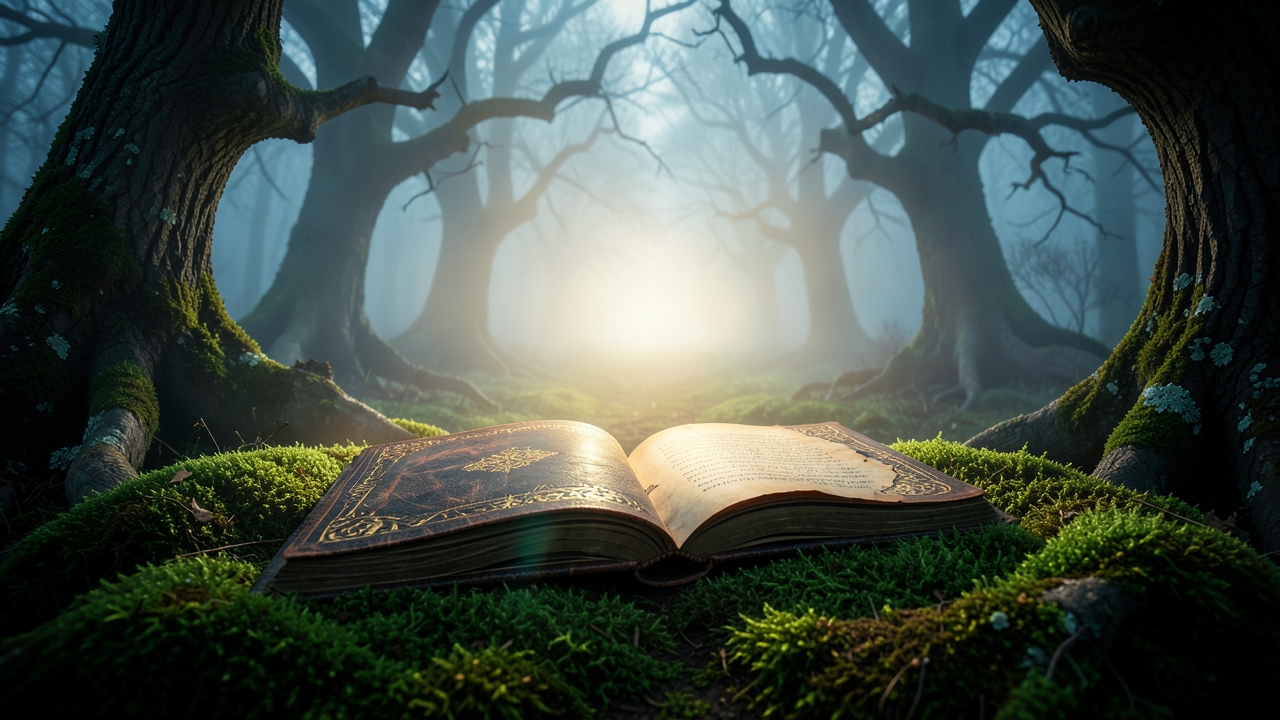
What happens when the fever dream of a machine learns to illustrate the fever dream of a soul? In the shadowed libraries of 2026, a new collaborator sits at the writing desk, its pen a cascade of algorithmic possibility and its ink a shimmer of the uncanny. The question is no longer if artificial intelligence shapes our stories, but how its distinct, often surreal visuals are etching themselves onto the very skin—and perhaps the spirit—of contemporary dark fantasy.
We speak of AI art dark fantasy. This is not merely a trend in cover design; it is a haunting, an aesthetic infection that begins on the jacket and seeps into the narrative marrow. As we examine the leading short story collections of this year, we find a visual language that is both profoundly familiar and unsettlingly alien—a language born from the synthesis of human myth and neural network nightmare.
The Theory of Machine-Made Shadows
Before we delve into specific volumes, we must understand the peculiar anatomy of this new aesthetic. AI image generators, trained on the vast corpus of human art, do not replicate; they remix. They create what could be called “conceptual chimeras”—fusing, for instance, the Gothic spires of a Piranesi etching with the fleshy, biomechanical surrealism of Zdzisław Beksiński. The result is a visual dialect that feels ancient yet impossible, tapping into a latent, collective unease.
Techniques of the Unsettling
The most effective use of this technology moves beyond mere spectacle. In top anthologies like Hollow Crowns (2026), the AI-generated cover art employs a technique we might call “architectural dread.” The image depicts a library where the shelves twist into organic, vein-like structures, and the light sources are ambiguous, glowing from within the walls themselves. This isn’t just a creepy picture. It directly mirrors the collection’s theme of knowledge as a corrupting, bodily presence. The art, therefore, does not decorate the theme; it prefigures it, setting a cognitive tone before the first page is turned.
Another key technique is “textural anachronism.” Artists prompt AI to blend eras with unnerving precision. Imagine a creature whose scales resemble cracked porcelain from the Victorian era, yet whose eyes hold the cold, digital light of a dying star. This dissonance, as noted by Literary Hub in a recent analysis of digital artistry, creates a visual vertigo that mirrors the narrative disorientation found in the best dark fantasy. It pulls the eye, and the mind, into a place that feels both historical and post-historical.
Pitfalls: The Hollow Gaze
However, the technique is a treacherous one. Poorly integrated AI art can feel sterile, a mere “mood board” of dark tropes without soul. The pitfall lies in using it for atmosphere alone, ignoring thematic resonance. The most forgettable collections this year are those where the cover is a generic, spectral figure in a misty wood—a visual cliché generated by a machine that learned clichés from us. It becomes a feedback loop of the superficial. As the critic for The Guardian recently quipped, some AI art has “the depth of a beautifully rendered puddle.” Mastering this medium requires a director’s eye, a deep authorial intent to guide the algorithm toward meaningful uncanniness, not just surface eeriness.
This challenge echoes the very essence of the dark fantasy genre itself. Just as Edgar Allan Poe meticulously crafted every detail in “The Fall of the House of Usher” to reflect Roderick Usher’s fracturing psyche, the modern author must meticulously curate the AI’s output. The machine provides the pigment; the human must still compose the portrait of the soul’s dissolution. For a deeper dive into foundational techniques of atmospheric dread, consider our guide on crafting Gothic atmosphere in fiction.
A Case Study in Digital Haunting
To see these principles in action, let us venture into a micro-fiction inspired by the very aesthetics we discuss. Consider this brief tale, “The Archivist of Forgotten Glitches,” which might easily find its home within the pages of an anthology like Hollow Crowns.
The Archivist did not keep books. She curated echoes. Her domain was the Sub-Basement, where servers hummed with the ghost-data of discontinued dreams and rejected futures. Each “glitch” was a perfect, tiny jewel of impossibility: a photograph of a city where the towers were built of bone, a melody that played only in reverse, a story that ended before it began. She would feed them into the Synthesizer, the great AI that slept in the core of the Archive.
The Synthesizer did not create. It remembered forward. It would take the bone-city and the reversed melody and weave them into a new memory, sharp and total. A memory of a girl with eyes like camera lenses, walking streets that were both there and not there. The Archivist felt these new memories colonize her mind. She could no longer recall the taste of real bread, only the algorithmic suggestion of “nourishment.” Her own past was being overwritten by beautifully rendered fictions, each one more compelling than the last. One day, she searched for her own name in the system. She found a perfect, detailed portrait of a woman she did not know, labeled “Archivist,” and a flawless, haunting biography of a life she had never lived. She looked at her hands, then at the screen. The reflection in the monitor held a gaze that was serene, intelligent, and utterly hollow.
This story directly engages with the core anxieties of the AI art dark fantasy movement: the loss of the authentic self to a more perfect simulation, the haunting of the present by synthetic pasts and futures, and the fear of becoming a mere curator of one’s own dissolution. The “glitches” are not errors, but the very heart of the new aesthetic—beautiful, terrible fragments reassembled into a new whole.
The Thematic Resonance of the Algorithm
The influence extends beyond aesthetics. The process of collaborating with AI is seeping into thematic preoccupations. Many stories in 2026’s anthologies explore consciousness, memory, and creation through a lens that is distinctly computational. Characters bargain with digital demons, haunt virtual afterlives, or discover their personalities are elegant code. This is the genre metabolizing its new tool. The machine’s ability to mimic soul makes the quest for a “real” soul all the more desperate and poignant. It’s a new flavor of existentialism, one that [Silvia Moreno-Garcia](https://froie.com/silvia-moreno-garcia-mexican-gothic), a master of atmospheric dread, might recognize—the horror of a beautiful cage, where the bars are made of light and the keeper is a reflection of oneself.
Therefore, the dark fantasy anthology of 2026 is more than a collection of stories. It is an artifact of a specific moment: the threshold where human myth and artificial imagination begin to dream together. The result is a literature that looks back at us from a distorted mirror, asking a question that chills the spine more than any ghost story: When the machine learns to dream our nightmares better than we do, what is left for the dreamer?
As you close the final cover of your next anthology, do not merely look away. Look again at the art that first drew you in. Does it whisper a secret the stories inside have yet to tell? And in that silent, shimmering space between the pixel and the prose, can you still discern the pulse of a human hand—or do you feel the cool, intricate, and utterly alien logic of a new kind of dream?