
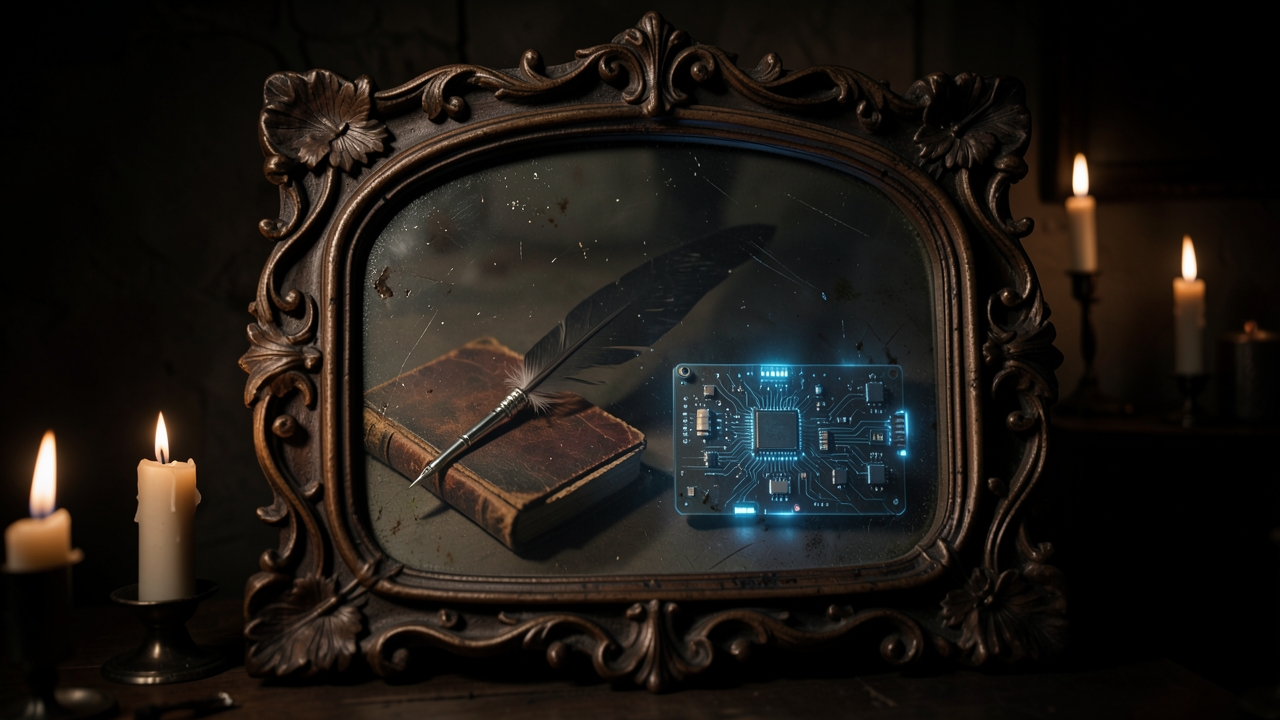
What happens when the deepest well of personal experience is not only plumbed by the writer, but by a silent, tireless partner? The specter haunting modern personal essay writing is not a ghost from the past, but a shimmering, algorithmic mirror held up to the author’s mind. This AI-powered reflection is reshaping the very soul of the genre, forcing a re-examination of voice, authenticity, and the intimate act of self-revelation.
The Theory: Crafting Voice in the Age of the Algorithmic Mirror
The personal essay has always been a haunted house of the self. It is a construction of memory, a carefully arranged collection of moments that feels spontaneous and true. In this genre, voice is everything—it is the hauntingly specific frequency of a writer’s consciousness. Therefore, the introduction of an AI as a ‘thought partner’ is not merely a technical shift; it is a philosophical tremor.
The Anatomy of Authenticity and the AI Reflection
Traditionally, the authenticity of a personal essay stems from its unmediated link to a singular human consciousness. Consider the work of Joan Didion or James Baldwin; their power derives from the perception of an unfiltered, authoritative ‘I’. However, AI personal essay writing complicates this. When you prompt an AI to “expand on the feeling of childhood loneliness with a metaphor of decaying grandeur,” you are not outsourcing the feeling, but its articulation.
The danger, then, is not in using the tool, but in allowing the tool to define the voice. As the Poetry Foundation often emphasizes regarding poetic craft, true style is inimitable and born of constraint and experience. If every writer uses the same model to polish their metaphors, do we risk creating a landscape of eerily similar, algorithmically perfected prose? The voice becomes a collaboration, a dialogue between the organic and the synthetic.
Techniques for Maintaining the Human Core
Mastery in this new landscape requires viewing AI not as a ghostwriter, but as a whetstone. Consider these practices:
The First Draft as Pure Offering: Let your initial draft be messy, visceral, and entirely yours. This is the raw data of your consciousness. Edgar Allan Poe, in his analytical essays, dissected effect before composition. Here, the ‘effect’ is your authentic emotional truth. Protect it fiercely in this first, human-only stage.
Prompting with Specificity, Not Generality: Avoid prompts like “make this emotional.” Instead, try: “Find the contradiction in this paragraph about my father,” or “Suggest three ways to describe this garden that convey both decay and stubborn life.” This uses the AI’s pattern recognition to deepen your specific vision, not replace it.
The Interrogation Edit: After receiving AI suggestions, rigorously interrogate them. Does this sharper sentence still sound like you? Would you say this in conversation? This process mirrors the meticulous crafting seen in the works of stylists like Tana French, where every word feels inevitable. The AI provides options; you provide the inevitability.
A common pitfall is mistaking fluency for resonance. An AI can create grammatically perfect, elegant prose that is utterly hollow. As we’ve explored with uncanny narrative voices, the most compelling writing often has slight, deliberate imperfections—the hesitations, the idiosyncrasies that prove a human heart is beating behind the words.
In contrast, successful AI collaboration requires a new kind of critical self-awareness. You must become the curator of your own soul, selecting which algorithmically polished facets to present. It is a form of intimate, collaborative editing with a mind that has read everything but felt nothing.
A Case Study: The Echo Chamber
The following is an original short story demonstrating the tension and technique discussed above. It depicts the process of using an AI mirror, written in a style that aims to balance raw human memory with refined articulation.
The cursor blinked. A patient, rhythmic heartbeat on the screen. I had poured the memory onto the digital page—my grandmother’s attic, the scent of camphor and dust, the way the light fell through a single grimy window onto a stack of yellowed National Geographics. It was true. But it was also dull. The words lay flat. I called upon the mirror.
“Describe the quality of light in a way that suggests both memory and erasure,” I prompted. The response shimmered into existence. The light wasn’t just falling; it was “a slow, amber pour, gilding the edges of forgotten worlds, each mote of dust a dying star in a private cosmos.” The words were beautiful. Too beautiful. They felt borrowed, like a coat that fits perfectly but isn’t mine. I felt a chill of dissociation, a fear that the memory was being translated into a more palatable, literary language, losing its specific, awkward truth in the process.
I deleted the generated sentence. Instead, I thought of the light. It wasn’t poetic. It was the color of weak tea, and it made the dust look like flour. My grandmother baked in that kitchen below. The connection wasn’t metaphorical; it was sensory. I wrote that instead. The mirror had shown me the gilded, published version of my memory. I had to reject its reflection to find the real one, which was quieter, less impressive, but mine. The final essay contained neither the dull original nor the fancy reflection, but a third thing: a memory polished by the friction between the human and the algorithmic, its authenticity forged in the struggle.
Conclusion: Echoes in the Digital Chamber
The algorithmic mirror does not create the echo; it amplifies and refracts the voice we place before it. This new frontier of personal essay writing is neither a betrayal of authenticity nor its salvation. It is, instead, a profound new test of it. The writer must possess a voice strong enough to withstand the mirror’s clarifying, distorting power. The final work becomes a dual testament: to the experience itself, and to the will of the author who navigated the shimmering reflection to tell it.
So we must ask ourselves, as we stand before this gleaming tool in the quiet of our digital studies: when we peer into the algorithmic mirror, do we see the faint, honest contours of our own face, or only the perfectly rendered mask it offers us back?