
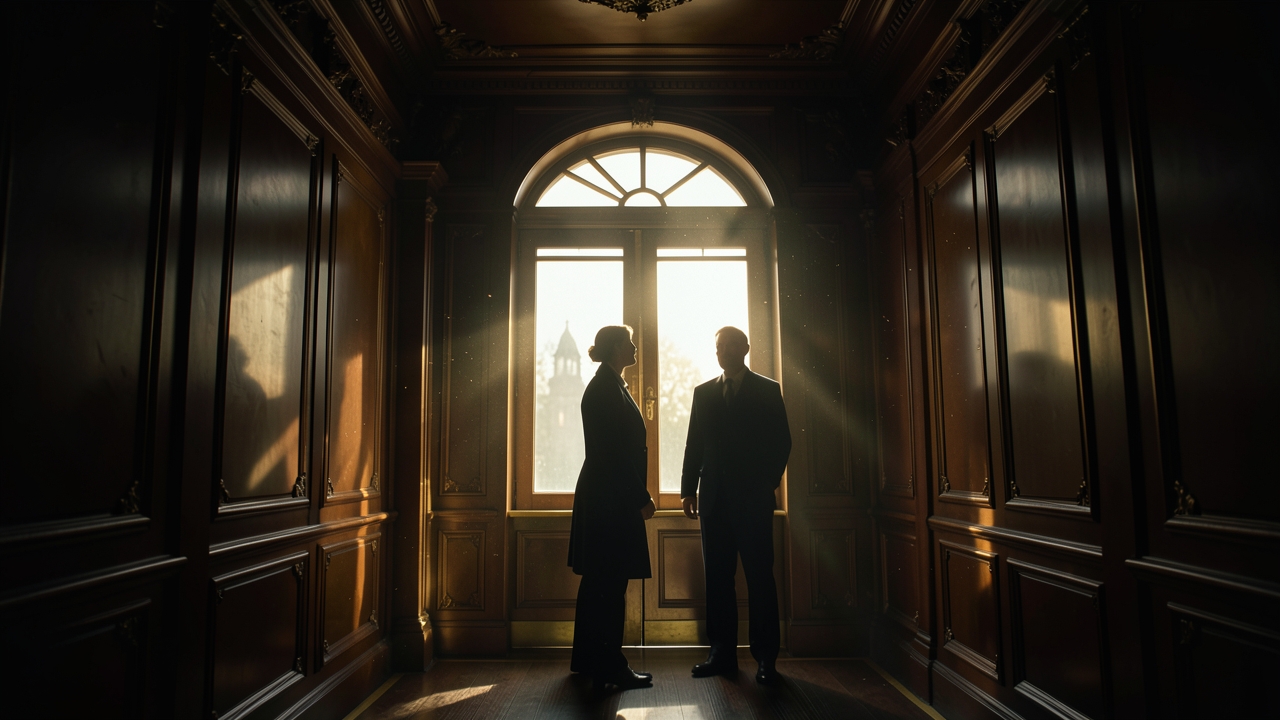
What can two strangers confess between the eighth floor and the twelfth?
The answer, for the disciplined writer, is: everything that matters. Ninety seconds is not a limitation. It is a blade. It cuts away the padding, the throat-clearing, the weather reports disguised as prose. What remains is the nerve of the scene itself. This week’s elevator writing prompt asks you to write a scene set entirely within a single elevator ride — and to let the doors open on a person who was not inside them when the doors first closed.
Why the Elevator Is the Perfect Narrative Pressure Chamber
An elevator is a room that refuses to stay put. It moves without asking permission. Its occupants cannot leave, cannot pace, cannot retreat into another hallway to compose themselves. The walls are close. The light is usually unkind. Above all, the duration is fixed and knowable — a fact the reader intuits instantly, without a single word of exposition.
This is pure narrative leverage. Consider how Edgar Allan Poe weaponized exactly this structure in “The Cask of Amontillado.” Montresor leads Fortunato downward through narrow catacombs, step by step, and the walls literally tighten as the story proceeds. The descent is the plot. The enclosure is the dread. Poe understood that confinement does not merely host tension — it manufactures it.
Your elevator is a modern catacomb. The difference is that yours has a floor indicator and a ding.
The Ninety-Second Contract With Your Reader
When you declare a time limit — even implicitly — you establish a contract. The reader agrees to watch closely, because they know the window will close. Consequently, every gesture swells with significance. A hand hovering near the buttons becomes an act of war. A throat clearing becomes a drumroll.
Daphne du Maurier mastered this economy. In Rebecca, her most devastating revelations rarely arrive through monologue. They arrive through a woman’s sudden silence, a husband’s too-quick answer, a change in the weather mentioned in passing. Small surfaces, enormous depths. Your elevator scene should work the same way: the surface is a metal box; the depth is a marriage, a betrayal, a decision.
The Anatomy of the Elevator Writing Prompt
A successful response to this prompt needs three structural organs. Miss one, and the scene flatlines into pleasant nothing.
1. Tension That Arrives Before the Doors Close
Tension must already exist in the room when the scene opens. If your characters meet as strangers, you have only the stranger-danger cliché to work with. Far richer: they know each other, or one knows the other’s secret. The audience should sense an electric charge before a single word passes.
Shirley Jackson built entire novels on this principle. In The Haunting of Hill House, the horror is not the house. It is Eleanor Vance’s desperate, humiliating need to belong. Your elevator needs that same pre-existing wound. Introduce two people who share history, then give them ninety seconds and a broken floor button.
2. Backstory Exposed Through Contact, Never Recap
The greatest danger of a confined scene is the flashback. Characters do not deliver biographies while riding between floors. They snap. They deflect. They mention a dog by name, and the name alone does the work of three paragraphs.
For example, do not write: “She remembered the night he left her at the hospital, alone, waiting for a diagnosis that never came.” Instead, let her say, flatly: “You came to the hospital once. I waited until four.” Then have him press the button for a floor that does not exist. The reader assembles the past themselves — and always, always credits you with the deeper intelligence.
For more on this discipline, study our guide to show, don’t tell with concrete examples. Restraint is not withholding. It is trust.
3. A Turning Point the Elevator Itself Delivers
The mechanical world must participate in the drama. The elevator stalls. It overshoots the floor. It opens on the wrong level, revealing a corridor neither character recognizes. The turning point should feel not authored but encountered, as if the building itself had opinions.
Haruki Murakami writes doors like this — thresholds that open onto places nobody ordered. In Kafka on the Shore, transitions between the ordinary and the uncanny feel inevitable rather than invented. Let your elevator become a threshold. The ride ends, but the life inside the box does not survive it unchanged.
Mastering Dialogue Economy in an Elevator Writing Prompt
Real people in elevators speak in fragments. They mutter. They complete each other’s sentences by accident. They say “after you” to settle entire power struggles. Your dialogue must honor this physics of the mundane.
Three rules govern compressed exchange:
First, cut the greeting. Nobody in a high-tension elevator says “hello, how have you been.” They say “Which floor.” Capital letters optional, but the coldness is mandatory.
Second, let the subtext do the screaming. Tana French, in In the Woods, builds interrogation scenes where the questions are polite and the answers are violence. Apply this. “Still running in the mornings?” is not small talk. It is an accusation, a memory, and a threat, compressed into nine words.
Third, interrupt ruthlessly. Elevators produce interruptions — the ding, the jolt, the arrival of a stranger. Use them. A sentence cut short by machinery is more chilling than a completed thought. Consider how Gillian Flynn terminates lines of dialogue with a blade’s precision, leaving the reader to fall into the gap.
Body Language: The Silent Second Script
In ninety seconds, you cannot rely on voice alone. You need the body’s parallel confession. Where are the eyes? Whose hand hovers near the emergency alarm? Who leans into the corner as if the corner could save them?
Angela Carter treated the body as a text unto itself. In The Bloody Chamber, a glove removed slowly can out-narrate a page of exposition. Similarly, your characters should speak twice at once — once with their mouths, once with their shoulders.
Notice the reflection in the elevator doors. Nearly every elevator has brushed metal walls, and brushed metal holds distorted faces. Use it. A character who cannot meet another’s eyes but meets their own reflection is telling you something a line of dialogue never could. For further study, see our piece on building gothic atmosphere in modern settings.
Common Pitfalls in the Single-Ride Scene
Writers stumble in predictable ways when they accept this challenge. Forewarn yourself.
Pitfall One: The Overloaded Ride
Ninety seconds cannot contain a divorce, a murder, a pregnancy, and a confession about the summer of 2011. Choose one detonation. The temptation to cram is the enemy. Borges could compress an entire cosmology into a single paragraph, but he did so by choosing one perfect image — a tiger, a mirror, a comb — and trusting it completely. Do the same. One image. One betrayal. One decision.
Pitfall Two: Ignoring the Machine
If the elevator is merely a setting, you have wasted it. Name the floor numbers. Describe the fluorescent hum. Mention the way the cable sways when the box passes the thirteenth floor. The machine is your third character. Let it breathe.
Pitfall Three: The Escape Hatch Ending
Do not let the doors open and dissolve the tension into ordinary hallway life. The moment the doors part, your story has roughly two sentences left. Use them to fracture something. A held gaze. A dropped key. A phrase that will now live in one character’s chest for years.
A Case Study: Between Floors Four and Nine
The indicator read four. The doors had closed on a woman holding a paper bag that smelled faintly of oregano, and on a man who had not expected to see her again in a lifetime.
“Floor?” she asked the air.
“Seven,” he said, and then, too quickly, “I’m visiting someone.”
She nodded once. The car climbed. Somewhere above them a cable whispered against its guide, the sound a rope makes when someone is thinking about it. She shifted the bag to her left arm. He watched her do it and understood, with the dull precision of a struck bell, that she had learned to carry things alone.
“Your mother,” he said. “She still makes the lamb?”
“She makes it every Thursday,” Elena said. “She sets a third plate. She has for six years.”
The number six landed between them like an object dropped from a height. He looked at the panel. Four buttons were lit. None of them mattered. His thumb found the emergency stop and pressed it, and the elevator shuddered into a silence so complete he could hear her breathing and, distantly, the building continuing without them.
“Daniel,” she said. Not a greeting. A verdict.
“I’m not visiting anyone,” he said.
She did not move. She stood there with the bag against her ribs, and he watched the decision travel across her face the way weather travels across water — first a darkening, then a wind, then a stillness that is not peace but the end of argument. When she reached past him to press the button for nine, her sleeve touched his wrist, and both of them felt the temperature of it.
The car exhaled and rose. At nine, the doors opened onto a corridor of beige carpet and closed doors. She walked out. She did not look back. Behind her, Daniel stood in the box that had carried them both upward and understood that the ride was over, and that nothing — not the lamb, not the third plate, not the six years — had been resolved, and that this, precisely this, was why he had come.
What the Case Study Demonstrates
Notice what happens across those paragraphs. The backstory arrives through oregano and a third plate, never through recollection. The turning point is mechanical — an emergency stop pressed by a hand that chose it. And the body speaks loudest: a sleeve touching a wrist, carrying the entire history of a marriage in a fraction of contact.
No paragraph explains the marriage. None needs to.
Your Turn: Riding the Prompt
Set a timer for ninety seconds. Write two people into a moving box. Give them one shared wound. Let the building interrupt them. Then open the doors and see who survives.
If you need further sparks, our collection of weekly writing prompts offers new constraints every week — each designed to sharpen rather than smother.
Constraint is not cruelty. It is the chisel. And the elevator, that humble ascending room, is waiting for you to carve something into its walls.
So tell me — when the doors finally part, will your characters step out the same people who stepped in? Or will the building have changed them, as buildings always do, whether we notice or not?