
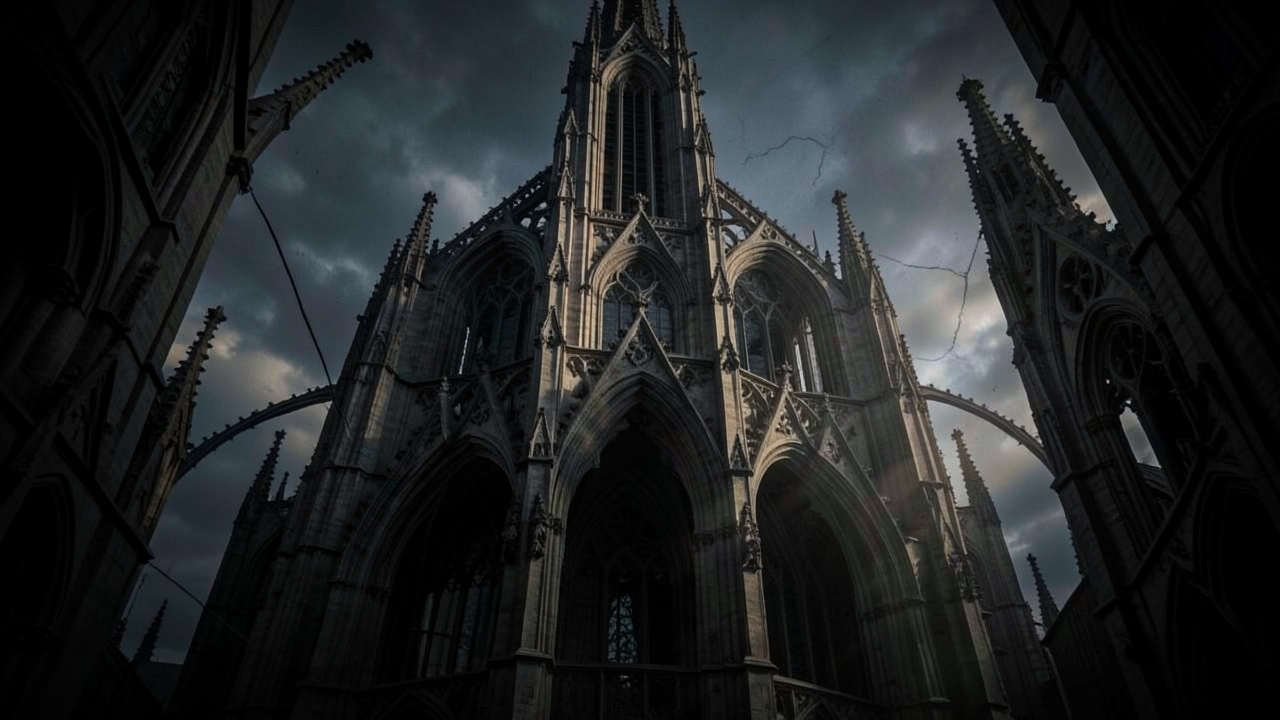
Have you ever felt the walls of a house watching you? Not with eyes, but with a patient, sentient weight, as if the plaster and timber held a memory of the footsteps that paced its halls, and were now judging your own? This is the primal whisper of the gothic, and nowhere is its voice more chilling than in the deliberate, architectural communion between a house and a soul. In this dark art, a corridor is never merely a corridor; it is a synapse in a decaying neural network. A locked door is not just an obstacle; it is a repressed memory given wood and iron form.
This is the core of gothic architecture psychology: the masterful, deliberate correlation between a crumbling manor’s floor plan and a character’s deteriorating mental state. It is a craft where bricks are moods and staircases are spiraling obsessions. Today, we shall descend into this blueprint of the psyche, mapping how authors from the Victorian era to our own shadowy 2026 landscape use the uncanny house to stage the collapse of the human mind.
The Theory of Trapped Corridors: Writing the Architectural Psyche
To wield this technique, one must first understand its mechanics. The gothic house is not a backdrop; it is a character in itself, a silent, often hostile, interlocutor. Its features are not decorative but diagnostic. Therefore, the writer must become a kind of architectural psychologist, drafting floor plans that diagnose and amplify internal fractures.
Anatomy of the Uncanny Layout
Consider Edgar Allan Poe, the master of this particular masonry. In “The Fall of the House of Usher,” the structure is a direct, almost clinical, metaphor. Poe gives us a house with a perceptible insanity—its windows are “eye-like,” its atmosphere “pestilent,” its very stones seem to ooze a “minute fungous vegetation.” The layout is key: Roderick Usher’s chamber is directly above the family vault. This vertical alignment creates a direct, physical conduit between his crumbling sanity and the literal tomb of his lineage. The architecture makes psychological inheritance inescapable. The house does not just contain the madness; it channels it.
In contrast, Daphne du Maurier’s Rebecca uses architectural psychology with a subtle, insidious genius. Manderley is not physically decaying; it is pristine, perfect, and overwhelmingly alive with the ghost of its previous mistress. The psychological horror for the new Mrs. de Winter comes from the house’s layout of exclusion. She is a guest in her own marriage, wandering corridors that are not hers, entering rooms that feel sacred to another’s memory. The uncanny here is not crumbling stone, but the chilling perfection of a space that refuses to acknowledge her psychological right to exist within it. This is a brilliant lesson: uncanny architecture can be as potent in its immaculate preservation as in its ruin.
Techniques for Crafting the Psychological Blueprint
To execute this, one must be deliberate. For example, you can employ mirroring: a house with two identical wings, where a character obsessively moves between them, representing a fractured self. Or use constriction: a once-grand manor now partitioned into small, maze-like apartments, symbolizing a mind compartmentalizing trauma. Furthermore, consider the impossible space, a staple from Shirley Jackson’s The Haunting of Hill House, where angles don’t meet and hallways seem longer than the house could contain. Jackson didn’t just make a scary house; she made a house whose geometry itself was a lie, a physical manifestation of Eleanor Vance’s own warped perception of reality.
Avoid the pitfall of mere description. A description tells you what a room looks like. Architectural psychology shows you what a mind feels like. Instead of “the hallway was long and dark,” try: “The hallway stretched ahead, a throat swallowing her sound, each door a closed eyelid in a face of indifferent wood.” See the difference? One is a statement; the other is an experience. For deeper dives into environmental storytelling, our exploration of setting as protagonist offers further technique.
Common Pitfalls in the Draft
First, avoid over-explanation. The power lies in suggestion, not diagnosis. Let the reader feel the house’s wrongness before you explain it. Second, ensure the architecture feels purposeful, not arbitrary. Every creak, every odd angle, should tie back to a specific psychological core—guilt, repression, madness, memory. Finally, remember that the house must change with the mind. As a character’s state deteriorates, the house should seem to respond, through shifting shadows, sounds that weren’t there before, or doors that now appear locked. Contemporary authors like Silvia Moreno-Garcia in Mexican Gothic excel at this, where the fungal infection in the house is both a real threat and a visceral metaphor for colonial and familial decay seeping into the protagonist’s consciousness. For more on this evolving tradition, see our piece on the modern gothic.
A Case Study: The Whispering Stair
The house did not have a proper name, so Elias called it the Whispering Stair, for the spiral at its core was the only part that ever spoke. It was a thing of impossible design, a continuous corkscrew of dark oak that connected all six floors, yet seemed to pass through the same spot in the foyer three times, each passage narrower than the last. When he first arrived, it was merely an architectural oddity, a curiosity to be sketched and admired. But as the weeks bled into one another, the stair began to answer him.
It started on the third ascent. He was thinking of his brother, of the argument, of the silence that followed. The stair groaned under his foot, a low, resonant note that vibrated in his bones like the memory of that final, bitter word. He paused. The echo did not fade. It seemed to hold, to curdle, into something that sounded like his brother’s laugh, but submerged in mud. From then on, he could not climb without listening. The second-floor landing held the cadence of his mother’s sighs. The fourth floor whispered in the voice of his childhood fear. The stair was not merely a part of the house; it was an archive of his own internal echoes, given form in whorling wood and shadow.
He began avoiding the lower floors. They were too clear, too sharp in their acoustic memory. He retreated to the attic rooms, where the stair ended in a sealed, brick wall. Here, the whispers were muffled, distant. But now, a new sound joined them: a soft, insistent tapping, coming from behind that final, bricked-up segment. It was a sound of profound wrongness, a heartbeat where none should be. Elias knew, with a certainty that froze the marrow, that it was the sound of his own guilt, finally trying to take solid form. The house, through its singular, maddening piece of architecture, had given his buried psyche a door to knock on.
The Echo in the Stone: A Final Reflection
We began with a question about sentient walls. We end with a darker one. If the house can be built to mirror a crumbling mind, does it not follow that the mind, once broken, might choose to inhabit a house it has built itself? The most potent gothic architecture psychology suggests that the walls we design—or the ones we allow to rise around us in silence—are not shelters, but diaries. They are the final, solid testament to the phantoms we could not exorcise.
So, when you next wander an old hall and feel a inexplicable chill, or note a staircase that turns just so, ask yourself: is this a quirk of the architect, or the blueprint of a soul that once paced these floors, and left its shadow in the very grain of the wood? For the house remembers. And sometimes, in the quiet of the dusk, it still whispers.