
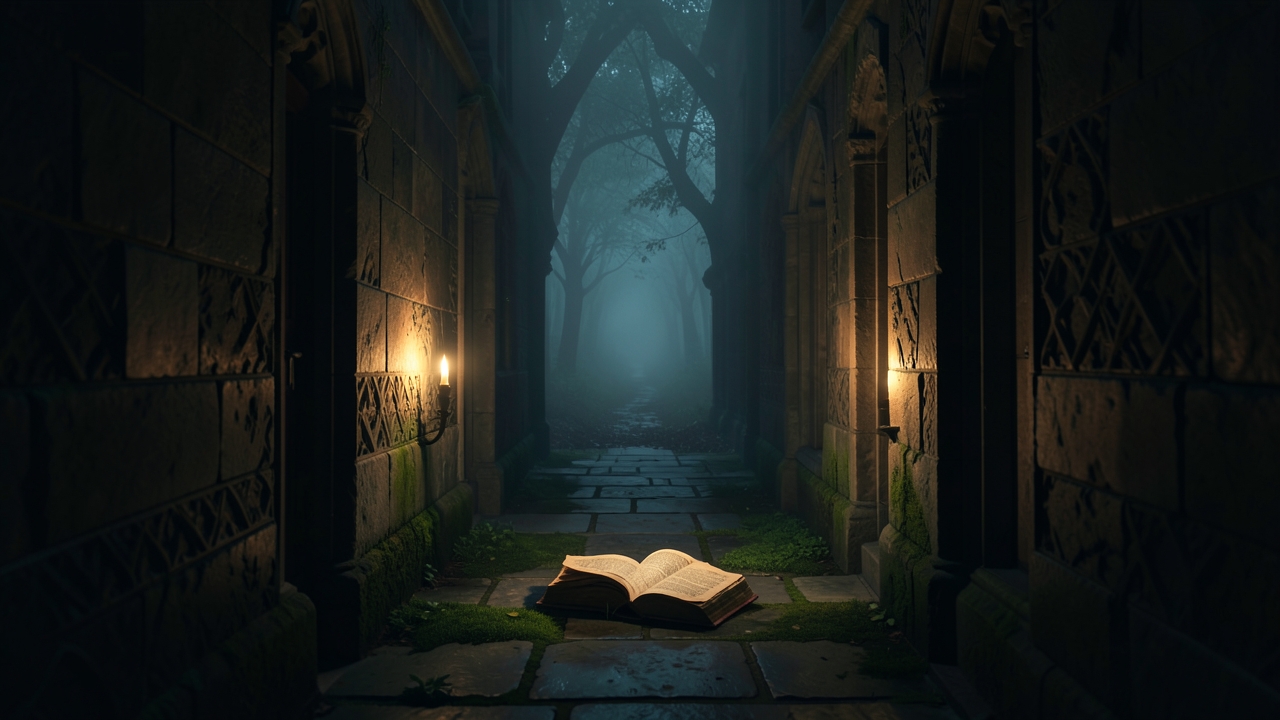
What happens when a house does not merely shelter its inhabitants, but begins to devour them?
Shirley Jackson understood that fear rarely announces itself. It arrives as a draught from a room that should be closed, as a hallway that runs one hallway too long. In The Haunting of Hill House, published in 1959, the dwelling is not backdrop. It is the argument itself.
Therefore, when writers study gothic house setting craft, Hill House remains the essential text. Jackson does not decorate her horror with cobwebs and candelabras. She builds it out of geometry — out of doorways that lead nowhere, ceilings that lean, and a floor plan that refuses to resolve. As a result, architecture becomes psychology, and the reader loses their footing in exact sympathy with the protagonist.
Gothic House Setting Craft: Hill House as Emotional Architecture
Every effective haunted house is really a portrait. Jackson simply refuses to hide the brushstrokes. Her novel teaches a lesson far more valuable than any ghost story: a setting is only as frightening as the mind it has been built to reflect.
The Floor Plan as a Diagnostic Chart
Jackson opens with one of the great statements of American horror: Hill House is not sane. It stands alone, holding darkness within. That darkness, crucially, is not supernatural in origin. It is architectural.
The house’s spatial logic is deliberately malformed. Doors open onto other doors. Hallways feed into chambers that seem to belong to a different building. Corners do not meet at the angles they promise. Consequently, the reader cannot hold the house in their mind any more than Eleanor Vance can hold herself together inside it.
Edgar Allan Poe taught the underlying principle first. In his theoretical writing, Poe argued that every element of a story must serve a single, predetermined effect. Jackson applies that unity ruthlessly. Every distorted corridor in Hill House serves one impression: you do not know where you are.
However, Jackson departs from Poe in an important way. In “The Fall of the House of Usher,” decay is literal — crumbling masonry, waterlogged stone. Hill House never truly decays. It was simply never properly assembled. The horror is not entropy. It is design.
For a practical lesson: draw your haunted house before you describe it. Mark the rooms. Then break the drawing. Remove a stairwell. Add a corridor that terminates at a blank wall. The strangest detail you invent will be the one your reader remembers.
Asymmetry as Emotional Grammar
Eleanor Vance arrives at Hill House already fractured. She has spent eleven years as the caretaker of a dying mother she both loved and resented. Her childhood was spent climbing a tower and tossing a rock in a window, listening for the sound of it hitting home.
Therefore, the house does not need to break her. It needs only to offer her rooms that match what she already is. Eleanor’s chamber holds a marble mantel, a china figurine, and a stain that spreads on the wall like a slow accusation. She stares at it longer than any sane guest would. For a moment, she sees the stain move. The house gives her permission to see.
Meanwhile, symmetry would have been a comfort, and comfort is precisely what Jackson withholds. Uneven rooms produce uneven thoughts. Rooms that misalign force the occupant to compensate — to tilt, to lean, to double back. Consequently, the character’s body begins to imitate the architecture, and then the architecture begins to imitate the character.
A useful question for any writer: what is my protagonist’s dominant emotional asymmetry? Grief, guilt, envy, denial? Then build a room that embodies it. If your protagonist is fractured by a secret, make the house’s corridor split at an impossible angle. If your protagonist craves control, make the house’s proportions subtly wrong — never wrong enough to name, only wrong enough to notice.
Doorways, Thresholds, and the Rite of Passage
Doors in Hill House function as valves. They regulate what enters the mind. Jackson understands that the threshold is the most charged object in any story — the place where one self ends and another begins.
The novel’s most famous sequence is not a chase or an apparition. It is two women, Eleanor and Theodora, standing in a corridor while something pounds at the door, and Eleanor whispering a confession she cannot possibly know: whose hand was I holding?
Therefore, notice how Jackson stages it. The horror is not the pounding. The horror is the doorway — the boundary the characters refuse to cross and cannot stop defending. A door held shut becomes an altar. Once you understand that, you understand every threshold scene in the history of gothic fiction.
For further reading on how isolation shapes the gothic interior, see our exploration of the isolated gothic protagonist, a figure Jackson perfected in her own work.
Craft takeaway: write your most important scene at a doorway. Not in a room. At a door. Let the character decide whether to open it. Let the reader decide what would happen if they did.
The House Has Senses
Doctor Montague arrives at Hill House with cameras, recording devices, and the hope of proving that ghosts are measurable. He fails. Meanwhile, Jackson does something more disquieting: she gives the house senses of its own.
Cold spots in the corridors. Raps on the walls. A scent of dust and old flowers drifting through sealed rooms. Whispered laughter from a floor above a room with no floor above it. The house does not announce itself with spectacles. It announces itself with perception.
Consequently, the reader begins to wonder which entity is observing: the woman, or the building. That ambiguity is the engine of dread. It is also, incidentally, what makes the uncanny so potent in literature — the sense that a familiar space has developed intentions.
Practical application: give your setting three recurring sensory signals. Not eleven. Three. Let them recur at escalating intensity. In Hill House, the cold, the rapping, and the voice escalate in lockstep with Eleanor’s decline, so that the reader cannot tell whether the house is intensifying or she is.
Four Techniques for Mapping Setting to Psychology
Here is the distilled method behind Jackson’s architecture — four moves any writer can employ, regardless of genre.
1. Assign a wound to the place. Hill House was built on a history no one will fully recount. Before you furnish your setting, decide what it did wrong, or what was done wrong inside it. A house with a guilt will behave differently than a house with a grudge.
2. Let rooms behave like symptoms. Eleanor’s obsession with the mantel, the figurine, the stain — these are compulsion rendered as furniture. Ask: what does my character fixate on? Then place it in the one room she cannot avoid.
3. Withhold a complete plan. Jackson never gives us Hill House’s full layout, and that omission is the point. Mystery requires partial legibility. Show the reader enough to orient them, then remove one corridor.
4. End with the house still standing. Jackson’s closing image — silence lying steadily against the dark wood of the door — refuses catharsis. The house survives the woman. It always will. For an alternate model of dread built through restraint rather than spectacle, study atmosphere through setting in our craft archive.
Common Pitfalls in Gothic House Craft
The most common failure is decoration masquerading as dread. Chandeliers, candelabras, mouldy portraits — none of these frighten unless causality binds them to the plot. If a detail cannot change the character’s choices, cut it.
The second failure is the jump-scare house: a building engineered purely to startle. Jackson avoids this by giving Hill House internal logic. The cold spots cluster where Eleanor is weakest. The rapping comes when she is alone. Pattern generates fear far more efficiently than shock.
The third failure is atmosphere without stakes. Fog, moonlight, and creaking boards are adjectives. Horror requires a character who needs something from the place and cannot leave it. In contrast, if your protagonist has a functioning car and a job offer in another town, no amount of shadow will make the reader believe they are trapped.
A Case Study: The Door That Led Backward
What follows is an original short story that applies the techniques above: asymmetry as emotional grammar, the threshold as the charged object, and a house whose sensory habits escalate in sympathy with its occupant.
Marta counted the doors in the hallway four times before she understood that the count was changing.
There had been seven when she arrived. She remembered because seven felt unlucky, and she had wanted to be unlucky. She had wanted the house to reject her so that leaving it would feel like an act of will rather than a failure of nerve. By the second morning there were eight, and the eighth door was not newly built. Its paint was as faded as the others. Its brass handle wore the same thumb-polished hollow. It had simply always been there, and she had always been wrong about the number.
The hallway itself resisted being learned. It ran slightly downhill in a direction that no map of the house could account for, so that Marta always felt herself arriving at the kitchen at a fraction faster than she had left it, as though the house were helping her along toward something she had not yet agreed to. The kitchen light hummed at a pitch that made her teeth ache. On the third day she stopped switching it off. She preferred the hum to the silence, and she understood, in a place just beneath language, that preference was the first concession and the house had accepted it.
She began leaving the bedroom door open at night. Then, on a Thursday she could not otherwise distinguish from the others, she found herself standing in the corridor at half past two with her hand on the eighth door, and she understood that she was not deciding whether to open it. She was deciding whether to remember having been told not to.
The room inside was her mother’s living room: the brown armchair, the shawl on the arm, the glass on the side table with the waterline still visible. Marta stood in the doorway for a long time, breathing the way she had learned to breathe as a girl, quietly, so as not to be noticed by the house that was also her mother. She did not step through. But when she closed the door she noticed, with the particular clarity that fear lends to ordinary objects, that the handle on this side was hollowed for a right thumb, and that her left thumb had worn it smooth.
There had never been a room on that side of the corridor. She was certain of it, in the same way she had once been certain of seven. In the morning the hallway held eight doors, and the count was steady, and she understood at last that the house was not hunting her. It was simply giving her somewhere to put the parts of herself she had spent forty years refusing to name — and a house that offers you a room for your grief will always, in the end, lock the door from the inside.
The House Still Waits
Jackson’s achievement is not that Hill House is frightening. It is that Hill House is persuasive. We believe in its crooked walls because we believe in Eleanor’s crooked mind, and we believe in her mind because Jackson has fused the two so completely that neither can be examined without disturbing the other.
That is the deepest lesson of gothic house setting craft: architecture is character, and character is architecture. When you next design a haunted house, do not begin with the ghosts. Begin with the doorways — and ask what your protagonist is truly trying to keep closed.
And if the floor plan of your own house seems to have changed overnight, tell yourself, as Eleanor did, that you were simply mistaken about the number. Tell yourself the count has always been steady. Now — which is the door you would swear was never there?