
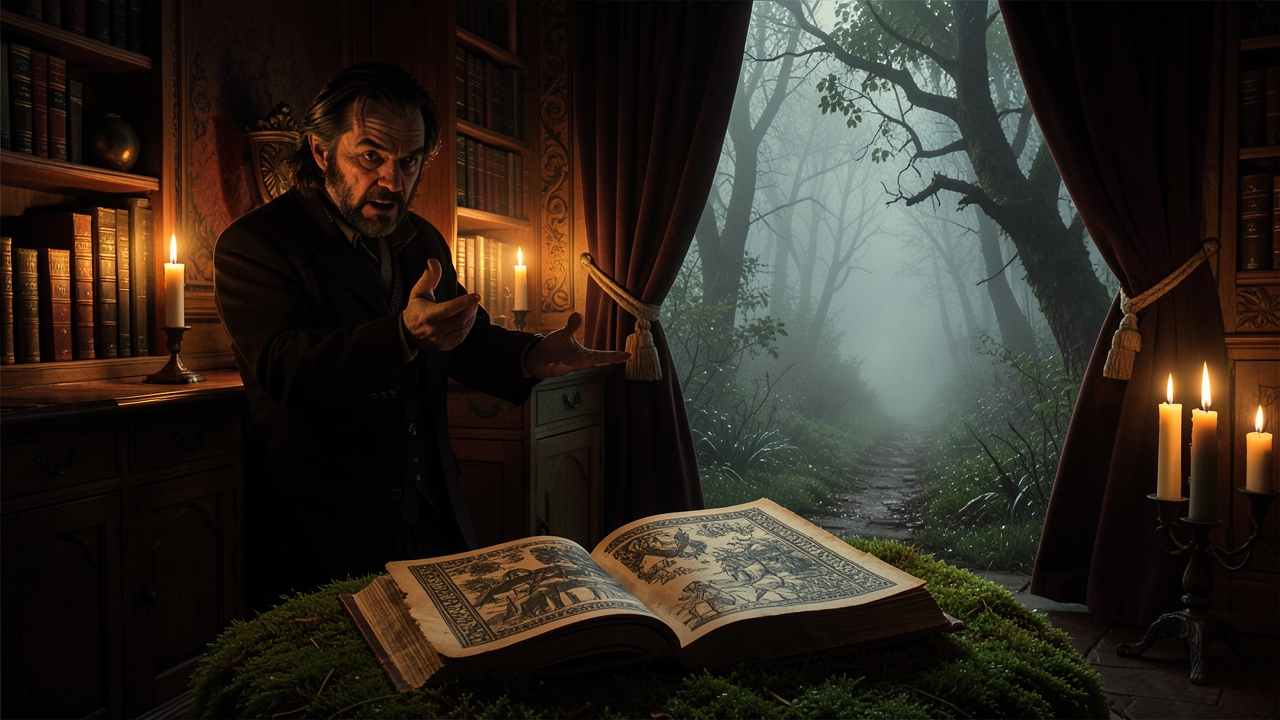
What does a villain do while the world holds its breath?
Not strike. Not yet. The blow waits. And in that waiting lives the whole architecture of dread.
Every writer of terror has felt the temptation to rush. The trap snaps. The door closes. The knife descends. Yet the masters understood something counterintuitive: violence arrives faster on the page than in the mind. It is the approach that haunts us. It is the pause that lingers.
This essay examines gothic villain monologues as a craft device — not as a trope to mock, but as a deliberate mechanism for delaying the inevitable. We will dissect how the speech slows time, then build a case study around a short original story that demonstrates the technique in action.
The Clock Inside the Sentence
Delayed violence is not inaction. It is a form of orchestration. The villain holds the room hostage while pretending to be charming, wounded, or merely conversational. Meanwhile, the reader counts.
Consider the mechanics. A monologue extends the interval between threat and consequence. Every additional sentence widens that interval. Consequently, the reader’s pulse accelerates even as the story’s action decelerates. This is the paradox that pacing in fiction ultimately serves — not speed, but pressure.
Poe knew this instinctively. In The Cask of Amontillado, Montresor lures Fortunato through the catacombs with wine, with flattery, with jokes. The wall is not yet built. The chains are not yet fastened. Every corridor descends a little further from safety, and every sentence delays the reckoning. Montresor even apologises for the cold. The courtesy is the horror.
As a result, the reader does not merely observe the trap. The reader walks into it beside the victim, and the slowness makes escape feel impossible. Speed would have ended the story in three paragraphs. Poe lets it breathe for a dozen.
Why Gothic Villain Monologues Delay the Act
There are four interlocking reasons the device works so powerfully in the gothic register.
1. The audience must understand what is coming
Without explanation, violence is noise. With it, violence becomes meaning. The monologue gives the blow its motive, its irony, its terrible logic. H.P. Lovecraft understood this in reverse: his narrators explain too much, and the excess of explanation becomes the dread itself.
2. Consent becomes a lie the reader watches unfold
The victim rarely knows. That gap between knowledge and doom is where suspense lives. Meanwhile, the villain fills the gap with language — charm as camouflage, reason as ritual.
3. The speech exposes the villain’s vanity
Monologues are acts of self-regard. The villain wants to be understood before being feared. This is what gives unreliable narration its edge. We trust the voice precisely because the voice wants to be trusted.
4. The reader’s imagination does the killing
What is described is bounded. What is merely anticipated is infinite. Shirley Jackson’s The Haunting of Hill House rarely shows its violence directly. It whispers, and the reader supplies the wound.
Therefore the great lesson emerges: the speech is not a delay of the story. It is the story. Everything after it is only consequence.
The Anatomy of the Delayed Blow
To write the device well, you must understand its moving parts. Here is the anatomy.
The Contract
First, establish the stakes. The reader must know that something irreversible is at hand. Without stakes, a monologue is merely talk.
The Interrupt
Next, give the victim a chance to leave, to speak, to flee. Let them almost go. The interruption that stops them is worth three pages of chase.
The Clock
Then place an object in the room that measures time: a candle burning low, a tide rising, a train arriving at nine. The reader glances at it between sentences. The monologue becomes a countdown.
The Turn
Finally, let the villain shift register. Charming becomes cold. Explaining becomes accusing. The voice changes, and the room changes with it. Daphne du Maurier excels at this in Rebecca and My Cousin Rachel — the moment the affection curdles into something else entirely.
Craft Techniques for Writing the Speech
Theory is useless without method. Apply these techniques to your next gothic scene.
Vary the sentence length
Long sentences lull. Short sentences jolt. Alternate between the two so the rhythm itself becomes a threat. Tana French does this masterfully in In the Woods, where the prose softens exactly when the horror is closest.
Give the villain a vocabulary of tenderness
The most chilling speeches are affectionate. The villain recalls your childhood, your favourite food, the name of your first dog. Cruelty disguised as intimacy is far worse than cruelty announced.
Use the environment as a witness
Let the house comment. Doors creak. Mirrors fog. The wallpaper darkens. The setting should behave like a second narrator, one that knows what is about to happen and cannot intervene. For more on this, study building gothic atmosphere without exposition.
End the speech at the wrong moment
Do not let the villain finish cleanly. Truncate. Cut mid-sentence. Then move forward in time, and let the aftermath do the work. A gap in the record is more frightening than any description.
Common Pitfalls in Writing Gothic Villain Monologues
Even skilled writers falter here. Avoid these traps.
The information dump. If the villain explains their entire plot in one go, you have written a summary, not a scene. Keep some motives withheld. Gillian Flynn withholds constantly; the withheld detail keeps us leaning forward.
The sympathetic villain overreach. Explanation does not excuse. If the monologue shifts the reader from fear to pity, you have changed the story. Do it only deliberately, and only to make the eventual violence more unbearable.
The stalled climax. If the delay becomes tedium, the reader will release the tension and never feel it again. Delay is a spring. Compress it long enough and it snaps — but not so long that it loses its force.
Meanwhile, avoid the exclamation-heavy cliché: the villain laughing in the dark, announcing their genius, then pausing for applause. Restraint is more menacing than spectacle.
The Contemporary Masters of the Delay
The technique is not confined to the nineteenth century. Modern writers have refined it into something cooler and more unsettling.
Angela Carter in The Bloody Chamber turns the fairy-tale villain’s speech into seduction and threat at once. Haruki Murakami lets his narrators talk past the danger, and the evasion itself becomes sinister. Jorge Luis Borges, in stories like The Garden of Forking Paths, makes explanation the trap. Even Silvia Moreno-Garcia’s Mexican Gothic weaponises the family’s polite conversation until politeness itself feels like a blade.
As a result, the device has migrated beyond gothic horror into thrillers, legal dramas, and literary fiction. The principle never changes: hold the blow. Make them earn it.
A Case Study: The Hour of Glass
Below is an original short scene demonstrating the techniques discussed — the contract, the interrupt, the clock, and the turn. Notice how the violence itself occupies almost none of the page.
“You should have eaten before you came,” said Dr. Vane, not looking up from the tray. “The tea is already cold.”
Elise stood in the doorway of the sanatorium’s east wing, her coat still buttoned, her gloves damp with the evening’s rain. Beyond her, the corridor lamps flickered in sequence, like a procession moving away from her. She did not remove her coat.
“I only wanted the records,” she said. “The ward ledger from the spring of 1911.”
“Ah.” Vane smiled, and the smile did not reach the parts of his face that mattered. He lifted the tray’s glass cover with two fingers, and beneath it lay not a pastry but a small brass key, polished until it seemed to glow. “You have always been precise, Elise. Your mother was precise. I admired it greatly.”
The grandfather clock in the corner struck half past eight. She counted. It was never wrong, that clock. Not once in the four years she had been coming here.
“Mother is dead,” she said.
“Yes,” said Vane, gently, as though agreeing about the weather. “Eleven years this November. I kept the notes. You would be surprised what I kept.”
He rose. He was smaller than she remembered, and that, somehow, frightened her more than the room did. He crossed to the window and drew the curtain, though nothing moved outside but rain and the long dark lawn. When he spoke again, his voice had changed — not louder, but nearer, as if he had stepped inside her ear.
“Do you know what the sea does to a body left long enough? It does not destroy it. It rearranges it. And a patient —” He paused, tasting the word. “— a patient is very like the sea. Very patient. Very long.”
The clock struck the quarter. Elise had not moved from the door. She understood, in that instant, that she had understood all along, and that understanding had never been the same as escape. Her hand found the latch behind her back. It was warm. That was wrong. It should have been cold.
“You should have told me,” Vane whispered. “I would have made it beautiful.”
The clock struck nine.
The corridor lamps went out, one after another, toward the front of the building — as if something had walked ahead of her, politely, holding the doors.
Notice what never happens on the page. The blow is never described. The reader supplies it, and the reader’s version is always worse. That is the engine of delayed violence.
What the Delay Teaches Us
A villain who strikes immediately is an obstacle. A villain who speaks is a presence. The monologue turns an event into a relationship, and relationships have histories — all of which the villain recites while the reader watches the victim make small, doomed decisions.
For deeper exploration of the tradition, the Poetry Foundation hosts essays on Poe’s influence on suspense, and Literary Hub has published extensive craft discussion on the modern thriller monologue.
Therefore, when you write your next confrontation, resist the urge to reach the knife. Let the villain explain. Let them be reasonable, wounded, parental, tender. Let the candle burn. Let the clock sound. And let your reader feel the exact distance between what they know and what they can do about it.
Because the deepest terror in any story is not that the villain will act.
It is that they might not. Not yet.
And we, breathless, remain in the room to hear why.