
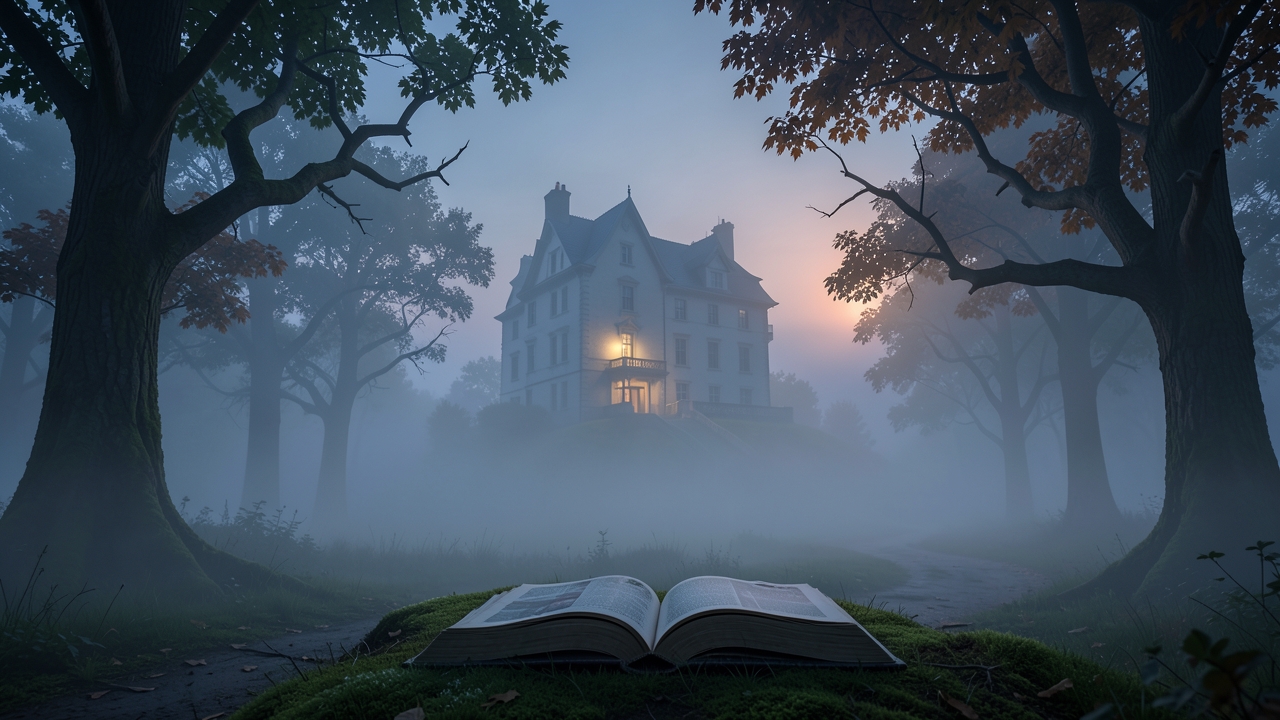
What if the ghost was never in the house at all? What if it was always in the woman who walked through the door? This Haunting of Hill House analysis argues that Shirley Jackson performed a quiet revolution in 1959. She moved the haunted house out of the parlor and into the psyche. More than six decades later, the walls of Hill House still refuse to tell us which of the two was truly screaming.
The result is a novel that behaves less like a ghost story and more like a trap. Jackson gives us every symptom of a supernatural haunting. She also gives us every symptom of a mind coming apart. She never resolves the tension. Consequently, each generation of readers re-opens the case with fresh certainty and fresh doubt.
The Haunted House Before Jackson: Spectacle and Inheritance
To understand what Jackson broke, we must first understand what she inherited. Before The Haunting of Hill House, the haunted house was largely an external affair. It was architecture, lineage, and debt. Ann Radcliffe and Wilkie Collins used old estates as engines of inheritance plots. Secrets lived in sealed cabinets. Ghosts served as legal clerks.
Antiquarian Ghosts and Cosmic Indifference
M.R. James perfected the antiquarian spectre. His hauntings arrive with provenance. A monk, a curse, a stolen relic. The horror is real, external, and knowable. Meanwhile, H.P. Lovecraft pushed the house toward cosmic scale. In “The Haunted Palace” tradition and beyond, the structure becomes a lens on indifferent universes. Yet even Lovecraft keeps the terror outside the skull, pressing against it.
One precursor deserves mention. Edgar Allan Poe’s “The Fall of the House of Usher” already braids building and bloodline. Roderick’s nerves and the mansion’s fissures rhyme. However, Poe still treats the collapse as spectacle. The house falls. The reader sees it fall. Jackson asks a crueler question: what if the house never moves at all? For more on building dread from masonry and mood, see our guide to gothic mystery writing craft.
A Haunting of Hill House Analysis of Jackson’s Interior Turn
The novel opens with a declaration disguised as natural history: “No live organism can continue for long to exist sanely under conditions of absolute reality.” Hill House itself, we are told, “stood then and might stand still for all the rest of its doors were shutters.” The house is not sane. But sanity, in this sentence, is an adjective applied to architecture by a human narrator. The Haunting of Hill House analysis that follows must therefore keep asking a simple question. Who is speaking, and how much do we believe them?
Three Readings, One Text
Jackson leaves three interpretive frames standing side by side. First, a literal haunting: cold spots, whispering, writing on the wall, a voice calling a name. Second, a psychological collapse: Eleanor Vance arrives at Hill House already fractured, already grieving, already outside every door she has ever knocked on. Third, a deliberate fusion, where the house and the woman confirm each other so perfectly that the distinction collapses.
Most writers pick one. Jackson refuses. As a result, the text becomes a hall of mirrors in which every clue supports its opposite. The famous final image, “silence lay steadily against the stone,” offers no verdict. It offers pressure.
The Anatomy of Eleanor’s Unraveling
Eleanor Vance is not a victim who discovers a haunted house. She is a haunted house who discovers a victim’s role. Her interior life is rendered with such intimacy that the external world begins to feel like a rumor. Jackson achieves this through craft, not confession. A careful Haunting of Hill House analysis notices that we are rarely told what happens. We are told what Eleanor decides it means.
Free Indirect Discourse: The Voice That Slips
Chief among Jackson’s instruments is free indirect discourse. The narration slips into Eleanor’s cadence without quotation marks or attribution. We do not read “Eleanor thought that the house was breathing.” We simply find ourselves inside a paragraph where houses breathe. The boundary between reported thought and reported fact dissolves.
This is the same machinery that powers the unreliable narrator in crime and gothic fiction alike. Yet Jackson’s version is subtler. Eleanor is not lying to us. She is narrating so sincerely that sincerity itself becomes suspect. The prose never signals the switch. Therefore, the reader supplies the alarm, and the reader arrives late.
Hedging the Senses: Seemed, As If, Almost
Jackson hedges her sensory verbs with surgical precision. Sounds are “like” something. Lights “might have been” moving. The famous cold spot is a place where the air “was cold.” Never is it a ghost. Always it is a temperature, a hesitation, a comparison. The supernatural arrives wearing the grammar of uncertainty.
This hedging does two jobs at once. It preserves plausible deniability for the skeptic. It also intensifies dread for the believer, because a hedged threat can never be measured and therefore never be escaped. Silence, in Jackson’s hands, is not empty. It is a substance that accumulates.
Motifs That Circle Rather Than Point
Notice how often Jackson’s images curve. Spiral staircases. The round library table. Eleanor’s fantasy of the cup of stars. The children’s song. Repetition replaces revelation. Instead of clues that advance a solution, we receive loops that deepen a mood. The narrative does not progress so much as tighten.
Meanwhile, the house’s geometry does the accusing. Hallways are “long” and then longer. Rooms are “cold” and then colder. Comparative adjectives without an absolute value create a world with no floor. Consequently, the reader loses footing at the same pace as Eleanor.
Common Pitfalls: What Jackson Refused to Do
The craft lesson here is partly negative. Jackson’s genius is defined as much by omission as by invention. Three refusals are worth studying.
She refuses to explain. No character delivers a monologue about the house’s history that resolves the horror. Backstory exists, but it never functions as a key. In contrast, many modern haunted house narratives front-load lore as if dread were a puzzle to be unpacked.
She refuses to resolve. The final pages offer a choice between interpretation and interpretation. Writers chasing the ambiguity of Jackson should read our essay on writing productive ambiguity, where withholding is treated as a structural decision rather than an evasive one.
She refuses to frighten first. Jackson earns the chill by earning the loneliness. The horror arrives as confirmation of an absence that was already there. Consequently, the scare survives rereading. Plot twists decay. Emptiness does not.
What the Rewiring Changed
Once the haunted house moved inside, the genre’s grammar changed with it. Tana French buries her mysteries in the interior weather of investigators. Gillian Flynn turns domestic space into a projection screen for self-deception. Silvia Moreno-Garcia loads Mexican Gothic with colonial history while keeping the dread lodged in the body. Even Haruki Murakami’s thresholds and Jorge Luis Borges’s labyrinths owe something to Jackson’s discovery that architecture is only ever a metaphor for mind.
Angela Carter pushed the method toward myth. Meanwhile, contemporary gothic writers treat the unreliable interior not as a gimmick but as the entire engine of suspense. For a broader view of the tradition Jackson reshaped, the Poetry Foundation’s profile of Shirley Jackson situates her within American letters.
The Room at the End of the Hall
Our Haunting of Hill House analysis turns now from theory to practice. What follows is an original tale built from the instruments discussed above: hedged sensation, free indirect slip, circling motifs, and a refusal to render a verdict.
Marthe arrived at Harker’s Reach in the hour when the sea forgets its own color. The house had been Ines’s for eleven months, and the landlord, when he finally opened the gate, said only that the estate was “settled” now. She did not ask what that word was doing in his mouth. She carried her suitcase up the salt-stiff steps and counted the doors along the hall. There were four. In the morning there would be five.
On the first night she heard the house breathe out. It was a long, level sound, like a chair drawn slowly across a floor, or like a pipe cooling in another room. The wind, she decided. The wind had been deciding things for her all week. She lay listening to the wind decide, and the ceiling above her was so white it seemed to be waiting for someone to write on it.
The mark appeared by the fourth morning. Something pale had been rubbed into the paper beside the door at the end of the hall, and it looked, if she tilted her head, almost like a word. She wiped it with her thumb. It came away on her skin and did not come away from the wall. By evening it was back, patient as a bruise, and it was no longer almost anything. It said COME BACK in a hand she recognized the way one recognizes a voice heard through water.
After that she spoke aloud. Not to the house, she told herself. She was simply the sort of person who now said things in rooms, the way Ines had been the sort of person who left them. Sometimes the answer came so near her ear that she felt the syllables rearrange the air. Sometimes she was certain she had asked the question herself and merely waited, politely, for her own reply.
On the seventh night she carried the lamp to the room at the end of the hall and sat down on the floor with her back to the door, because that was how you waited when you had finally stopped pretending you were leaving. The corridor held its breath around her. The silence lay steadily against the wood, warm now, almost like a shoulder. Marthe put out her hand, and the dark came to meet it, and she whispered the only honest word she had left.
Yes.
Notice what the tale withholds. It never confirms the fifth door. It never confirms the handwriting. It never confirms whether the whisper belonged to Ines, to the house, or to the narrator’s own guilt. The horror is generated entirely by grammar and gap.
Closing: The Echo in the Stone
We began with a question about ghosts. We end with a question about reading. Jackson understood that the deepest hauntings are not events but interpretations. The house never has to move if the mind will do it for her.
So what does this Haunting of Hill House analysis leave us with? A method, perhaps. Anchor the supernatural in the mundane. Hedge your senses. Let the narration slip into its subject’s pulse. Circle rather than point. And above all, trust the reader to stand in the corridor alone, waiting for a verdict you will never hand them.
If the walls of Hill House could speak, would they tell us anything we have not already confessed to ourselves?