
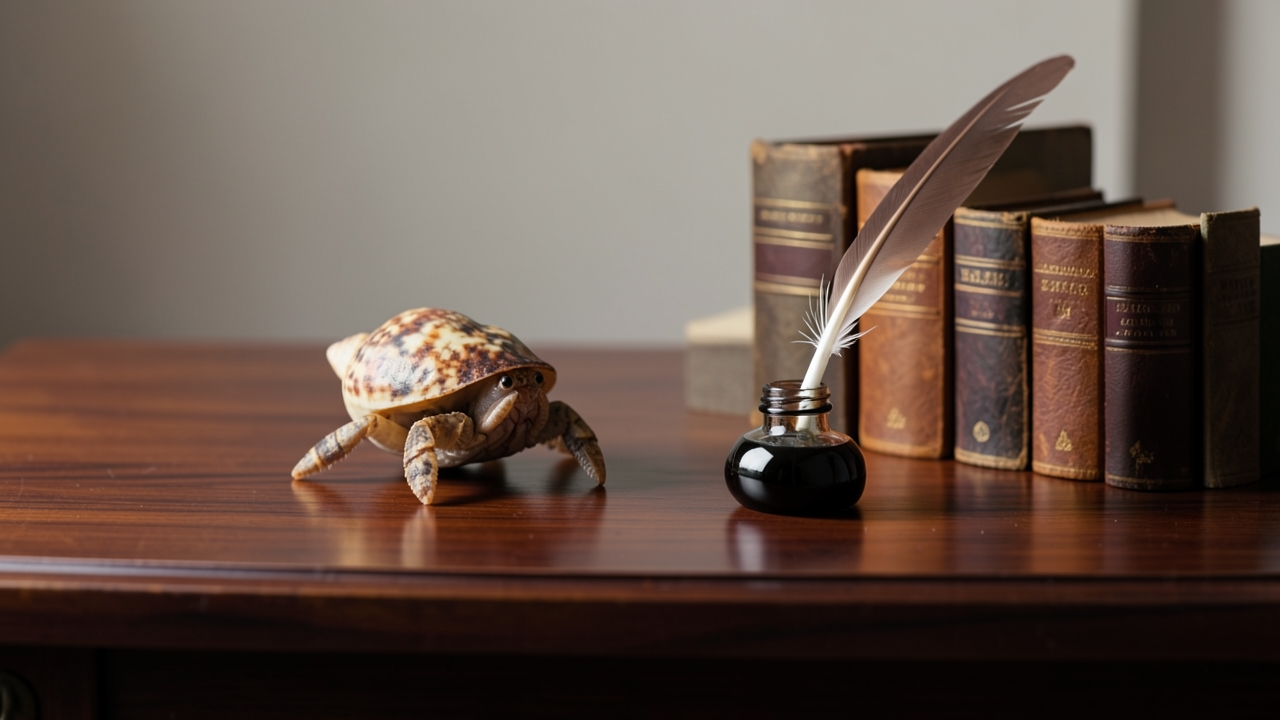
What if the truest confession hides not in the diary, but inside the rigid confines of a recipe? What if cultural critique emerges most potently not from a rant, but from the meticulous notes of a field guide? In the ever-evolving landscape of 2026, one literary form thrives by seeking shelter in another’s shell: the hermit crab essay form. This method of borrowing pre-existing structures to house deeply personal reflection creates a fascinating, and often unsettling, resonance. It asks us to consider how meaning shifts when contained within a foreign form.
The Theory: Anatomy of the Borrowed Shell
At its core, the hermit crab essay is an act of structural mimicry. The writer adopts a non-literary format—a menu, a user manual, a set of medical exam questions, a to-do list—and populates it with lyrical, personal, or critical content. The power lies in the tension between the shell’s expected function and the creature of thought that now inhabits it. For instance, a recipe’s instructions for “Folding in the Past” might detail how one incorporates a mother’s memory, with “bitter ingredients” and “long simmering” acting as metaphor. The form becomes a vehicle for meaning, not merely a container.
This technique forces a unique discipline. The constraints of the borrowed form—its syntax, its inherent logic—act as a creative crucible. As the poet and essayist Claudia Rankine has demonstrated, using the structure of a police report or a news broadcast can starkly illuminate the mechanics of racial violence, making the form itself an argument. The hermit crab writer, therefore, must master two crafts: the intimate art of reflection and the external architecture of the chosen form.
Why Borrow? The Alchemy of Displacement
The act of borrowing creates an essential displacement, a defamiliarization that jolts the reader out of conventional expectations. When we encounter a tender elegy formatted as a warranty claim for a “defective human heart,” the bureaucratic language heightens the emotional absurdity and pain. This is a trick the surrealists understood, and it echoes in the work of writers like Sheila Heti, who has woven questionnaire formats into philosophical inquiries about motherhood. The borrowed shell protects the fragile, vulnerable material inside, allowing the writer to approach difficult subjects obliquely, with the safety of a formal mask.
However, the hermit crab form is more than a mere conceit. When successful, the form and content fuse into a new, cohesive species of meaning. The structure doesn’t just hold the essay; it actively comments on it. A grief journal structured as a naturalist’s field guide for “The Avian Migration of a Beloved” uses the language of taxonomy to both categorize and resist the chaos of sorrow. The form becomes a coping mechanism, an attempt to apply order to the formless void of loss.
Crafting the Hermit Crab: Pitfalls and Precision
Mastery requires avoiding the most obvious pitfall: using the form as a shallow gimmick. If the borrowed shell feels arbitrary, disconnected from the content’s emotional core, the essay collapses into novelty. The connection must feel inevitable, not imposed. Ask: why this form? Does a to-do list aptly capture the overwhelming, fragmented nature of modern anxiety? Does a set of IKEA instructions ironically comment on the attempt to assemble a coherent self from scattered parts?
Consider the difference. A mere gimmick would be a grocery list of “ex-lovers” with checkboxes. A profound use of the hermit crab form might be an essay structured as a grocery receipt, where each item (“1 jar of silence, 2 lbs of unresolved conflict, 1 bunch of wilted apologies”) is followed by a subtotal of emotional cost, creating a devastating inventory of a relationship’s end. The form here doesn’t just list; it audits, calculates, and reveals.
Lessons from the Masters of Metamorphosis
\p>Angela Carter, a weaver of dark fairy tales, understood transformation at a cellular level. While not strictly an essayist, her method of using folkloric forms to critique patriarchal narratives is foundational. Similarly, the poet Charles Olson, in his essay “Projective Verse,” argued for a form dictated by the breath and the content’s energy—a principle the hermit crab essayist inverts by taking a form dictated by outside forces. Writers in 2026, navigating an age of information overload, find this method particularly potent. It allows them to curate the cacophony, using the familiar shapes of digital and bureaucratic life—the FAQ, the terms of service agreement, the playlist description—as vessels for timeless human questions.In conclusion, the hermit crab essay is an essay of layers. It demands that we read between the lines and also around them. It is a form for our time, mirroring how we ourselves adopt social media profiles, professional personas, and algorithmically suggested identities to navigate the world. To write in this form is to perform a small, elegant act of alchemy: to take the mundane shell of the everyday and, within it, nurture a pearl of startling literary meaning.
A Case Study: Field Notes on a Vanishing Dialect
Specimen: The Language of Grandfather.Habitat: A shrinking territory bounded by the porch swing and the kitchen table.
Field Notes: Observed usage includes the word “holler” not as a shout, but as a hollowed-out space of memory (“that’s a right holler of a story”). Phonetics are slow, vowels stretched like taffy. Primary threat: accelerated extinction due to the invasive species of standardized digital communication.
Collection Method: Passive listening. Recording on a cassette tape now considered an antique artifact. Note: Specimen becomes agitated when asked to define terms. Definition is a taxidermist’s art; this language is meant to live, to be heard.
Preservation Status: Critical. The last fluent speakers are retiring to silence. The habitat degrades daily. Without active intervention—a deliberate, reverent practice of speaking it, even to oneself—the dialect will pass into the silence of the archive, where it will be studied but no longer felt, like a pinned butterfly still beautiful but drained of flight.
This brief piece adopts the clinical, observational framework of a naturalist’s field guide. Yet, the subject is not a bird or a plant, but the intimate, fading language of a beloved relative. The scientific terminology (“specimen,” “habitat,” “invasive species”) creates a poignant distance, mirroring the speaker’s own helpless observation of loss. The form’s inherent urgency—preserving a species—infuses the personal grief with a larger, cultural weight. It transforms a private memory into a report on the extinction of a small, private world.
Therefore, the hermit crab essay form is not an escape from sincerity, but a unique pathway toward it. By borrowing the language of another discipline, we can often articulate emotional truths that direct confession cannot reach. It is a reminder that sometimes, to speak our own story most powerfully, we must first learn to listen to the echo of another, and find our voice vibrating within its ancient, resonant form.
For further exploration of experimental essay structures, consider reading about the evolution of essay genres or our analysis of how constraints fuel creativity, a principle Poe himself knew well. The Poetry Foundation also offers insight into the related concept in poetry.