
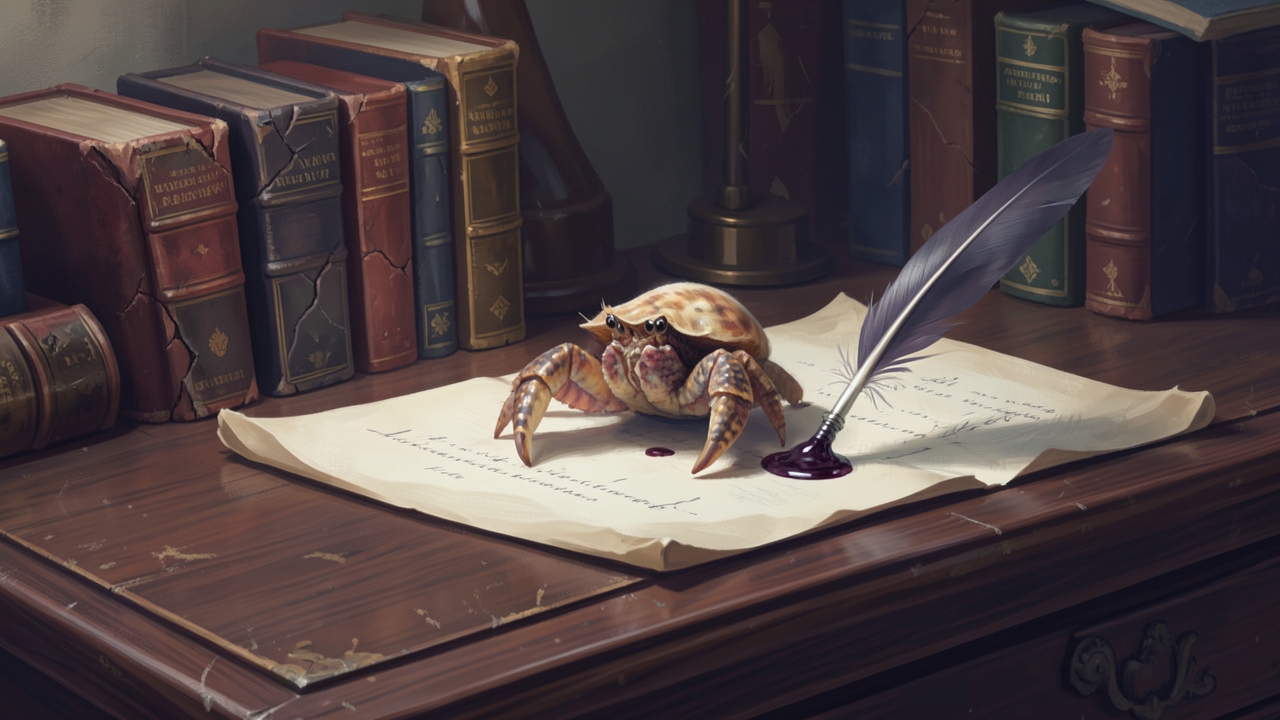
What if the most profound critique of a novel could be found not in a traditional essay, but in the sterile columns of an inventory ledger, or the clinical notes of a patient’s file? What if the truth of a story resides in its cracks, its absences, in the very shape of the document that failed to contain it? This is the haunting premise of the hermit crab essay technique, a form that borrows the shell of another document to house its own secret life.
This method is no mere gimmick. It is a masterclass in subtext and constraint, a way for the writer to analyze by indirection. We shall dissect this form, explore its anatomy, and learn how to wield it as a scalpel of critique, cutting to the heart of a narrative’s mystery.
The Anatomy of the Hermit Crab Essay
The hermit crab, that cunning crustacean, abandons its own calcified history for the borrowed spiral of a snail’s shell. Similarly, this essay form abandons the conventional introduction-thesis-conclusion architecture. Instead, it appropriates a pre-existing structure: a recipe, a field guide, a FAQ, a warranty, a to-do list. The borrowed form becomes a metaphor, a framing device that comments upon its own content.
Why Borrow a Form? The Power of Constraint
Constraint, paradoxically, breeds liberation. The poet using a sonnet’s strict iambic pentameter and rhyme scheme is forced into unexpected turns of phrase. Likewise, the hermit crab essayist, confined by the logic of an inventory list or a repair manual, must find profound connections within that rigid framework. This tension is where the magic ignites. As Jorge Luis Borges understood in his labyrinthine fictions, the true mystery often lies within a meticulously crafted system. A field guide entry on “The Unreliable Narrator” forces us to classify, to diagnose, to make clinical what is often a visceral, emotional experience of reading.
The form itself becomes an argument. To analyze Wuthering Heights through the lens of a Weather Advisory is to say something essential about the novel’s elemental, destructive passions. The borrowed shell is not neutral; it brings its own history, its own tone, which clashes and resonates with the subject matter, creating a rich, critical dissonance.
Crafting the Technique: A Writer’s Guide
To master the hermit crab essay technique is to become a curator of forms and a keen analyst of narrative essence. It requires a dual vision: seeing both the borrowed document and the literary subject with equal clarity.
1. Choosing the Right Shell
The chosen form must be more than a container; it must be a commentary. Daphne du Maurier’s Rebecca might inspire a series of anonymous “Housekeeping Directives for Manderley,” each directive revealing the creeping horror and the erasure of the second wife. A Gillian Flynn novel could be dissected through a series of “Social Media Profile Updates” from a character, exposing the performative nature of truth. The form must offer a conceptual hook.
2. Infusing the Content with Analysis
Here is where the essay becomes criticism. Every line must do double duty. In a “Repair Manual” for a character’s psyche, a step like “Inspect for hairline fractures originating from childhood trauma” is both a valid instruction in the manual’s world and a penetrating piece of literary analysis. Consider Shirley Jackson’s The Haunting of Hill House: its crumbling architecture is a perfect subject for a “Structural Integrity Report,” where every note on a weakened joist or a sinking foundation mirrors the psychological unraveling of the protagonists.
3. Mastering the Voice of the Borrowed Form
The voice must be authentic to the source document but twisted to serve your purpose. The dry, bureaucratic tone of a government form can make the horror it describes more chilling. The enthusiastic, sales-driven voice of a product manual can highlight the terrifying allure of a dangerous object or idea in a story. This tonal mimicry, when juxtaposed with dark literary content, creates a uniquely unsettling and insightful effect, much like the deadpan delivery in Poe’s “The Tell-Tale Heart,” where the sane voice describes the insane act.
Common Pitfalls in Hermit Crab Essays
The path is fraught with dangers. The most common is the failure of metaphor—the form and content feel disconnected, merely a quirky juxtaposition without deeper synergy. Another pitfall is sacrificing analysis for cleverness; the essay must illuminate the subject, not just showcase its own inventive format. Finally, writers must avoid the trap of the incomplete metamorphosis. The piece must fully commit to its borrowed form; any regression into traditional essay structure breaks the spell and undermines the technique’s power. It must feel like a complete, organic document from its invented world.
A Case Study: Field Guide to Narrative Unreliability
Specimen: First-Person Narrator, Variant “Confessional.” Common in psychological thrillers and Gothic romance. Habitat: Isolated manors, cramped apartments, therapy sessions.
Field Markings: Voice is often intimate, persuasive, and laced with self-justification. Note the frequent use of “I swear,” “Honestly,” and “You must believe me.” This is a key camouflage. Examine the narrative for temporal distortions—events are often reordered to control the observer’s emotional response. A crucial indicator is the selective omission of corroborating witnesses or objective records. The specimen may present vivid, sensory details about moments that support its thesis, while rendering traumatic or incriminating events in a blurred, impressionistic fog. Compare to the controlled, meticulous testimony of the specimen in Tana French’s In the Woods, where omissions speak louder than admissions.
Behavioral Notes: When confronted with contradictory evidence, the “Confessional” Variant may exhibit increased agitation or attempt to reframe the evidence as a misunderstanding. It may, as in the case of Poe’s narrator in “The Tell-Tale Heart,” become overly focused on a mundane sensory detail (the ticking of a watch, the beating of a heart) to distract from a larger logical inconsistency. Observe for signs of a fractured relationship with time—the past intrudes violently upon the present, often as a symptom of the specimen’s own unresolved guilt. This behavior is diagnostic of a narrator constructing a version of reality to survive.
Conservation Status: Endangered in literal narratives, but thriving and adaptable in literary fiction. Their continued existence is essential for understanding the fragile architecture of human perception. A reminder that the most unreliable narrator is often the one who claims, with perfect clarity, to be telling you the absolute truth.
The Echo in the Borrowed Shell
The hermit crab essay technique is ultimately an act of empathetic analysis. It forces us to crawl inside not just the story, but the very mechanisms by which stories are told and interpreted. By donning the mask of a clinical report, a personal ad, or a troubleshooting guide, we reveal truths that straight-faced criticism sometimes obscures. We find the haunting in the handbook, the terror in the terms and conditions.
It asks us to consider that form is never innocent, and that every document carries a ghostly echo of the truth it was designed to contain—or to conceal. When we next crack open a novel’s spine, will we find our analysis, like a hermit crab, seeking a new and more revealing home?
For further exploration of Gothic narrative structures, see our analysis of the unreliable narrator in modern fiction.