
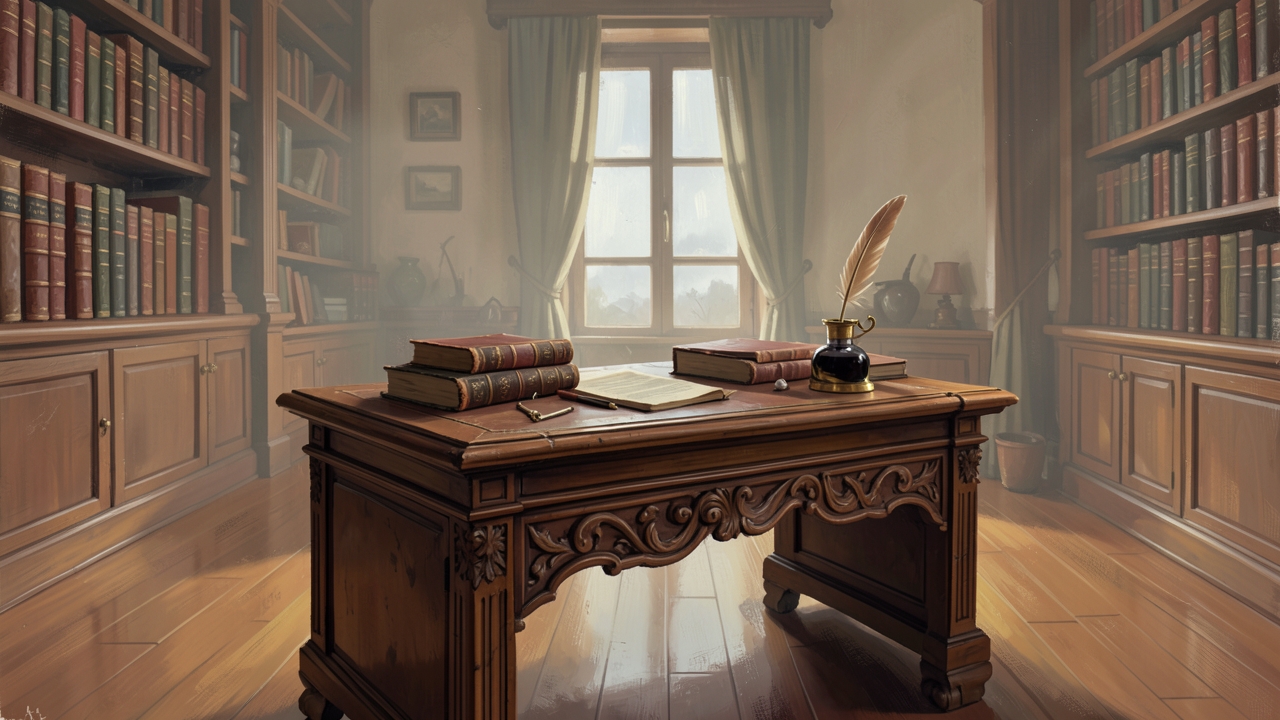
What if the truest shape of a city is not in its stone and mortar, but in the hollows between them? What if memory itself is less a vault of preserved things, and more a draft of absences, a palimpsest where the erased lines hold the most power? This is the unsettling, magnificent territory Italo Calvino charts in Invisible Cities, a work that is less a travelogue and more a ghostly cartography of the mind. Here, the concept of Italo Calvino negative space becomes the primary architectural material, a deliberate blueprint for absence that forces the reader to construct the city’s essence from its own imaginative void.
We, as readers, are conditioned to seek the solid—the described landmark, the named street, the narrated event. Calvino subverts this expectation with an almost gothic precision. He presents us with the blueprint and then, with a magician’s flourish, removes the walls, leaving only the suggestion of rooms in the chilling draft of their former presence. This technique is not mere minimalism; it is a profound philosophical and narrative strategy. It posits that imagination, when faced with a carefully curated emptiness, becomes more active, more haunted, and ultimately more certain of what it believes it sees.
The Blueprint of Absence: Calvino’s Narrative Omission
Calvino’s method is one of profound narrative omission. In his cities, key details are conspicuously absent. We learn of Isidora’s fountains, but not their sound. We hear of Laudomia’s unborn citizens, but not their faces. This is the first pillar of Italo Calvino negative space: the strategic withholding of sensory and concrete detail. The effect is twofold. First, it creates a sense of universal abstraction. The city is no longer a specific point on a map, but a concept—of desire, of memory, of loss—that can overlay any landscape in the reader’s mind. Second, and more importantly, it transforms the reader from a passive recipient into an active co-author.
Consider the gothic tradition of Edgar Allan Poe, where the most terrifying entity is often the unseen one, the thing lurking just beyond the candlelight’s feeble reach. In “The Fall of the House of Usher,” the horror is amplified by what is left to the imagination’s feverish painting. Calvino applies this principle not to horror, but to wonder and melancholy. The absence is not a void to be feared, but a canvas to be filled. As literary theorist Maria Teresa Chialant suggests, Calvino’s cities exist “in the interstices of language,” their reality residing in the gap between signifier and signified. The reader’s mind bridges that gap, and the city that rises is uniquely theirs, built from personal sediment.
Technique: The Fragmented Vignette
The structure of the book itself is an exercise in fragmentation. It is a mosaic of 55 short chapters, not a continuous narrative. Marco Polo describes these cities to Kublai Khan, but the descriptions are disjointed, poetic, and often contradictory. This fragmentation is another form of negative space. The connections between cities—thematic or otherwise—are not explicitly drawn. They exist as invisible threads in the reader’s own perception. This forces a non-linear, associative reading, mirroring the very way memory operates: not as a straight file, but as a web of disconnected, emotionally charged fragments that suddenly cohere. For example, the lesson from Tana French’s mysteries, where character and place are built through a mosaic of suggestive details rather than exhaustive description, finds its purest, most abstract form in Calvino’s work.
Common Pitfall: The Illusion of Emptiness
A common misinterpretation is to see Calvino’s negative space as mere emptiness or vagueness. This is a pitfall. His omissions are as precise as an architect’s beam. Every absence is measured. The negative space is not a lack, but a structural element with specific load-bearing properties. To attempt this technique oneself requires not laziness, but discipline. You must know what to leave out. Ask yourself: what is the essential emotional or conceptual core of this scene? Then, build the architecture around that core, using the reader’s expectation as the absent pillar. As Shirley Jackson demonstrated in “The Lottery,” the most unsettling normalcy is built upon a foundation of carefully unstated dread. The architecture is sound because the negative space is deliberate.
Memory as an Unfinished Architecture
At its heart, Invisible Cities is a meditation on memory. Calvino’s negative space is the perfect medium for this exploration because memory itself is an architecture of absence. We rarely remember an event in its entirety. Instead, we remember a sharp detail—the slant of light, a fragment of conversation, the feeling of a cold wind—while the surrounding context fades into a hazy, negative space. The mind then reconstructs the scene around these luminous fragments, often inaccurately, but always emotionally true.
Calvino’s cities map this very process. Zaira is “the city that, once in your lifetime, you must visit before death.” The description focuses not on its present reality, but on the “thread” of one’s own life embedded within its streets. The city is a negative mold into which one’s past and future are poured. This connects to the work of Jorge Luis Borges, whose labyrinths and libraries are vast, conceptual spaces defined as much by their impossible boundaries as by their contents. Calvino’s cities are personal Borgesian labyrinths, built from the shadowy materials of individual recollection and anticipation. The true “architecture” is the shape of the absence that the reader’s memory provides.
In this, Calvino achieves a unique synthesis. The cities are simultaneously concrete in their poetic description and utterly fluid in their mental reality. They are a haunting reminder that the places we hold most powerfully in our minds are perhaps the ones we remember least clearly, but feel most profoundly. The negative space is not an error in memory, but its very structure, a testament to the mind’s role as an architect of the invisible.
The City of Echoed Stones
The city she described to him had no name she could recall. It was a place built from the residue of a single, sustained silence. The towers were not stone, but the compressed weight of words left unspoken, their heights measured in the depth of held breaths. The plazas were shaped like cupped hands, designed to hold nothing but the memory of a touch. She spoke of streets that converged not at a fountain, but at a hollow square of air where, she insisted, one could feel the precise temperature of a forgotten afternoon.
“And the people?” the listener asked, his voice cutting the thick atmosphere of the tent.
She paused, tracing a pattern on the silk carpet. “The people are the spaces between the stones. They are the pause in a sentence, the glance that holds a whole history. You see their architecture everywhere: in the curve of a bench worn smooth by absence, in the gap in a tapestry where a figure was excised. To walk the city is to walk through the negative shapes they left behind. Their presence is defined entirely by the voids they create in the world.” She looked up, her eyes reflecting the guttering lamplight. “It is the most honest city. It admits that we are made more of what we have lost than of what we keep.”
The Haunting Legacy of the Unseen
We return, then, to the shadows and the silences. Italo Calvino’s narrative genius lies in his understanding that the most potent structures are those we build ourselves. His Italo Calvino negative space is a form of dark matter in the literary universe—unseen, yet its gravity shapes everything around it. It is a gothic inheritance, where the unseen room and the untold story hold more power than their revealed counterparts. He teaches us that in storytelling, as in memory, and perhaps in love, absence is not a lack to be mourned, but a fundamental element of the architecture.
The final, lingering question, therefore, is not whether these cities are real. It is whether any city, any memory, ever truly exists outside of the beautiful, terrible negative space we carve for it in our own minds. Are we not all, in the end, architects of our own invisible worlds?
For further reading on the architecture of narrative gaps, explore The Ghostly Gaps in Gothic Fiction. To delve deeper into poetic fragmentation, see our essay on Crafting the Unreliable Narrator.
For scholarly context on Calvino’s work, consult the Poetry Foundation.