
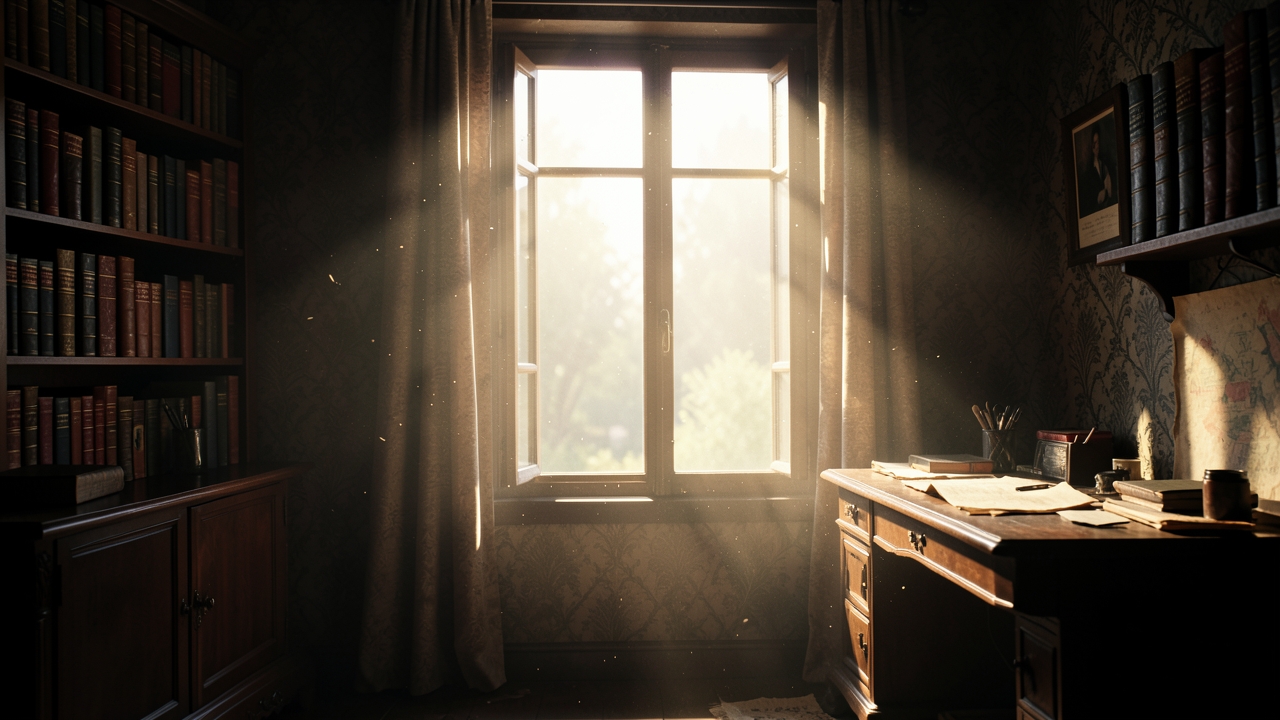
What if the most haunting tales are not those that sprawl across hundreds of pages, but those that whisper from the confines of a single, perfect paragraph? In an age of distraction, the art of concision becomes a radical act. The discipline of the micro-fiction writing prompt is not merely an exercise; it is a forge for the narrative soul, compelling us to distill atmosphere, character, and consequence into a luminous, fleeting shard of story.
The Architecture of a Haunting Prompt
A truly effective micro-fiction writing prompt does more than assign a topic. It erects a prison of beautiful constraints, forcing the writer’s imagination to work in magnificent, concentrated ways. Like the sealed chamber in Edgar Allan Poe’s “The Pit and the Pendulum,” the boundaries become the very engine of terror and invention.
Constraint as Catalyst
First, embrace the tyranny of the word count. Mandating a limit of 500 words or fewer immediately kills digression. For example, a prompt might demand a complete narrative arc—beginning, middle, end—in exactly six sentences. This forces ruthless prioritization. As Jorge Luis Borges demonstrated in his brief, labyrinthine tales like The Library of Babel, immense concepts can be housed in small spaces. The constraint becomes the catalyst for density.
Therefore, design prompts that pair a rigid form with a volatile theme. Challenge writers to tell a story of forbidden love using only dialogue. Ask for a ghost story where the ghost never speaks or appears. This friction between container and content is where sparks fly. It mirrors the technique Shirley Jackson used in “The Lottery,” where a placid, communal ritual conceals a horrifying truth, all within a deceptively simple structure.
Seeding the Uncanny
The most potent micro-fiction often thrives in the uncanny—the strangely familiar made wrong. Your prompts should plant such seeds. Instead of “write about a house,” prompt: “Describe a house that remembers its inhabitants better than they remember themselves.” This immediately invites psychological unease. H.P. Lovecraft built his dread not from monsters alone, but from the shattering of mundane reality. A good prompt destabilizes the writer’s, and the reader’s, sense of the normal.
In addition, incorporate elements of discovery. A prompt like “Begin with the last line of the story you will now write” inverts the traditional process. It forces the writer to construct a path to a predetermined, often enigmatic, destination. This technique is reminiscent of Tana French’s investigative narratives, where the end reframes everything that came before, but applied here to a miniature scale.
The Emotional Payload
Brevity demands emotional efficiency. The story must achieve resonance, not just completion. Craft prompts that target a specific, potent feeling: the chill of loneliness, the heat of a secret, the hollow echo of loss. Gillian Flynn excels at crafting visceral, compact emotional blows. A prompt might be: “In under 300 words, make the reader feel the precise moment a lifelong trust fractures.” This focuses the writer on impact over exposition.
Consequently, the most effective micro-fiction prompts often imply a larger, unseen world. They are the tip of a submerged iceberg. For instance, referencing the magical realist traditions of authors like Silvia Moreno-Garcia, you might prompt: “Write about a family heirloom that subtly alters reality for the one who polishes it.” The writer must hint at vast, unspoken rules, leaving the reader’s imagination to fill the shadows.
A Case Study: The Unwritten Note
The prompt: Write a story in which the entire narrative is contained within the act of a character reading a single, one-sentence note they find. The note must be quoted exactly. Word count: under 150.
He unfolded the brittle paper, found in the hollow of the antique music box she’d forbidden him to touch. Three words, in her familiar, spidery script, annihilated twenty years of memory. “It was always you.” The scent of lavender and decay rose from the box, and he finally understood why her portrait in the hallway, the one painted last, had eyes that didn’t just follow him—they were warning him.This example demonstrates several key principles. The constraint (one quoted sentence, 150 words) forces immediate immersion. The uncanny element is the living portrait and the music box’s scent. The emotional payload—a devastating revelation of lifelong deceit—is achieved not through explanation but through the character’s single, chilling realization. The story implies a vast, dark history, leaving the reader to unravel the threads of the “twenty years” and the true nature of the warning.
Forging Your Own Shadows
To design your own micro-fiction writing prompts in 2026, think like an alchemist. Combine two disparate elements: a mundane object and a cosmic fear, a historical period and a futuristic technology. Use constraints not as limitations, but as lenses that focus the light of your narrative into a burning point. Refer to the masters of brevity, like Lydia Davis or the flash fiction collections curated by Poetry Foundation, for inspiration on compression and impact.
Remember, the goal is not to write a miniature novel. It is to capture a moment so charged with story that it vibrates long after the words are read. It is to plant an image or a feeling that takes root and grows in the reader’s mind. The weekly practice of wrestling with these tiny, fierce narratives hones a writer’s instinct for what truly matters in any story: the emotional core, the sharp detail, the resonant ending.
Therefore, let your prompts be both map and mystery. They should point the way, but also leave vast regions of the tale in evocative darkness. In that darkness, the reader—and the writer—will find the truest shadows of the tale, for a story is often most alive in what it leaves unsaid. After all, is not the most terrifying whisper always the one that leaves the meaning for you to discover?