
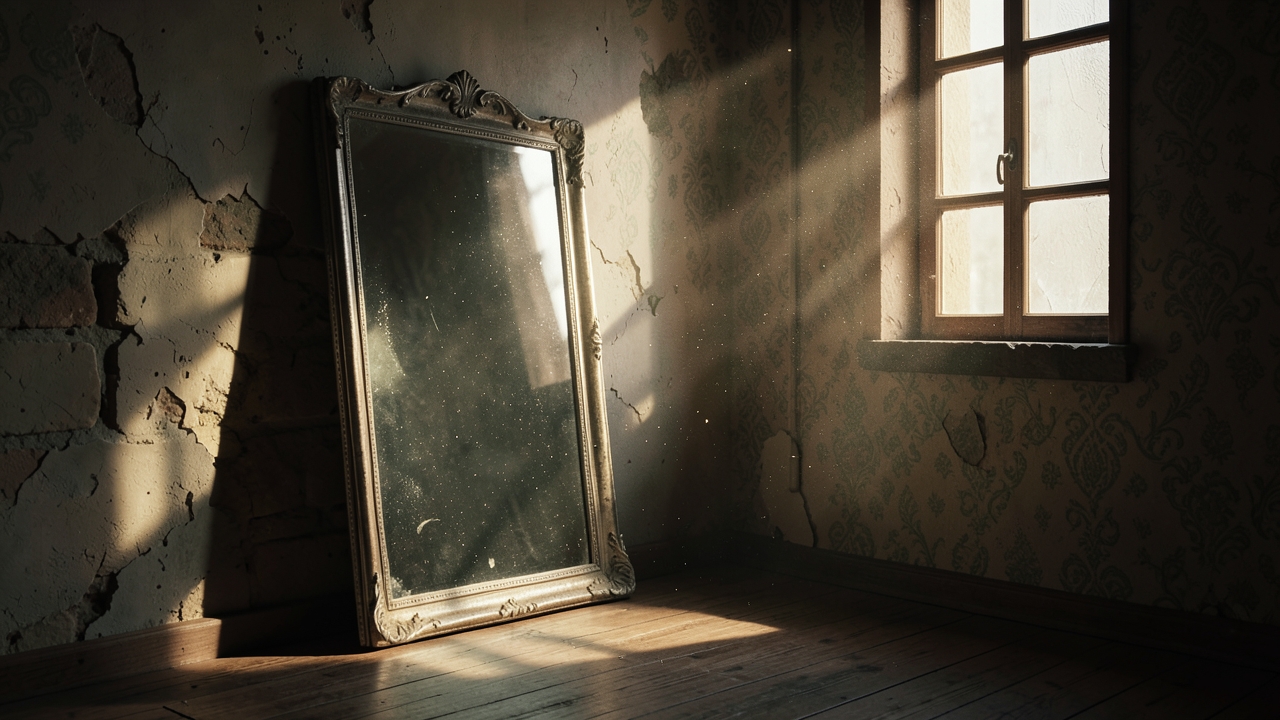
What if the glass answered back? This week’s mirror writing prompt begins with that single, uncomfortable question — and then refuses to let it go.
There is a particular hush that settles after a lie is spoken aloud in an empty room. Not silence, exactly. Something denser. The air seems to lean in, waiting to see whether you will repeat yourself.
That hush is where your scene lives. Step into it.
The Mirror Writing Prompt: An Invitation into the Uncanny
The premise is almost insultingly simple. A character stands before a mirror. They speak a lie. The mirror replies.
The trap is just as simple: make the mirror a wizard, and the story dies in your hands.
Because this is not a story about enchanted glass. It is a story about self-deception that happens to have a witness. The mirror is not a magical object. It is the oldest, cheapest, most merciless audience a human being will ever have.
It has watched every rehearsal of every version of you.

Therefore, the craft question is never “How does the mirror speak?” It is “What does the character need the mirror not to say?”
The Anatomy of the Talking Mirror
Before you write a line of dialogue, decide what the glass actually is. Three viable answers exist, and only three.
First, the mirror may be a projection — the character’s conscience given just enough voice to be unbearable. Second, it may be a genuine other, something patient and cold waiting behind the silver. Third, and most unsettling, it may be impossible to tell which is true.
That third option is almost always the richest. Ambiguity is not a failure of nerve. It is the engine.
The Lie Must Cost Something
A lie told to a mirror is a confession wearing a mask. The character is not performing for an audience they can deceive. They are performing for the one witness who already knows.
Consider Gillian Flynn’s Gone Girl. Amy’s diary is a lie told in the first person, and the novel’s horror arrives when the reader realises the diary was always a character, never a narrator.
Flynn never needed a talking mirror. She simply let a voice lie to itself. Your scene should do that work in miniature.
Choose a lie the character needs to believe, not merely one they need others to accept. A lie told for survival is thin. A lie told for comfort is a wound.
The Answer Must Be Smaller Than the Question
Amateur mirror fiction fails because the glass talks too much. It explains, warns, prophesies, moralises. It becomes a fortune-teller with a thesaurus.
H.P. Lovecraft understood the alternative. In The Outsider, the narrator’s horror arrives in one devastating