
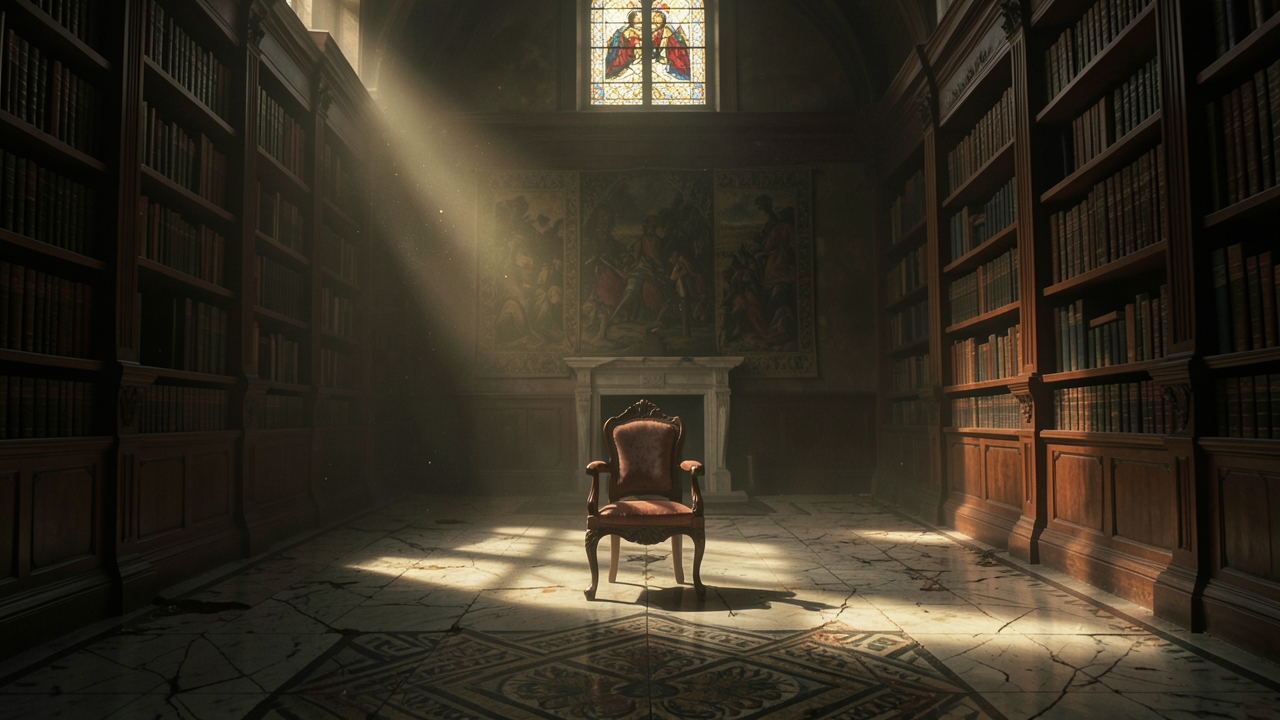
What is more terrifying than a whisper that cuts off mid-word, a door left ajar to a room we cannot see, or a silence that follows a scream? In the shadowed corridors of literature, the most profound dread often arises not from what is revealed, but from what is meticulously, deliberately withheld. This is the core of modernist narrative gaps, an architectural technique where authors build haunting psychological landscapes from emptiness itself.
The Theory of the Void: Crafting Meaningful Emptiness
To master the narrative gap is to understand that silence can speak louder than any monologue. It is an active, potent form of storytelling. For instance, Virginia Woolf does not merely describe a dinner party; she describes the fleeting thoughts that evaporate between sentences, the entire emotional history implied in a character’s pause before speaking. This technique forces the reader to become a detective, a psychic archaeologist, piecing together the story from the shards of what is unsaid.
The Fractured Timeline and the Unsaid
Woolf, a master of the stream of consciousness, often uses temporal gaps to mirror the disjointed nature of memory. In To the Lighthouse, the celebrated central section, “Time Passes,” is a profound narrative gap in itself. Years elapse in a few pages. Characters die in bracketed asides: “[Mr. Ramsay, stumbling along a passage one dark morning, stretched his arms out, but Mrs. Ramsay having died rather suddenly the night before, his arms, though stretched out, remained empty.]”
Consequently, the emptiness of the house after these events carries more emotional weight than any detailed account of grief could. The physical void of the abandoned rooms becomes a cathedral of loss. Here, the narrative gap is not a lack, but a vessel for overwhelming, accumulated sorrow. As unreliable narration often hinges on omission, so too does the fragmented chronology of modernism force a confrontation with the abyss of time.
The Hemingway Iceberg and the Weight of Silence
Ernest Hemingway famously posited his iceberg theory: the dignity of movement of an iceberg is due to only one-eighth of it being above water. A writer who omits things because he does not know them only makes hollow places in his writing. Therefore, the most potent narrative gaps are those built upon a foundation of deep, unstated knowledge. In “Hills Like White Elephants,” the entire agonizing decision about an abortion is never named. It lives solely in the charged dialogue, the descriptions of the landscape, and the deafening pauses between the couple’s words.
The physical setting itself—a dry, barren side of the valley versus a fertile, green side—becomes a metaphorical map of their irresolvable conflict. The actual subject is a void at the center of the conversation, and its gravitational pull threatens to collapse their relationship. This is the mastery of modernist narrative gaps: the most significant event is the one that never takes place on the page. In contrast, a more traditional narrative might have explored the argument explicitly, thereby diminishing its haunting power. For more on creating this kind of psychological pressure, consider our guide on crafting tension in gothic mystery.
Common Pitfalls: The Empty Void vs. The Full Void
However, a significant pitfall awaits the aspiring writer: the empty void. A narrative gap cannot be mere laziness or confusion. It must be a sculpted absence, filled with the pressure of what is withheld. As literary critic David Orr has written about poetry, the effective use of white space is deliberate. In fiction, every omitted scene, every skipped year, every unnamed emotion must resonate. It must make the reader lean forward, straining to hear the whisper in the silence. If the gap feels accidental, the architecture collapses, leaving only a plot hole where a haunting should be.
Furthermore, modernist authors like Woolf and Hemingway use these gaps to mirror their characters’ internal landscapes. A fragmented memory, a repressed trauma, an inarticulate longing—these are all internal narrative gaps. By externalizing them in the structure of the novel itself—in the setting’s emptiness, in the dialogue’s omissions, in the timeline’s fractures—the author creates a profound unity between form and psychological content. The reader doesn’t just learn about the character’s inner void; they experience it structurally.
A Case Study: The Echo in Room 404
Let us then examine a brief original tale, one that attempts to weave these threads of absence into a tapestry of quiet dread.
The hotel registry showed Room 404 had not been occupied in three years. Yet, the housekeeper insisted the ice machine on the fourth floor always needed emptying. Elias, an architect tasked with the building’s renovation, noted this. He stood in the center of the room, a perfect square of silence. The carpet bore no indentations, the windows were shut with desert-like dust, the air was still as a held breath. It was a void.
On his drafting table later, he did not draw the room. Instead, he drew its absence: a void in the floor plan, bordered by the busy geometries of occupied spaces. He sketched the silence between the pipes, the stillness in the walls. That night, he dreamt not of the room, but of a constant, soft draining, as if all sound, all light, all substance was being siphoned from the world toward that single, square point of nothingness. He woke with the phantom sensation of being hollowed out.
He returned the next day. This time, he brought no tools. He simply sat on the bare floor, within the frame of the empty doorway. He listened to the profound absence. It was not merely quiet. It was a positive entity, a pressure against his eardrums, a weight in his lungs. The narrative of the room, he realized, was not in the history of its guests, but in its relentless refusal to have one. Its story was its own void. As dusk bled through the window, he understood the housekeeper’s mistake. The room didn’t need emptying. It was, itself, a perpetual act of emptying.
When the renovation plans were finally filed, Room 404 was marked not as a suite to be restored, but as a structural void to be preserved. A square of absence in the blueprint. Elias’s final note read: “Some spaces are not meant to be filled. Their purpose is the echo.”
The Lingering Question
We began with the terror of the unsaid. We end in the resonant silence of the preserved void. The genius of modernist narrative gaps lies in this alchemical process: transforming absence into presence, silence into a scream, and an empty space into the most haunted room in literature. By mastering the architecture of what is not there, you do not merely tell a story. You conjure its ghost. So, when you next approach the blank page, ask yourself: what will you have the courage to leave out?