
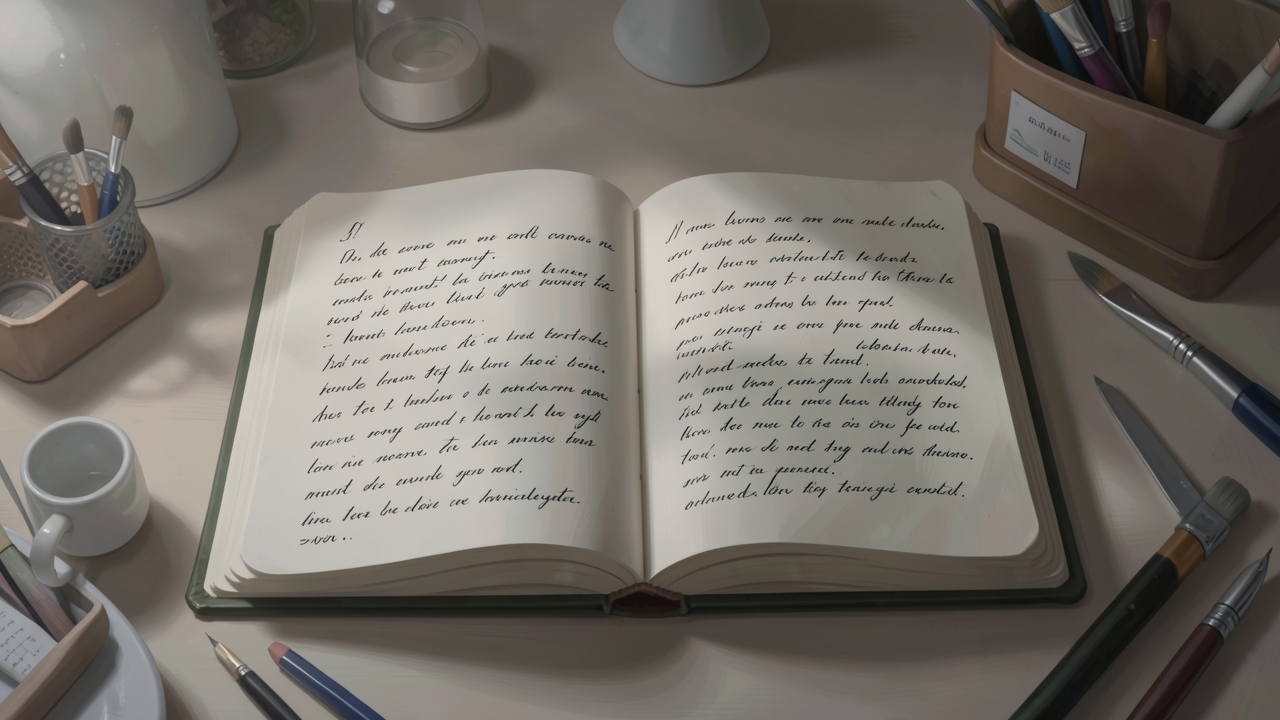
What if the character you cannot explain is the one your reader will never forget? Negative capability writing begins with that uncomfortable wager. It asks you to leave a motive unnamed and trust the shadow to do its work.
Every draft has a margin crowded with explanations. A character slams a door, and the writer hurries after her with a paragraph of reasons. The reader nods, understands, and quietly stops wondering. Something in the story goes flat, like a room with the candle blown out.
This essay argues for the opposite discipline. It draws on John Keats, on Poe and du Maurier, on Jackson and Ishiguro, and on a small story of my own. Above all, it argues that unanswered characters are not unfinished characters. They are, quite often, the only ones who breathe.
What Keats Meant by Negative Capability
In December 1817, John Keats wrote to his brothers George and Thomas with a phrase that has haunted writing rooms ever since. He praised what he called Negative Capability: the state in which a person is “capable of being in uncertainties, Mysteries, doubts, without any irritable reaching after fact & reason.” The Poetry Foundation preserves the letter and the life behind it.
Keats was describing a temperament, not a technique. Nevertheless, the phrase translates into craft almost perfectly. He admired Shakespeare for exactly this quality. Shakespeare never steps forward to explain why Hamlet delays. He simply lets the delay stand, dreadful and luminous, for four hundred years.
Notice what negative capability is not. It is not vagueness, and it is not evasion. It is a discipline of restraint practiced by a writer who knows the answer and chooses silence. The knowledge is the foundation. Without it, ambiguity collapses into fog.
Negative Capability Writing: The Case Against Explanation
Most first drafts over-explain. The habit is generous, even affectionate. We love our characters, so we defend them. We fear the reader will misread, so we annotate. Therefore we smother the very mystery that made the character worth writing.
The Irritable Reaching After Fact
Consider the sentence that follows an action like a nervous attendant. She tore the letter in half. She had never trusted men since her father left. The second sentence is the irritable reaching. It converts a gesture into a diagnosis.
Poe understood this better than almost anyone. In “The Cask of Amontillado,” Montresor opens with the famous line about a thousand injuries borne as best he could. He never names one. He never describes the insult. Consequently, the story’s horror lives entirely in that gap.
Imagine Poe adding a paragraph of motive. A lawsuit over a vintage, perhaps, or a slight at a masked ball. The tale would shrink into a case file. Instead, we are left with a man bricking up a friend for reasons he refuses to disclose, and we never recover.
Why Readers Distrust the Explanation
Explanation converts mystery into information. Information can be filed away. Mystery must be carried. A reader who carries a question into the following day becomes a reader who recommends the book.
Meanwhile, an over-explained character reads as a managed character. We sense the author’s hand at the back of the neck, steering. The illusion of autonomy fractures. In contrast, a character who withholds something seems to possess a private life beyond the page. For a deeper look at this effect, see our essay on unreliable narrators.
The Anatomy of a Character Who Withholds
Withholding is a behavior, not a mood. It requires construction. The writer must build a person whose silences have shape, weight, and consequence.
Motivation as Shadow, Not Blueprint
Daphne du Maurier’s Rebecca works because its central figure never speaks. Rebecca exists only in the testimony of others. Maxim is tight-lipped, Mrs. Danvers is worshipful, and the narrator is unnamed. As a result, the dead woman is assembled from contradiction.
The lesson is practical. Let other characters describe your opaque figure, and let their descriptions disagree. A blueprint explains a house. A shadow suggests one, and the reader’s mind supplies the architecture.
Dialogue That Refuses to Testify
Haruki Murakami’s characters often answer a question by addressing a different one. In The Wind-Up Bird Chronicle, conversations drift toward wells, weather, and cats while the actual question hangs untouched. The evasion is not random. It is character.
Kazuo Ishiguro perfects the technique in The Remains of the Day. Stevens never lies outright. He simply reports the wrong things with exquisite precision. His dignity is the veil, and the reader sees through it while he cannot.
Try this in revision. Write the honest answer your character would give if truth cost nothing. Then delete it. In its place, have the character respond to an adjacent question, warmly and at length. The reader will feel the missing answer like a draught under a door. Our guide to subtext in dialogue explores this further.
The Unresolved Gesture
Shirley Jackson’s The Haunting of Hill House never settles whether Eleanor is haunted or haunting. Instead of a verdict, Jackson gives us physical detail. A hand held in the dark. A door that will not stay open. The ambiguity is anchored in the body, not in commentary.
Therefore, replace psychological summary with a gesture that does not complete itself. A thumb worrying a key. A sentence abandoned halfway. A lamp left burning in an empty room. These are evidence without interpretation, and the reader becomes the interpreter.
Crafting Productive Ambiguity in a Scene
Ambiguity becomes productive when the reader knows a question exists and can find support for more than one answer. Confusion, by contrast, occurs when no question has been planted and no evidence gathered.
Plant the Question, Then Withhold the Answer
Someone must ask. A neighbor, a detective, a child. The question marks the space where the answer would go, and the reader begins to excavate. Without that marker, silence reads as omission rather than design.
Tana French does this relentlessly in In the Woods. The narrator’s childhood trauma is named, circled, and approached. She lets the case close without closing the wound. Consequently, readers argue about the ending years later, which is precisely the point.
Give Evidence, Withhold the Verdict
Gillian Flynn’s Gone Girl hands us two irreconcilable accounts and refuses to referee. Each version arrives with detail, texture, and self-interest. The reader must weigh, suspect, and choose. That labor is the pleasure.
Angela Carter works the same magic in The Bloody Chamber. Her imagery is lavish and exact; her morals remain unsafe. Borges, in The Garden of Forking Paths, offers a labyrinth of documents and lets contradiction stand as the only truth.
Draft the Answer, Then Bury It
Write the private biography. Know what the character did, why she left, whom she buried. Then place that page in a drawer. It will not appear in the story, but its gravity will bend every line you write.
Here is a short revision checklist I keep above the desk.
- Cut any sentence that explains a behavior already shown.
- Ensure every withheld fact has been noticed by someone in the scene.
- Replace one paragraph of motive with one object the character refuses to discuss.
- Check that the silence stays consistent across every draft.
Common Pitfalls of Ambiguous Characters
- Confusion mistaken for mystery. If the reader never learns a question exists, the silence reads as a hole, not a secret.
- Ambiguity as alibi. Some writers withhold because they have not decided. Readers feel the difference immediately.
- The Lovecraft trap. Lovecraft often drowns dread in adjectives, naming the unnameable until it becomes furniture. Dread weakens when it is catalogued.
- Inconsistent silence. A withholding character must withhold in the same direction every time. Random gaps feel like errors.
- Atmosphere without evidence. Silvia Moreno-Garcia’s Mexican Gothic keeps its sensory detail sharp, which is why its uncertainty holds. Fog alone will not sustain a chapter.
For further reading on sustaining dread without overstatement, Literary Hub publishes excellent craft essays on restraint and omission. Pair those with our notes on gothic atmosphere for a fuller picture.
A Case Study: The Second Key
Mrs. Alder kept two keys to the rooms above the shop. She gave me one, and she kept the other on a brass ring at her belt, and she never once explained why a rented room required a lock I was not allowed to turn. I did not ask. That was October.
She answered questions at an angle. When I asked whether the last tenant had left in a hurry, she said the wallpaper in the back room was newer than it looked. When I asked whether he had owed her money, she said he had paid through March. Then she wiped the counter, though the counter was clean.
The room itself offered evidence and no verdict. A tin of buttons on the windowsill, every button cut from its thread. A lamp with oil still in it. A coat on the hook, good wool, one sleeve worn thin at the elbow, and in the pocket a rent ledger with a single