
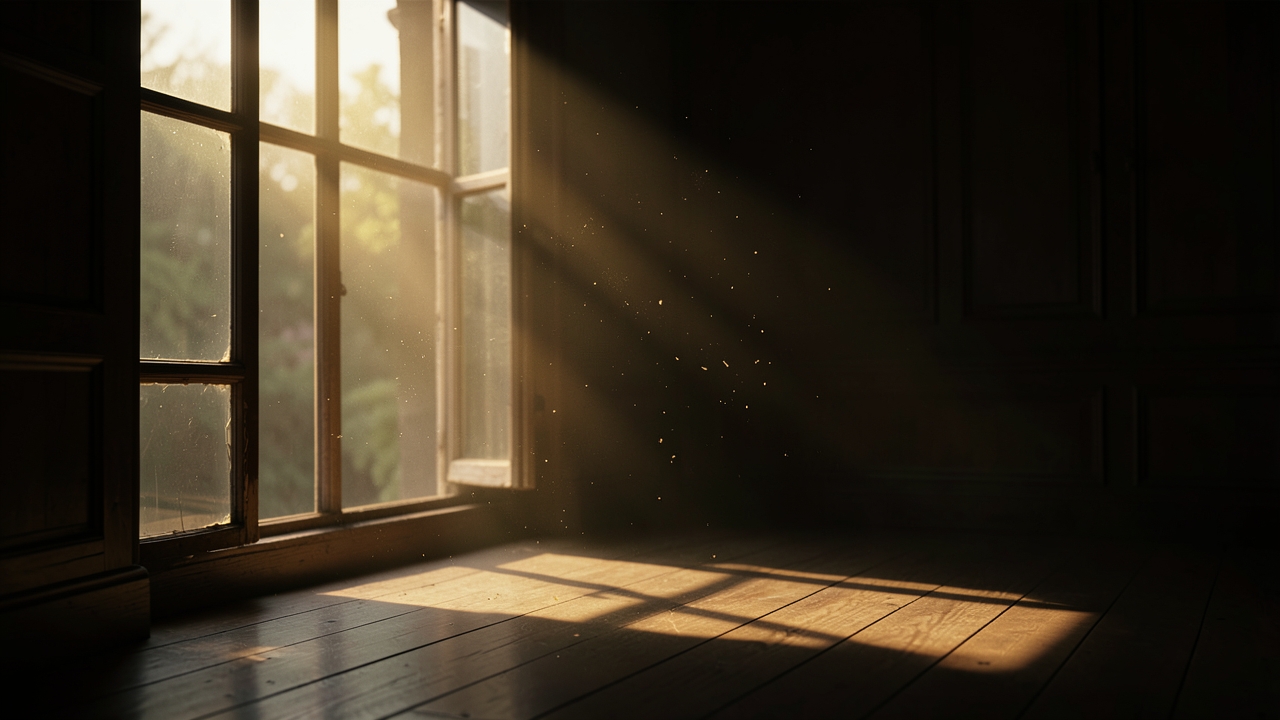
What, precisely, do you remember of yesterday’s dusk? Not the fact of it, not the clock’s arithmetic, but the colour of the light along the floorboards, the sentence someone spoke, the exact moment the room surrendered to dark. Most of us cannot say. The mind edits as it files, and what survives is less a record than a rumour. That quiet treason of recollection is the soil from which the unreliable memory writing prompt grows.
This week we ask you to write into that fog deliberately. Build a scene your narrator cannot fully retrieve. Let the gaps do the haunting.
The Anatomy of an Unreliable Memory
Memory is not a filing cabinet. It is a firelit room where someone keeps rearranging the furniture while you sleep. Every act of recall is also an act of reconstruction. Consequently, the narrator who remembers everything perfectly is always slightly false, and readers sense it immediately.
The prompt therefore asks you to build a scene the way the mind actually builds one. Choose a moment of crisis — a death, a betrayal, a disappearance, a fire. Then let your narrator recount it through frayed and contradicting testimony.
Why Gaps Frighten Us More Than Lies
A liar controls the story. A forgotten one does not. That is the source of the form’s peculiar dread.
When a narrator lies, the reader hunts for the truth behind the veil. When a narrator forgets, there is no truth behind the veil — only more veil. Edgar Allan Poe understood this before anyone thought to name the device. In Ligeia, his narrator drifts through opium and grief, never certain whether the woman he buries is the woman who returns. His account hovers rather than confirms.
H.P. Lovecraft pushed the device toward horror in The Rats in the Walls, where inherited memory surfaces like something drowned. That narrator does not merely forget. Something inside him remembers on his behalf. In addition, Daphne du Maurier opens Rebecca with a dream of a house already lost, and the entire novel becomes a reconstruction by a woman who admits her account is imperfect.
These writers share a single instinct. They let the gap perform the work of the ghost.
The Craft of Contradiction
Contradiction is the heartbeat of the form, yet it must be measured. Random inconsistency reads as carelessness. Patterned inconsistency reads as a mind at war with itself.
Consider Gillian Flynn’s Gone Girl, in which two competing diaries fight for authority. Or Tana French’s In the Woods, where a detective investigates a killing while refusing to investigate his own vanished childhood. In both, the contradiction is not in the facts. It lives in the narrator’s insistence that everything is fine.
Here is a technique you can use tonight. Have your narrator describe one object, then describe it again three paragraphs later with a single change. The dress was ivory; no, it was grey. The door was locked; he is certain it was locked, though he never touched the handle. The reader will feel the ground shift without ever being told to look down.
For a deeper survey of how ambiguity operates at the sentence level, Literary Hub’s essays on narrative craft reward slow reading. Study how skilled essayists revise a claim without announcing the revision.
Sensory Anchors in the Fog
Fragmented narration collapses if everything dissolves. You need anchors — hard, specific, physical details the narrator cannot distort.
A smell. A scar. The cold weight of a brass key. Shirley Jackson builds The Haunting of Hill House on architecture so exact that the house becomes a character; the horror arrives because the walls are certain. Meanwhile, the people inside them are not.
Therefore, give your narrator two or three immovable facts. Let everything else rot around them. The contrast produces the sensation of truth encircled by fog, and that sensation is the whole effect.
Silvia Moreno-Garcia uses the same principle in Mexican Gothic, where wallpaper, mould, and a particular shade of green remain vivid while the heroine’s sense of time quietly disintegrates. The room is reliable. The witness is not.
Common Pitfalls of Fragmented Narration
The first pitfall is vagueness for its own sake. A narrator who remembers nothing is not mysterious; he is empty. Ambiguity must be populated, never evacuated.
The second is the amnesia gimmick. A blow to the head erases the plot, and the reader loses agency along with the character. The better version keeps the memory present but poisoned — intact in outline, corrupted in detail.
The third is withholding for the sake of a twist. If the narrator knows the truth and merely refuses to share it, you are writing suspense rather than unreliable memory. In contrast, a narrator who genuinely cannot retrieve the truth generates a stranger anxiety. The reader is not waiting for a reveal. The reader is wandering.
Finally, resist the tidy explanation. If a therapist arrives in the last scene to name the repression, the fog clears and the story flattens into diagnosis. Leave one detail unexplained. Let it follow the reader out of the room and stand behind them on the stairs.
The Unreliable Memory Writing Prompt: Five Constraints
Here is the prompt itself, refined into five constraints. Write six hundred words. Obey every rule, even where it hurts.
1. Begin in the middle of a second attempt
Do not start at the event. Start at the retelling. Your narrator has told this story before and is telling it again, differently, perhaps to a stranger who was not there.
2. Include one contradiction you never resolve
Two versions of the same hour. The narrator notices the discrepancy, pauses, and moves on. You move on with him. No footnote, no apology.
3. Anchor the scene with a single physical object
Choose something small enough to hold. A photograph, a matchbook, a cufflink, a key. Let it appear three times, and let it change once.
4. Break the timeline without warning
Once, mid-sentence, slip from past tense into present. Let the narrator catch himself in the act. For example: I picked up the receiver — I am picking up the receiver, and my hand is shaking, and — no. That came later. That came after.
5. End before the memory resolves
Close on the blurred edge. Not the answer, but the shape of the answer, the way a lamp leaves a shape on a wall after it is turned down.
If you want to sharpen the atmosphere surrounding this exercise, our guide to building gothic atmosphere from a single object pairs well with it. You may also draw on our archive of weekly short story prompts to keep the discipline sharp between drafts. Moreover, if your narrator’s voice begins to slip into mere confusion, revisit the art of the unreliable narrator before you revise.
A Case Study: The Second Photograph
The following short scene obeys all five constraints. Read it once for the story, then again for the seams.
There were two photographs on the mantel, and my mother swears there was only ever one. I remember the silver frame best — the kind that tarnishes at the corners, the kind that keeps every fingerprint. In the first photograph my sister stands by the window in a pale dress, holding a gardenia. The dress was blue. I have written that wrong, and I will not correct it again.
The house on Alder Street had a hallway that ended in a mirror, and the mirror had a crack shaped like a river. We were told not to run there. We ran there. That is the one fact I would swear to under oath, though no one has ever thought to ask me.
On the night of the fire — and it was a fire, I am nearly sure it was a fire — I came down the stairs and the hallway was full of light that had no source. My sister was not in the hallway. My sister was in the garden. My sister never went into the garden after dark. I am holding the second photograph now, and in it she is smiling at someone standing just outside the frame, and I can see the lamp reflected in her eyes, and the lamp was not lit that night.
I am on the stairs. I am