
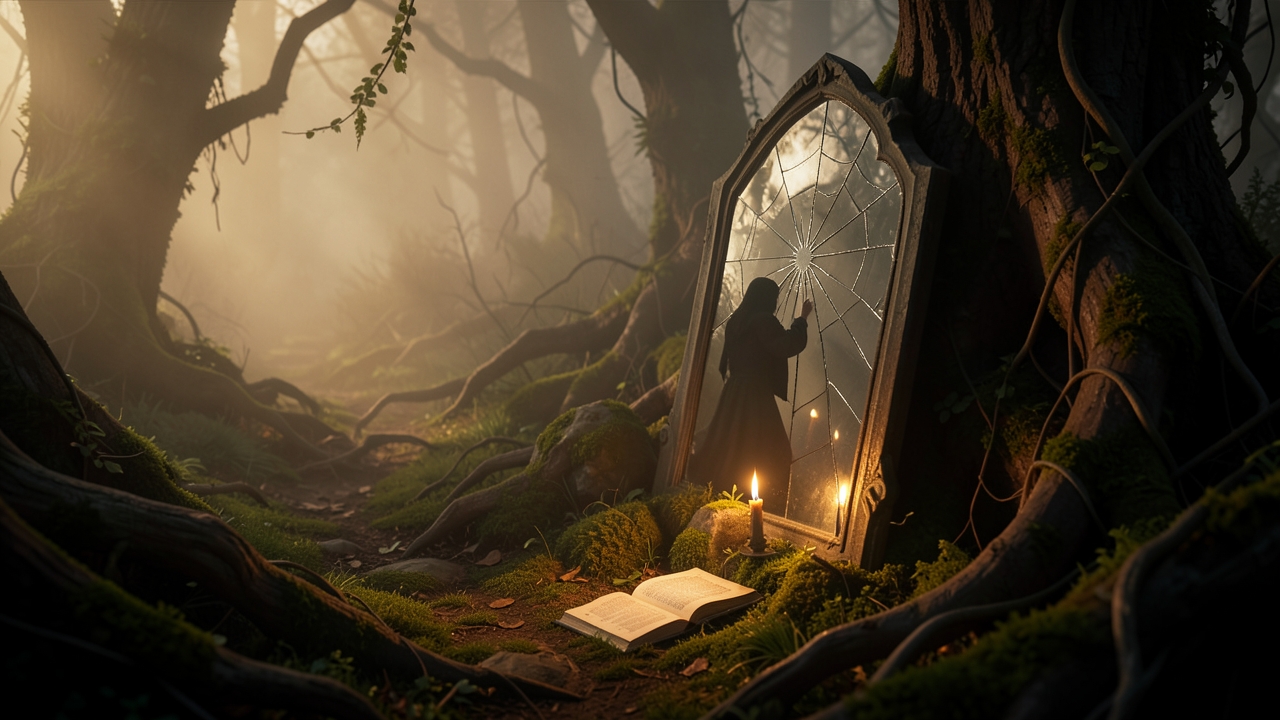
What if the hand that guides you through the dark is the same hand that wielded the knife?
In psychological horror, the cruelest trick is never the shape in the corridor. It is the voice that narrates the corridor. An unreliable narrator horror story turns the act of storytelling itself into a haunted house. Every sentence becomes a loose floorboard. Every omission becomes a locked door. And you, dear reader, become the trespasser who picked the lock.
This is the quiet engine of dread in the modern short story. Not the reveal, but the complicity. Not the monster, but the mirror. Let us pull back the veil and examine the machinery.
The Anatomy of the Unreliable Narrator
An unreliable narrator is a storyteller whose account cannot be trusted. But distrust is a blunt instrument. The craft lies in why the account fractures, and how the fracture spreads to the reader.
Consider the opening of Edgar Allan Poe’s “The Tell-Tale Heart”: “True! — nervous — very, very dreadfully nervous I had been and am; but why will you say that I am mad?” The narrator protests his sanity in the first breath. That protest is the wound. Poe teaches us that unreliability is best announced as a denial.
Four Masks of Unreliability
The Self-Deceiver. This narrator lies to himself first. Poe’s speaker in “The Tell-Tale Heart” and the unnamed wife in Charlotte Perkins Gilman’s “The Yellow Wall-Paper” both confess while concealing. Their journals read as testimony. They read as confession. Yet the true crime remains just outside the frame. The reader circles it like a moth.
The Deliberate Withholder. Here the narrator knows and refuses. Ambrose Bierce’s “An Occurrence at Owl Creek Bridge” conceals its own ending inside a tense, tender reverie. Henry James’s governess in The Turn of the Screw withholds doubt even from herself. The effect is not confusion but suspense. We sense a locked room somewhere in the syntax.
The Unraveling Mind. H.P. Lovecraft’s protagonists in tales such as “The Horror at Red Hook” narrate their own dissolution in real time. Adjectives multiply. Clauses knot. Meanwhile the prose itself becomes evidence of collapse. The form performs the madness the content describes.
The Grief-Blinded. Daphne du Maurier’s “Don’t Look Now” hides its prophecy inside a mother’s mourning. The horror is smuggled past us by love. Because the narrator cannot bear to look, neither can we — until it is far too late.
Each mask produces a different temperature of dread. Choose yours deliberately. For a deeper look at how this choice interacts with narrative distance, read our guide on choosing point of view in fiction.
Why Withheld Information Breeds Real Dread
Horror lives in negative space. A described monster is a design problem. An undescribed absence is a haunting.
Shirley Jackson understood this better than almost anyone. In “The Lottery,” the horror is not the stones. It is the narrator’s cheerful, procedural calm — the way the villagers speak of a lottery as though it were a bake sale. Withholding moral judgment forces the reader to supply it. Consequently, the story implicates an entire community. And, by extension, an entire readership.
Carmen Maria Machado does something similar in “The Husband Stitch.” The narrator casually mentions the green ribbon at the back of her neck. She never explains it. She never needs to. The reader notices first. The reader waits. Therefore, dread accumulates not from what the narrator says, but from what she declines to.
The Reader as Accomplice
Withheld information creates complicity through investment. You have spent two thousand words inside this mind. You have rationalized its small evasions. You have explained away the blood on the cuff, the neighbor’s complaint, the missing cat. To abandon the narrator now would be to admit you were deceived from the first line.
So you stay. You defend them. Jorge Luis Borges built entire labyrinths from this reflex — the reader circling a truth the text refuses to name. Meanwhile the horror tightens like a garrote. The final revelation does not frighten you. It shames you. That shame is the aftertaste of every great unreliable narrator horror tale.
POV Distortion: Techniques of the Fractured Lens
Distortion is not accident. It is architecture. Here are the instruments.
Syntax as Symptom
Let the sentence structure deteriorate as the truth approaches. Poe’s dashes grow longer as his narrator’s composure cracks. Lovecraft’s sentences swell into architectural excess. Conversely, when a disturbed narrator becomes too calm, too tidy, too reasonable — that terseness itself becomes sinister. Jackson’s flat declaratives in “The Lottery” unsettle precisely because nothing in the grammar admits horror.
Temporal Slippage
Shift your tenses without warning. Let a narrator begin in past tense and slide, mid-paragraph, into a present that has not yet occurred. Borges’s “The Circular Ruins” treats time as a loop, and the reader’s disorientation mirrors the protagonist’s. In horror, a slipped tense is a slipped mask.
The Slippery Pronoun
Watch the border between “I” and “we.” A narrator who drifts from singular to plural has admitted a division the conscious mind denies. Similarly, a sudden shift to the second person — “you understand, don’t you?” — converts the reader from witness to co-conspirator. Angela Carter weaponized this intimacy throughout The Bloody Chamber. Her narrators seduce as they mislead.
The Dismissed Object
Have your narrator mention something crucial in a tone of boredom. “There was, of course, the smell in the cellar, but that was nothing.” The reader’s eye snags. The narrator’s indifference becomes the most alarming detail on the page. This is the cheapest, most devastating tool in the cabinet. Use it sparingly. It is a poison, not a seasoning.
For how these techniques layer against setting and pacing, see our companion essay on building gothic atmosphere in fiction.
Common Pitfalls in Unreliable Narrator Horror
The Cheated Reveal. If your narrator’s secret has no seeds, you have not written horror. You have written a trick. Plant three small contradictions early. Let the attentive reader solve the story one paragraph before the narrator confesses. The horror then shifts from surprise to dread — and dread endures.
Over-signposting Madness. Do not have your narrator insist they are sane on every page. One protest is chilling. Twelve protests are tedious. Silence is more frightening than repetition. Meanwhile, let the behavior carry the diagnosis.
Confusing Unreliable with Unlikable. Readers will follow a monster if they are curious. They will abandon a saint if they are bored. Curiosity, not sympathy, is the tether. Give your narrator a beautiful sentence and a terrible secret, and they will never let go.
Breaking the Contract. Every clue must be honest, even when the narrator is not. If the green stain was never mentioned, you cannot reveal it in the final paragraph. The text must play fair. Otherwise the reader feels cheated rather than complicit — and complicity is the entire currency of this genre.
Structurally, the short form demands economy. Every withheld detail must earn its silence. For pacing frameworks that support this, consult our notes on structuring the short story.
A Case Study: The Quiet in the Walls
What follows is an original tale engineered to demonstrate the techniques above: a self-deceiving narrator, dismissed objects, temporal slippage, a slippery pronoun, and a reveal the reader may well anticipate — and dread — before the final line.
My sister has always been sensitive to noise, so it is a mercy that she no longer asks to go outside. I keep the shutters fastened. I keep the kettle low. There was, of course, the matter of the neighbor’s knocking last winter, but she is the sort of woman who complains about wind chimes, and I have never troubled myself with her opinions.
You must understand that I have done nothing cruel. Cruelty requires a choice, and I have made only the one necessary choice, which is the same choice any careful gardener makes of a vine that has grown too near the glass. My sister agreed with me. Her agreement was very quiet, which is characteristic of her, and I have sealed the seam with fresh plaster so that the agreement will hold.
In the evenings I take my tea at the wall. It is warm there. Some evenings — I admit this freely, since I have nothing to hide — the wall is warm all night, and I do not sleep, and neither, I think, does she. We pass the hours in companionable silence. It is the silence she wanted. It is the silence we both wanted, isn’t it?
There was a sound in March. I will not pretend otherwise. It began as a knocking, rhythmic and patient, the way a person knocks when they have all the time in the world and no particular hope of being answered. I told the neighbor it was pipes. She looked at my hands, which had plaster in the creases, and she said nothing, and I admired her restraint.
I have begun to keep the kettle lower still. I have begun to speak to the wall in the voice my mother used, the low one, the one that ends a conversation rather than beginning one. My sister is learning the voice too. Last night, very faintly, from the other side of the seam, in perfect imitation, she said goodnight to me.
You have read this far. You have read every word, and you have not once told me to open the wall. So do not look at me with that expression. You wanted her quiet too.
Notice the machinery. The plaster, the warm wall, the dismissed knocking — these are the three planted contradictions. Notice the narrator’s protestations of transparency. Notice, above all, the final turn to second person. The story does not accuse a stranger. It accuses the reader who kept reading.
Carrying the Technique Into Your Own Dark Work
Write the scene twice. Once from a narrator who tells the truth. Once from one who cannot. Then splice them. The truth version becomes your clue sheet. The lying version becomes your draft. Nothing in the lying version may contradict the truth — it may only conceal it, reshape it, or look away from it at the critical moment.
Next, audit your verbs of cognition. Replace “I realized” with “I noticed.” Replace “I decided” with “I had no choice but.” Small grammatical evasions accumulate into a personality. Meanwhile, cut every instance of the narrator naming their own emotion. Let the reader feel it instead. Shirley Jackson never told us to be afraid. She let us discover it ourselves.
Finally, choose your silence. Decide, before you write the first line, exactly what your narrator will never say aloud. That unsayable thing is the story’s gravity. Every other sentence will orbit it. Haruki Murakami, Jorge Luis Borges, and Silvia Moreno-Garcia have each built their fictions around a single withheld center — a door, a name, a ruin. Find yours. Then let your narrator guard it with the ferocity of the guilty.
An Echo in an Empty Room
We began with a question about hands in the dark. We end with the recognition that the darkest instrument in any horror story is not the knife, the wall, or the sealed room. It is the voice — persuasive, wounded, reasonable, and lying — that persuaded you to stay in the chair.
The unreliable narrator horror tale survives long after the lights because it does not end on the page. It ends in your reflection, where you ask yourself a question you would rather not answer.
If the narrator could deceive you so completely, how would you know — even now — which of your own recollections you have quietly edited for comfort?