
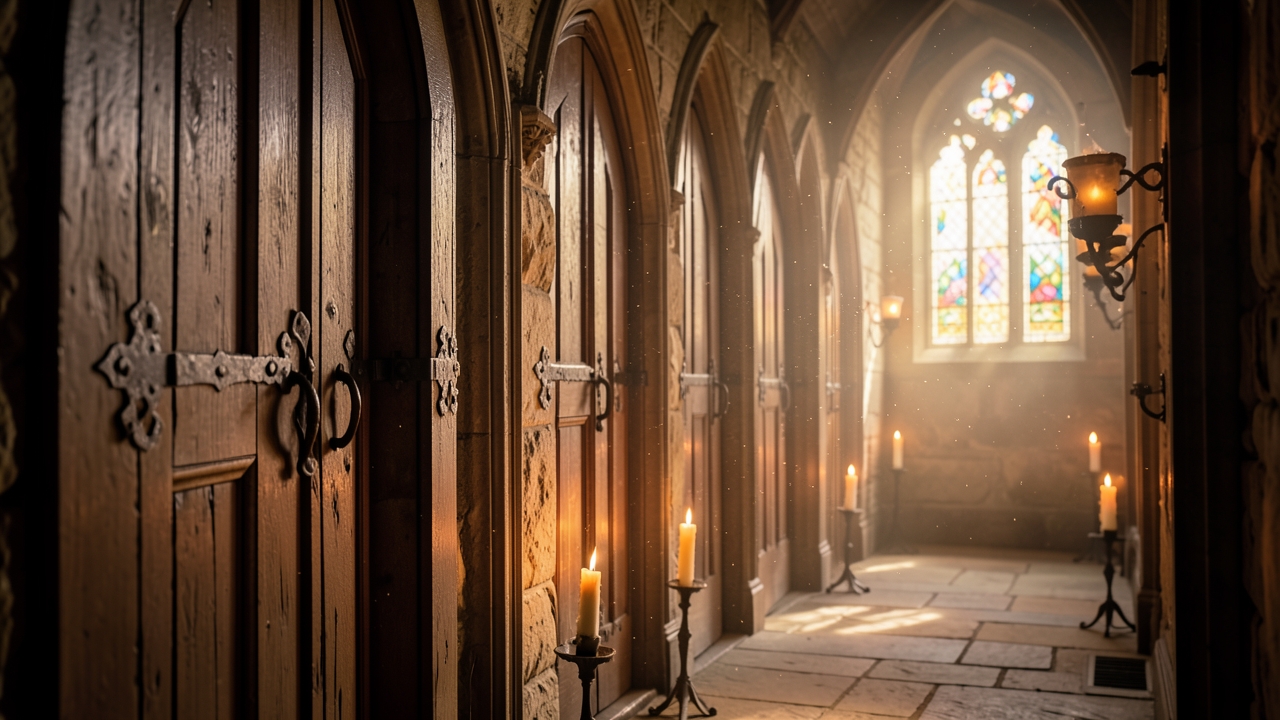
What happens to a mind when every door it opens leads deeper into itself?
That is the question behind this week’s exercise. This writing prompt confined setting asks you to stage an entire story inside one house, moving the reader from room to room as the plot tightens. The architecture becomes your outline. The floor plan becomes the character’s psyche.
Constraints have always haunted the best fiction. They force invention. They refuse the lazy escape of a new town, a new stranger, a new horizon. When you cannot change the scenery, you must change the pressure.
What Is a Writing Prompt Confined Setting?
A confined setting story restricts the action to a single contained space. Your variation tightens the rule further. Every scene takes place in a different room of the same house. No porch monologues. No flashbacks to the office. Only thresholds, corridors, and closed doors.
The rule sounds limiting. In practice, it becomes a engine. Because the reader knows the map, each new room carries meaning. A bedroom after a kitchen feels different. A cellar after a nursery feels unbearable. Spatial progress substitutes for plot mechanics.
Consider Poe’s The Masque of the Red Death. The tale survives almost entirely on movement through seven chambers. Color deepens. Sound swells. The final black room does the work of an entire climax. Read it alongside Poe’s legacy at the Poetry Foundation, and you notice how rarely he needed more than one building.
The Anatomy of Spatial Progression
Spatial progression means your rooms form a sequence with direction. The story moves somewhere. Front hall to kitchen. Kitchen to landing. Landing to the locked room at the end of the corridor.
First, map the house before you write a line. Draw it. Number the rooms. Decide which door connects to which. Ambiguity here produces fog later. A clear map lets you control the reader’s sense of dread.
Second, give every scene a causal bridge. What happens in room one forces the character into room two. A slammed drawer reveals a key. A key fits the door down the hall. Nothing should feel like tourism.
Third, choose a direction of descent or ascent. Rising through a house suggests ambition or mania. Falling toward the cellar suggests confession, memory, or burial. Your final room should feel inevitable once reached.
Crafting Room-to-Room Momentum
Momentum in a confined story comes from difference, not distance. Each room must contrast with the one before it. Vary temperature, light, sound, and scale. A cramped nursery follows a wide, echoing parlour. The shift itself becomes a beat.
Assign each room a sensory signature. In Poe’s masque, each chamber owns a color. Your kitchen might own the smell of scorched sugar. Your study might own the tick of a clock that runs fast. Repetition of one motif across rooms ties the house together.
Let objects migrate. A photograph carried from the hall to the bedroom changes meaning each time it appears. This technique rewards careful readers and builds the quiet dread that our guide to gothic atmosphere describes in depth.
Meanwhile, use sound as connective tissue. Voices bleed through thin walls. Footsteps overhead remind us that other rooms still exist. The unseen room haunts the seen one.
Also, compress time deliberately. If your story spans one night, let each room advance the clock. A chiming grandfather clock in the hall becomes a metronome for panic.
How Architecture Mirrors Emotional Unraveling
Here lies the heart of the exercise. The house should not merely contain the breakdown. It should perform it.
Shirley Jackson opens The Haunting of Hill House with four paragraphs of impossible geometry, then declares the house “not sane.” The rooms bend before the characters do. Jackson proves that structure can carry theme without a single line of explanation.
Silvia Moreno-Garcia’s Mexican Gothic treats the mansion as an organism. Walls sweat. Staircases resist. The heroine’s growing dread maps onto the house’s decay. Consequently, the reader trusts the building more than the people inside it.
Daphne du Maurier’s Rebecca does something subtler. Manderley remains whole while the narrator fragments. The rooms hold memory better than she can. When you want emotional restraint, study how du Maurier lets corridors do the grieving. For more on that quiet technique, see our piece on the unreliable narrator in gothic fiction.
Lovecraft’s The Rats in the Walls offers the darkest version. A hidden chamber behind the wall becomes the sealed room of the mind. The final descent shows what the architecture always knew. Meanwhile, Borges reminds us that a labyrinth need not be large to be infinite.
Common Pitfalls in the Confined Setting
The first failure is room tourism. The character wanders, observes, and feels nothing. Fix it by giving every room a want, an obstacle, and a consequence.
The second failure is repetition. If three rooms smell of dust and silence, the reader stops noticing. Therefore, vary your sensory palette ruthlessly.
The third failure is static emotion. If the character enters the house anxious and leaves anxious, the architecture wasted itself. Let each threshold wound or reveal.
The fourth failure is over-explaining. Never name the symbolism. Never announce that the cellar represents repressed memory. Show the cold stone, the damp air, the locked hasp. In addition, trust your reader to complete the circuit.
A Blueprint You Can Follow Tonight
Begin with six rooms: hall, kitchen, parlour, landing, bedroom, cellar. Write one scene per room. Keep scenes short, between four hundred and seven hundred words.
End every scene on a question the next room must answer. This creates the forward pull that our essay on pacing suspense in fiction calls the unbroken chain.
Reserve the final room for the truth. Lock it, then lose the key midway through. Let the character earn entry by losing something else.
Finally, reread your draft as a floor plan. If the emotional line rises and falls in step with the physical route, the technique has worked.
A Case Study: The Rooms of Alder House
The following micro-story obeys the rule exactly. Six rooms. Six beats. Notice how the house narrows as the narrator does.
The hall smelled of rain and cold ash. Eleanor set the key on the hallstand, exactly where her mother had always set it. The umbrella stand held one umbrella, as if it had been waiting thirty years. She told herself she would stay one hour. She told herself a second time, and the second telling sounded less true.
In the kitchen, the wall clock ran four minutes fast. Eleanor had forgotten that. A cup sat upside down on the drainer, and she touched its rim with two fingers, as though checking for breath. The kettle held a finger of water. Nothing moved. Yet the room felt recently abandoned, and the recently abandoned is harder than the long dead.
The parlour kept her father’s chair at an angle to the fire that no living person would choose. She sat in it anyway. The radio, unplugged, murmured a weather report for a coastline forty miles away. She listened until the voice said rain, then heavier rain, and she understood that the house had been forecasting her return all week.
On the landing, the runner had worn to a pale track down its centre. Eleanor followed it because there was nothing else to follow. Doors stood open on either side, each offering the same dim square of wallpaper. She stopped counting them at eleven. Her breathing had begun to keep time with the boards, and she could not say whether the house creaked or she did.
Her mother’s bedroom held a mirror that returned her face a half-second late. She brushed her hair and watched the delay, and in that delay she saw her mother’s hands doing the same gesture thirty years before. She said the word Mamma aloud. The word did not travel. The curtains had not been opened since spring, and the light that entered did so apologetically, in slivers, as though it had been told not to wake anyone.
The cellar door was unlocked, which was the final cruelty. Below, the air tasted of iron and sealed earth. One bulb swung. Boxes stood in rows, each labelled in her mother’s patient hand: Eleanor’s teeth, Eleanor’s ribbons, Eleanor’s letters unsent. She did not open them. She stood in the last room of the house and understood that the house had never been her mother’s. It had been an archive of her, and she had just arrived to catalogue herself. The stair waited behind her, patient as everything else. She climbed because the dark below had finished speaking, and above, the clock ran four minutes fast, and she was late for nothing at all.
The Door That Closes Behind You
The exercise works because it removes escape routes. Your character cannot flee to a diner. Your narrator cannot change the subject by changing the street. Every beat must be earned inside four walls.
That pressure mirrors the writing process itself. You sit in one room. You move through sentences the way a character moves through doorways. Each paragraph opens onto another, and the only way out is through.
So draw your house tonight. Give it a cellar it does not deserve. Then let your character walk it, room by room, until the architecture confesses what the dialogue never will.
When the last door swings shut behind them, whose voice will be left echoing in the hall, yours or theirs?