
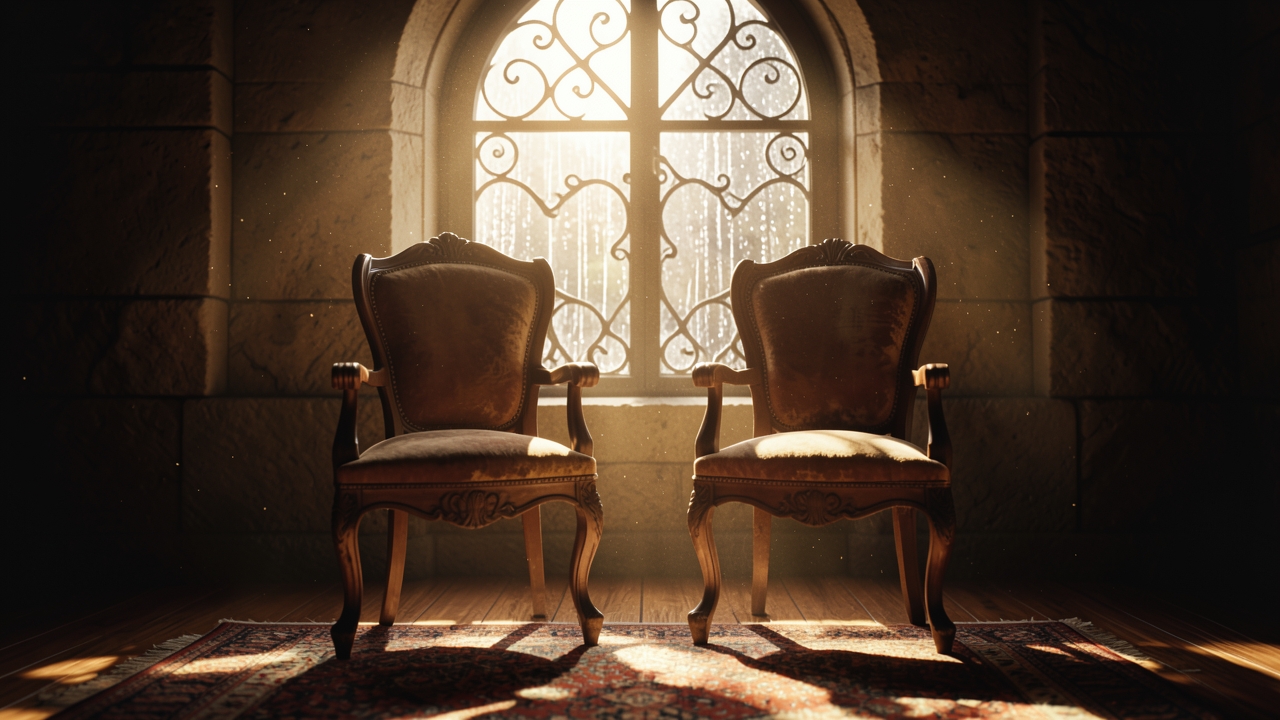
What remains when a man opens his mouth and closes it again? What trembles in the air between two people who have decided, or been condemned, to say nothing at all?
That is the question at the heart of this week’s writing prompt silence. You will write a scene in which two characters communicate entirely without speech. No dialogue. No dialogue tags. No remembered conversations. Only breath, gesture, object, and the terrible eloquence of the pause.
It sounds like deprivation. In practice, it is liberation. Silence forces you to abandon the drug most writers lean on — the explanatory sentence — and to trust the reader’s intelligence instead. Below, we will dissect the craft, then practice it in the dark.
The Theology of the Unspoken: Why This Writing Prompt Silence Works
Language is a veil we wear to hide from one another. Remove it, and the two figures in your scene stand exposed. That exposure is where story lives.
Consider Raymond Carver’s Cathedral. The narrator — jealous,封闭, bored of his own marriage — sits with his wife and a blind stranger. He expects nothing. Then the stranger asks him to describe a cathedral on television, and takes his hand. Carver writes the moment of transcendence almost entirely through physical fact: two men, one drawing over the other, the lights off, the narrator’s eyes closed. “It’s really something,” he says at last. The revelation arrives not as explanation but as sensation. Nothing is named. Everything is felt. For more on this strange economy, see our deeper guide to subtext in fiction.
Carver’s mentor, John Gardner, called this the “vivid and continuous dream.” A scene without dialogue tests whether your dream can survive on image alone. If it cannot, the fault was never in the missing words.
Carver’s Cathedral of Pauses
Study “A Small, Good Thing,” in which a bakery owner and grieving parents circle each other for pages. The famous ending — the sharing of bread, the whispered word life — earns its warmth only after pages of withheld speech. Carver understood that a pause is not an absence. It is a room the reader enters and fills.
Furthermore, Carver’s minimalism is not vagueness. It is precision under compression. Every object in his rooms does double duty: a glass, a plate, a table edge. When you write your own scene, choose three objects and make each one a hinge.
The Anatomy of a Silence
A dialogue-free scene is not empty. It is built from four load-bearing elements:
1. Gesture. Small, specific, involuntary. A thumb worrying a scar. A woman setting down a cup exactly where it was before. Daphne du Maurier’s Rebecca runs on such tremors — the second Mrs. de Winter’s hands, her stammer, her refusal to look up. The gesture tells you what the character will not admit.
2. Proximity. Where are the bodies? Leaning in, drifting apart, standing at opposite ends of a table. Distance is dialogue. Shirley Jackson understood this in We Have Always Lived in the Castle, where Merrcat and Constance communicate through the choreography of a shared kitchen.
3. Rhythm. Sentence length becomes your actor’s voice. Long, crawling clauses suggest dread. Short ones suggest refusal. Read your scene aloud; the ear will find the argument your characters will not speak.
4. Object. The chipped bowl, the unopened letter, the coat left on the chair. In Haruki Murakami’s quieter stories, an ordinary object becomes the whole emotional register of a room. Let your objects carry the weight.
Subtext: The Undertow Beneath the Quiet
Subtext is what a character means but does not say. In a silent scene, subtext becomes the entire text. Ask yourself, before you write a single action line: What does each of these two people want, and what are they refusing to want?
For example: a father wants forgiveness. A daughter wants him to ask. Neither will move first. Every motion in the scene — filling a glass, wiping a counter, standing in a doorway too long — becomes a move in that silent chess game. Consequently, the reader supplies the dialogue themselves, and feels clever for doing so.
Gillian Flynn, in Gone Girl, builds entire marriages out of withheld speech and performed civility. The violence is in the gaps. In contrast, Angela Carter fills her gaps with myth and muscle; her characters rarely whisper because their bodies do the shouting. Study both. Learn where the pressure builds.
Common Pitfalls of the Writing Prompt Silence
Writers falter in predictable ways when they accept this challenge. Avoid these.
The fog of vagueness. “Something passed between them.” No. Name the thing. The reader cannot see your feeling; show the sweat on the glass, the sound of the fridge.
The ghost narrator. Do not smuggle speech back in through indirect thought — “She wondered if he would ever forgive her.” That is dialogue wearing a shroud. Stay outside. Stay embodied.
The overloaded symbol. One mirror, one broken clock. Not seven. Tana French’s In the Woods shows how a single scarred place can hold an entire unspeakable history without ever tipping into ornament.
The empty page. Silence is not the absence of writing. It is denser writing. If your scene feels thin, you have not written less — you have written too vaguely.
Three Drills Before You Begin
First, list ten objects in the room. Choose three. Second, decide what each character wants and what they will never say aloud. Third, write the scene twice: once from behind Character A’s eyes, once from behind Character B’s. Then cut the version you like best.
For atmospheric scaffolding, consult our essay on setting as mood, and for the wider grammar of restraint, the Poetry Foundation’s portrait of Carver remains essential.
A Case Study: Chapel of Two Chairs
Below, an original scene written to this week’s writing prompt silence. Two sisters. One farmhouse kitchen. Zero words. Watch how the argument moves through the body instead of the mouth.
The kettle began its small complaint, and neither of them moved to lift it from the burner. Elin stood at the sink with her sleeves pushed past her elbows, washing a bowl that was already clean. Behind her, Mara sat at the table their mother had bought in 1987, her palm flat on the wood, as if she could feel through it the fingerprint of everyone who had ever pressed down there.
On the counter lay the envelope. It had lain there for eleven days. Elin rinsed the bowl again. She set it in the rack with the rim turned up, exactly parallel to the plates, and dried her hands on the same dish towel twice. Then she turned off the kettle, which had been screaming for some time.
Mara did not look up. She opened her hand, closed it, opened it. In the gap between their two chairs — three feet of linoleum, a distance their mother had once crossed with a birthday cake — a fly made its stupid cathedral of the air. Elin crossed the kitchen and stood behind her sister. She put one hand on Mara’s shoulder. It was a heavy hand. It stayed.
After a while, Mara reached up and took Elin’s wrist, and did not pull it away. She only held it there, feeling the pulse hurry, the way it had hurried when they were children and a storm had taken the power and they had lain together in one bed listening to the house confess its bones. Neither of them looked at the envelope. The water in the kettle began, faintly, to cool.
Then Mara let go. She rose, took the dry dish towel from the rack, and folded it into thirds, then into halves, and hung it over the rail. She lifted the envelope and carried it to the drawer beneath the telephone. She did not open it. She closed the drawer. Outside, the November dark arrived the way it always did — without permission, without apology — and Elin reached up and switched on the light over the sink, so that her sister would not have to cross the room in the dark.
Notice what the scene never does. It never explains the mother’s death, the contents of the letter, or the sisters’ history. Yet the reader feels all three. That is the reward of disciplined silence.
Your Turn: Accept the Silence
Now write your own. Five hundred to a thousand words. Two characters. No speech. End on a gesture, never on an explanation. And when you have finished, read it aloud to no one — the room itself is the best editor this exercise will ever have.
If the draft falters, return to Carver, to du Maurier, to our notes on gothic tension. Then sit with the quiet a little longer.
Because what, after all, is a story but the courage to leave something unsaid — and the craft to make the reader hear it anyway?