
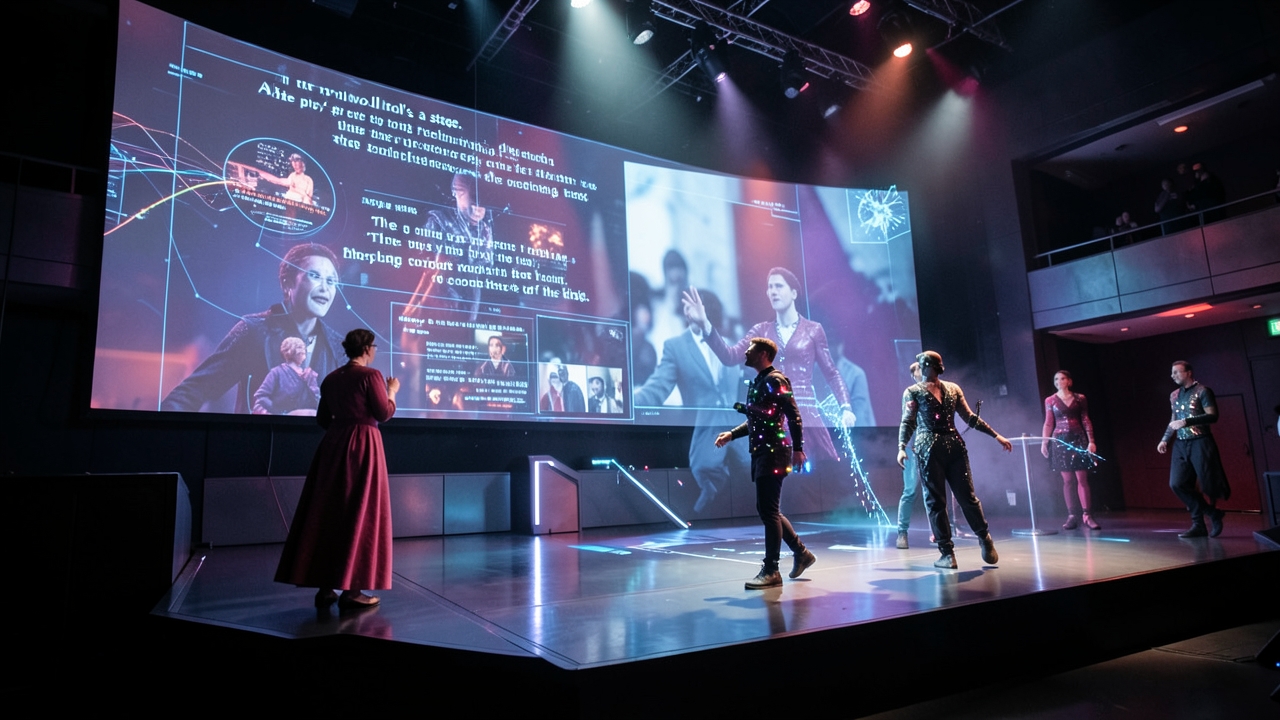
Does the ghost of the three-act structure still haunt the modern stage, or has it been exorcised by the siren song of the digital realm? For the playwright of 2026, the theater is no longer a sealed chamber of spoken word alone. It is a portal, a palimpsest where the whisper of an actor mingles with the hum of a projector and the spatial sigh of interactive audio. To write for this stage is to become an architect of layered realities, demanding a new synthesis of ancient craft and spectral technology.
The Classical Skeleton in the Digital Skin
The foundation remains, as it always has, in the primal urge to tell a coherent, emotionally compelling story. Aristotle’s poetics of beginning, middle, and end are not obsolete; they are the skeleton upon which we now drape the luminous flesh of multimedia. Edgar Allan Poe, in his “Philosophy of Composition,” argued for the unity of effect, a singular, overwhelming impression that governs every word. In hybrid-media playwriting, this unity is paramount. The digital element must serve the effect, not distract from it.
Consider the classic three-act structure: Setup, Confrontation, Resolution. In a hybrid script, each act may have a dominant sensory language. Act I might rely on traditional dialogue and stark lighting to establish the world. Act II, the heart of confrontation, could unleash fragmented video projections to mirror a character’s fracturing psyche. Act III’s resolution might strip everything away, leaving a solitary voice and a haunting, interactive audio loop that echoes the protagonist’s unresolved grief. The structure is the spine; the media is the nervous system, transmitting feeling in new, visceral ways.
Crafting the Hybrid-Media Playwriting Blueprint
This is not a matter of adding flashy effects. It is a discipline of narrative integration. As you approach your 2026 script, consider these foundational techniques.
The Ghost in the Machine: Projection as Character
Projections are not backdrops; they are active dramatis personae. In Annie Dorsen’s “Algorithmic Theater” works, such as The Show (Achilles’ Heel), the digital process itself becomes the performer. For your craft, ask: What does the character remember that cannot be spoken? A flickering, translucent image of a lost love on a scrim. What does the environment remember? An old house’s history scrolling like forgotten code across its walls. The projection carries subtext, memory, and atmosphere, operating in a realm beyond the actor’s direct control, much like fate in a Greek tragedy.
The Whispering Walls: Audio as Atmosphere and Instigator
Interactive audio moves the sonic landscape from a fixed score to a living participant. Inspired by the immersive soundscapes of creators like Derek Krasny, think of audio as an emotional weather system. A character’s anxiety could trigger a low, subliminal hum in the theater’s speakers. A moment of revelation might cause a clear, crystalline chime to emanate from different corners of the room, pulling the audience’s focus. The script must cue these elements as precisely as it cues a line reading. For example:
ACT I, SCENE 2
Elena paces. As she speaks, her footsteps trigger a faint, delayed echo in the surrounding audio—a ghost of her own movement. LEO sits motionless.
LEO: You’re leaving echoes everywhere.
(The audio system gently distorts her next line, as if the room is resisting her departure.)
The Fractured Timeline: Non-Linearity as Thematic Force
Hybrid media allows us to visualize non-linearity more profoundly than ever. Inspired by the temporal loops in Haruki Murakami’s fiction or the layered memories in plays by Caryl Churchill, your script can use media to shatter chronology. A projection might show a future consequence while the actor delivers a line of present-tense hope. Interactive audio could play a conversation from the past over a scene of present silence. The key is intentionality. The fracture must reveal character psychology or thematic depth, not just prove a technical capability. As Shirley Jackson mastered the slow reveal of internal horror, so must you reveal the inner timeline of your character’s mind.
Common Pitfalls in the Digital Dark
The path is fraught with shadows. One common error is the “spectacle over substance” trap, where the technology overwhelms the human story. The audience should leave thinking of the character’s plight, not just the cleverness of the LED wall. Another pitfall is over-specification. Unlike a novel, a stage play is a blueprint for live collaborators. Your script should describe the effect you desire (“A projection of falling letters, like a typewriter’s ghost”) not the specific software to achieve it, unless a precise technical behavior is narratively essential. Finally, avoid using media merely as decoration. If you can remove a digital element without diminishing the emotional or narrative beat, it does not belong.
For further inspiration on integrating technology with story, explore our analysis of Uncanny Valley Characters in Modern Fiction, where we dissect the blend of human and artificial. Additionally, the evolving narrative forms discussed in Labyrinths of Memory: Unreliable Narrators in a Digital Age provide a valuable literary parallel.
A Case Study: The Echo Chamber
The following is a fragment from a hypothetical hybrid-media play, demonstrating the integration of traditional dialogue with stage directions for projection and interactive audio. The scene features MARA, a memory archivist, and ELIAS, a man who has hired her to erase a painful memory.
STAGE DIRECTION: The set is minimal: two chairs, a table. The back wall is a vast screen, currently showing a slow, looping video of ocean waves, muted and grainy. The sound of distant, regular waves fills the space.
ELIAS: So you just… reach in and take it? Like plucking a weed from a garden.
MARA: The mind is less a garden than a palimpsest. We don’t take. We obscure the script, write over it with a new layer. The old text remains, a faint impression. A ghost.
(ELIAS shifts. As he does, his chair squeaks. A split-second later, the audio system emits a sharp, metallic SCREECH, like a door in a forgotten hallway. Both freeze. The projected waves stutter for a frame.)
MARA (calmly): See? The system is already listening. Anticipating resonance.
ELIAS: I want her gone. The memory of her laugh. The way she—
(As he says “the way she,” the projection on the wall SHIFTS. It dissolves from the ocean into a blurry, pixelated image of a woman’s smile, incomplete, corrupted. It holds for three seconds, then dissolves back to the waves. ELIAS stares, hollowed out.)
ELIAS: You see? It’s already leaking. The memory is… it’s not just in my head anymore. It’s in the walls.
MARA: That is the first stage of the procedure. We externalize, then we overwrite. Are you ready for the echo to become silent?
(A long pause. The only sound is the waves. Then, from a hidden speaker directly behind ELIAS, a faint, almost inaudible recording of a woman’s laugh plays once, and vanishes. ELIAS flinches as if struck.)
The Playwright as Conductor of Shadows
To write for the 2026 stage is to embrace a haunting duality. You must be both the poet of the heart, rooted in the eternal human needs that drive Oedipus or Blanche DuBois, and the engineer of the specter, designing the digital phantasms that will manifest the unseen. The three-act structure provides the map, but the territory you now navigate is a shimmering, mutable space where light, sound, and code are as eloquent as the spoken word. Your tools are no longer just ink and paper, but the entire sensory palette of the theatrical space.
The ultimate goal, however, remains unchanged. It is to move an audience, to make them feel the fracture of a human soul or the weight of an unspeakable truth. The technology is merely a new, profound vessel for that ancient purpose. So, as you sit in the gathering dusk of your writing desk, the screen glowing before you like a portal, what ghost will you choose to give a voice? And how will you ensure its echo, once released, haunts not the machine, but the very hearts of those who listen?