
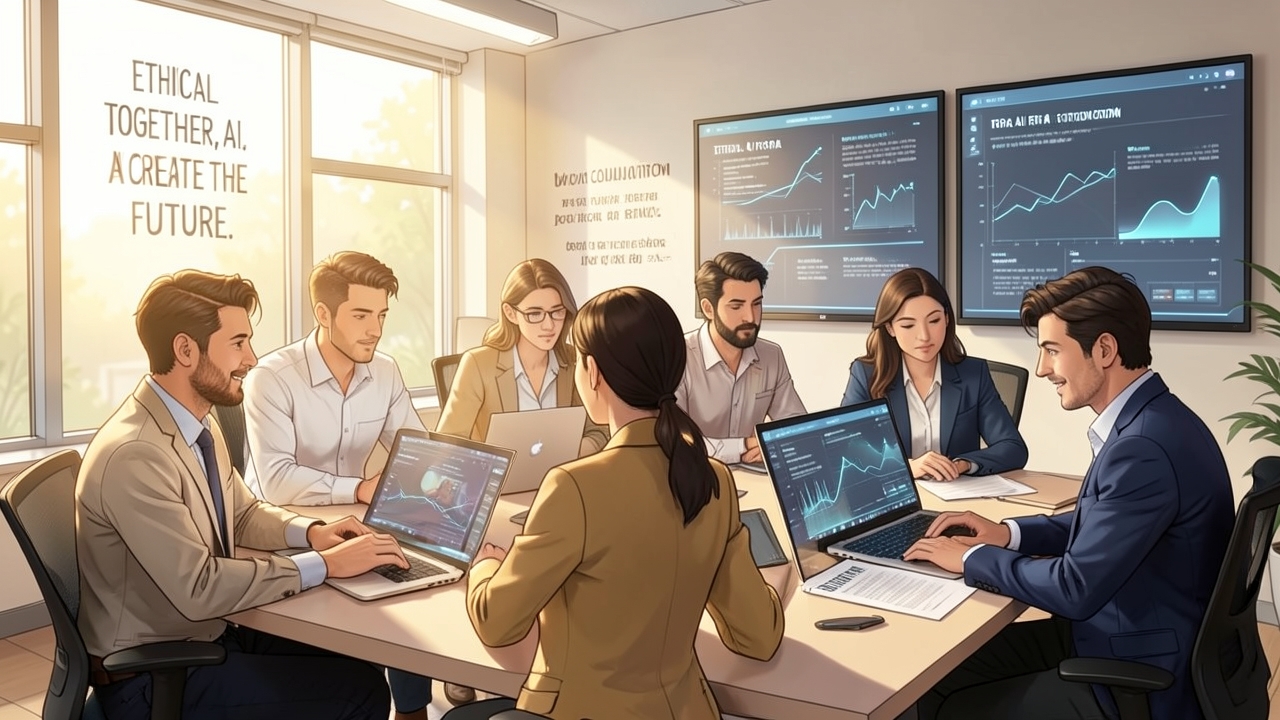
Does the digital specter of a machine-born paragraph haunt the corridors of your own creativity? In the year 2026, the question is no longer whether to interact with artificial intelligence, but how to do so without surrendering the soul of your prose. The path toward ethical AI writing collaboration is not one of rejection, but of deliberate, mindful partnership—a dance with a helpful shadow that must never eclipse the dancer.
This guide moves beyond the frantic debate of replacement. Instead, we will explore a precise workflow where AI tools become your apprentice, not your master. They can excavate structural foundations and stir the murky depths of brainstorming, yet the singular voice—the very breath of your story—must remain unequivocally yours.
The Anatomy of an Ethical Workflow: Theory and Technique
The core of ethical collaboration lies in assigning the AI its proper role: that of a structural generator and brainstorming catalyst. Think of it not as a co-author, but as a highly advanced reference library that talks back. Your voice is the curator, the editor, and the final, discerning authority.
Brainstorming: The Ghost in the Idea Machine
Every writer knows the paralysis of the blank page. Here, AI can be a potent, if cold, muse. Instead of prompting it to write a sentence, ask it to generate lists of potential plot twists for a gothic mystery, or to name ten atmospheric settings in a forgotten coastal town. The key is to use these outputs as raw material, not finished product. As unreliable narrators in fiction twist truth, you must be the reliable narrator of your own process, filtering machine suggestions through the sieve of your own taste and thematic intent.
For example, you might input: “Generate 5 symbolic objects for a story about inherited guilt.” The AI might list a tarnished locket, a cracked mirror, a perpetually wilting gardenia. You, the writer, then select the mirror, but envision it not merely as cracked, but as reflecting faces that aren’t there—a detail born from your own imagination, sparked by a machine’s nudge.
Structural Generation: Building the Skeleton
Structure is architecture, and AI can draft blueprints. You can provide the premise of a story—the emotional core, the central conflict—and ask the AI to suggest a three-act structure or a chapter-by-chapter outline. This is where its pattern-recognition becomes invaluable. However, as Literary Hub often explores, the most resonant narratives often subvert expected structures. Use the AI’s outline as a default framework, then consciously break it. Move a climax earlier. Introduce a revelation in the first chapter that the AI might have saved for the end. The ethical violation occurs not in using the blueprint, but in forgetting you are the architect.
Tana French, in works like The Searcher, masterfully builds suspense by delaying revelations and letting setting dictate pace. An AI might suggest a faster reveal. Your task is to weigh that suggestion against the atmospheric tension you are crafting and, perhaps, reject it for the sake of slow-burn dread.
Voice Preservation: The Unyielding Authorial Fingerprint
Your voice is the cumulative effect of your diction, rhythm, and perspective—the literary equivalent of a fingerprint. Allowing AI to generate final prose risks smudging this unique mark into a generic, albeit polished, blur. The ethical workflow demands a firewall between AI-generated content and your final text.
The Paraphrase Imperative
Treat any AI-generated text, no matter how helpful, as a translation from a foreign language. Your duty is to render it anew in your own tongue. If the AI produces a paragraph describing a gloomy library, do not copy-paste. Instead, use it as a note: “Library: dusty, smells of old paper and regret, light from a single window illuminating floating dust.” You then write the scene yourself, letting your own sentences and sensory preferences breathe life into the scaffold. This is the difference between plagiarism and inspiration.
The Ethical Pitfalls: Voice Dilution and Homogenization
The greatest peril is not a single act of copying, but the slow erosion of one’s voice through habitual reliance. If one consistently accepts an AI’s smoother, more common phrasing, the writer’s distinct, perhaps idiosyncratic, rhythms atrophy. In contrast, Angela Carter’s baroque, carnivalesque prose would be the first casualty of a collaborative process that favored simplicity. Therefore, actively use your writing sessions to push against the AI’s suggestions—to make them stranger, more personal, more dissonant. This friction is where true artistry lives.
As reported by The Guardian, conversations around authorship are intensifying. The writer who simply edits AI text may be seen as a mere compiler. The writer who uses AI to generate a raw idea, then rebuilds it completely in their own voice, remains an author.
A Case Study: The Luminous Debt
The following short story demonstrates the described workflow. The premise given to an AI assistant was: “A librarian in a dying town discovers a book that writes itself, revealing the secrets of the town’s founding families. The price of reading is a memory.” The AI provided a list of potential founding family secrets and a chapter outline. The voice, atmosphere, and final execution are entirely human.
The dust in the Atherton Municipal Library did not dance; it waited. Clara felt it settle in the hollows of her lungs as she shelved the day’s returns. Here, time was not a river but a stagnant pool, and the town of Prospect’s secrets sank like stones to its bottom. The book arrived on a Tuesday, left on the returns cart though no one had checked it out. It had no title, its cover the color of a day-old bruise. Its pages were not paper, but something smoother, colder.
Clara opened it under the weak glow of her desk lamp. Words bloomed in ink that seemed to writhe, not dry. They spoke of the Hargroves, the founding family, and a pact made not in ink, but in blood, with something that lived in the bedrock beneath the town. The book named a secret: that the Hargrove matriarch had not died of fever, but had been the fever, her jealousy a contagion that claimed six rivals. As Clara read, a memory fluttered in her own mind—her mother’s face, soft and smiling—and then it was gone, snatched away. A cold vacuum took its place. The book promised more truths, for a greater price.
She became a scholar of erasure. Each night, she fed the book a memory: the smell of her father’s pipe, the name of her first childhood friend, the sound of rain on a tin roof. In return, it disgorged Prospect’s buried sins. The Ashworths’ prosperity was built on a massacre of river traders. The Bellamy heir was not a man, but a hollow thing wearing a man’s shape. Clara’s own past became a quilt with growing holes. She could no longer recall her own age with certainty. The town’s history, once a murmur, was now a scream in her skull, and the silence of her own life grew louder.
The climax came with the last memory: her name. The book required it to reveal the final, foundational secret—the nature of the thing beneath the rock. Clara sat at her desk, the book open. She thought of the hollow in her chest, now a vast, echoing chamber. She thought of the vibrant, screaming history she now carried. To give her name was to become a footnote in the very story she had excavated. She dipped her pen, not to write in the book, but on a slip of paper. She listed every memory she had purchased from it, every family name, every sin. She then wrapped the list around the book and, with a steadiness that surprised her, slid it into the library’s furnace. The final secret, she decided, would remain a stone at the bottom of the pool. Some debts are luminous in their refusal to be paid.
The Echoing Question: What Remains?
The tools of 2026 can draft a skeleton, but only you can imbue it with blood, memory, and the particular quality of its light. Ethical collaboration is an act of conscious curation and courageous revision. It is the decision to use the machine’s output not as a destination, but as a departure point for your own journey into the shadowlands of story.
So, the final inquiry lingers like smoke in a locked room: When you place your finished work upon the page, will it bear the unmistakable, imperfect, and vital imprint of a human hand—or merely the flawless, chilling silhouette of the tool that assisted it?
For further exploration of voice in fiction, consider our deep dive into crafting uncanny prose.