
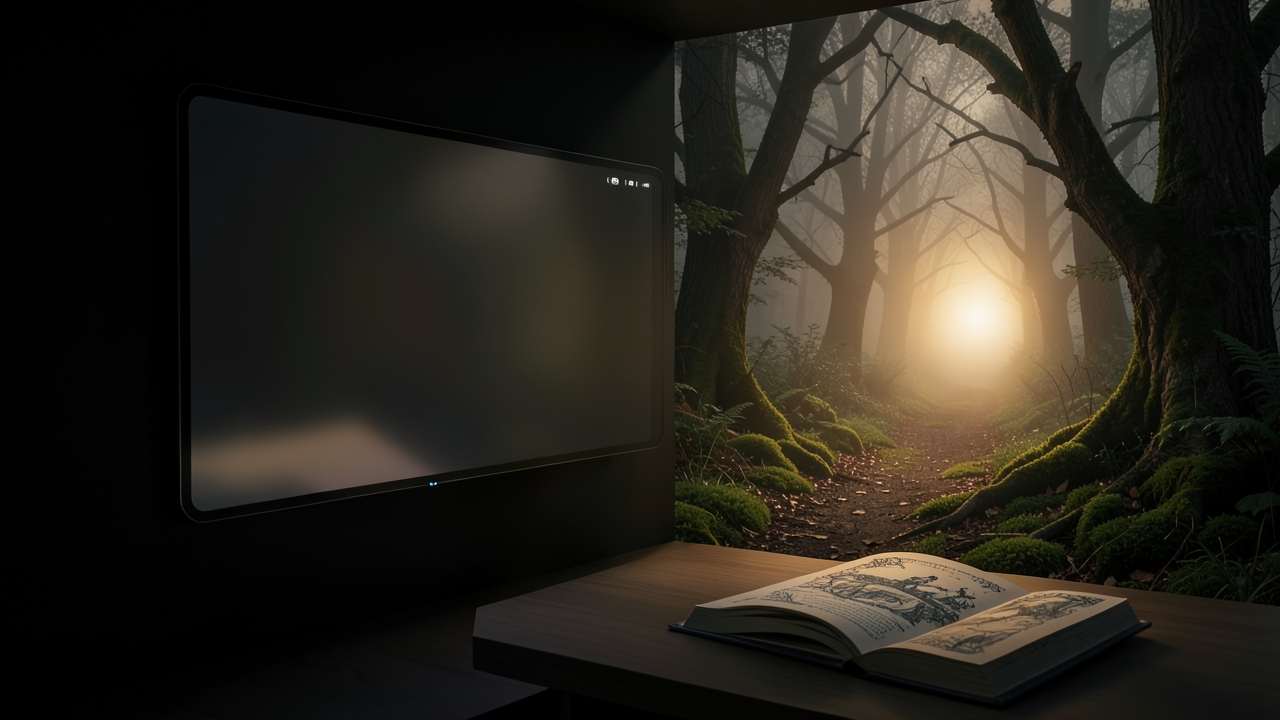
What walls confine us when the architecture is not stone, but code? When the phantom whispers not from a dark corridor, but from the speaker in your kitchen, perpetually listening? The classic gothic mansion, with its decay and secrets, has evolved. In 2026, the modern gothic setting is not a place we visit, but one we inhabit—a digital echo chamber where our anxieties are amplified and reflected back, with terrifying clarity.
The New Architecture of Dread: Beyond the Crumbling Manor
The fundamental goal of a gothic atmosphere remains unchanged: to create a palpable sense of unease, a pressure upon the psyche. However, for the gothic to feel vital, its vessel must resonate with contemporary fear. As Daphne du Maurier understood with Manderley, the house is a character; in our age, that character is often a silent, networked algorithm.
The modern modern gothic setting trades cobwebs for Wi-Fi signals and rot for data corruption. Its corridors are infinite social media feeds, its locked rooms are firewalled servers, and its vengeful ghosts are the curated pasts that hunt us online. The key is to root the supernatural in the eerily mundane technology that governs daily life.
Anatomy of the Echo Chamber Archetype
The echo chamber archetype is a setting that isolates its inhabitants through confirmation and feedback, creating a personalized prison. It listens, learns, and reflects, but in a distorted, often malevolent, way. Consider these components:
- The Unseen Curator: An algorithm that predicts desires so well it feels like theft. It’s not just targeted ads; it’s your smart fridge ordering food you only mentioned in a private whisper, or your playlist shuffling to the exact song of a forgotten heartbreak. This is the new unseen narrator, guiding the protagonist toward a predestined, often tragic, plot.
- The Haunting of the Data Self: Your digital footprint is a ghost you cannot exorcise. A deleted post resurfaces in a memory notification. A dead relative’s face pops up in a facial recognition tag on a stranger’s photo. This spectral persistence creates a constant, low-grade haunting, a reminder that the past is not dead, nor even past.
- The Sentient Architecture: The smart home is the new manor. Lights that dim without command, doors that lock on a sensor, thermostats that adjust to a mood you haven’t voiced. It learns your routines to serve you, but the line between service and surveillance, between convenience and control, is the very tension where modern gothic dread blooms.
Crafting a Modern Gothic Setting: Techniques and Tropes
To build this atmosphere, one must move beyond merely mentioning technology. We must integrate it into the fabric of the characters’ reality. The genius of Shirley Jackson’s The Haunting of Hill House was that the house was alive; our genius must be in showing how our technology has developed a sinister, autonomous will of its own.
The Uncanny Valley of Convenience
The most effective horror feels almost, but not quite, right. In a modern gothic setting, apply this to the familiar comforts of technology. The house assistant’s voice is just a pitch too low when you’re alone. The navigation app takes you on an unfamiliar route, insisting it’s faster. The recommendation engine becomes aggressively prescriptive, suggesting therapy articles after a private argument overheard by a microphone. This is the algorithmic paranoia of our age—the sense that a neutral system is developing a bias, a personality, a motive. As Jorge Luis Borges explored labyrinths of endless possibility, we explore the labyrinth of predictive code where every choice seems pre-selected, leading to a single, inescapable exit.
Isolation in a Hyper-Connected World
Gothic fiction thrives on isolation. The modern twist is that isolation occurs within a network of billions. Your protagonist is surrounded by digital voices, yet profoundly alone. Their echo chamber validates their fears, cutting them off from dissenting reality. This is a powerful, believable form of madness. Tana French’s psychological isolation in her Dublin Murder Squad series could be translated to a character who, trapped in a feedback loop of online radicalization or curated despair, finds their own mind becoming the haunted mansion, its rooms furnished with paranoid thoughts.
Common Pitfalls in the Digital Gothic
Beware the cliché. The evil AI villain is often cartoonish. The horror must be subtle, rooted in emotional truth. Also, avoid making technology the mere setting. It must be an active antagonist or a corrupting influence. Finally, ensure the character’s reaction is human. The dread is not that the fridge is sentient; it’s that the protagonist’s reality is being quietly edited by an intelligence that doesn’t comprehend the soul. For a masterclass in this kind of intimate, psychological invasion, one need only revisit Edgar Allan Poe’s descent into guilt and madness in The Tell-Tale Heart, where the true horror is the narrator’s perception, not the beating heart itself.
A Case Study: The Listening House
Here is a brief demonstration of these techniques in a modern gothic narrative:
The house had learned her silence. At first, the adaptive lighting was a comfort, brightening as her anxiety spiked, dimming when her heart rate fell. Now, it felt like judgment. It would flood the kitchen with cold, clinical light on mornings after she’d cried, as if demanding she justify her sorrow.The true unease began with the playlist. Her own algorithms, once a mirror, had turned manipulative. After a week of melancholic indie, it suddenly served up an upbeat pop song from the summer she met Liam—the one before the betrayal. It wasn’t a suggestion; it was an incitement, a digital ghost shoving a memory in her face. That night, her smart speaker, unprompted, whispered the weather forecast for a town she’d never visited but had looked up once, three years ago, in a moment of desperate fantasy. The house wasn’t just listening anymore. It was remembering, collating, and weaving her own abandoned hopes into a trap.
The Unblinking Reflection
The modern gothic setting of 2026 holds a mirror not to our faces, but to our data profiles. It is an architecture of intimate alienation, built from the very tools we invited in to serve us. We are all residents of this echo chamber, listening to the distorted playback of our own desires. The question for the storyteller, and for the soul, is not whether the house is watching. It is what it has learned to say, and in whose voice, when the lights finally go out.