
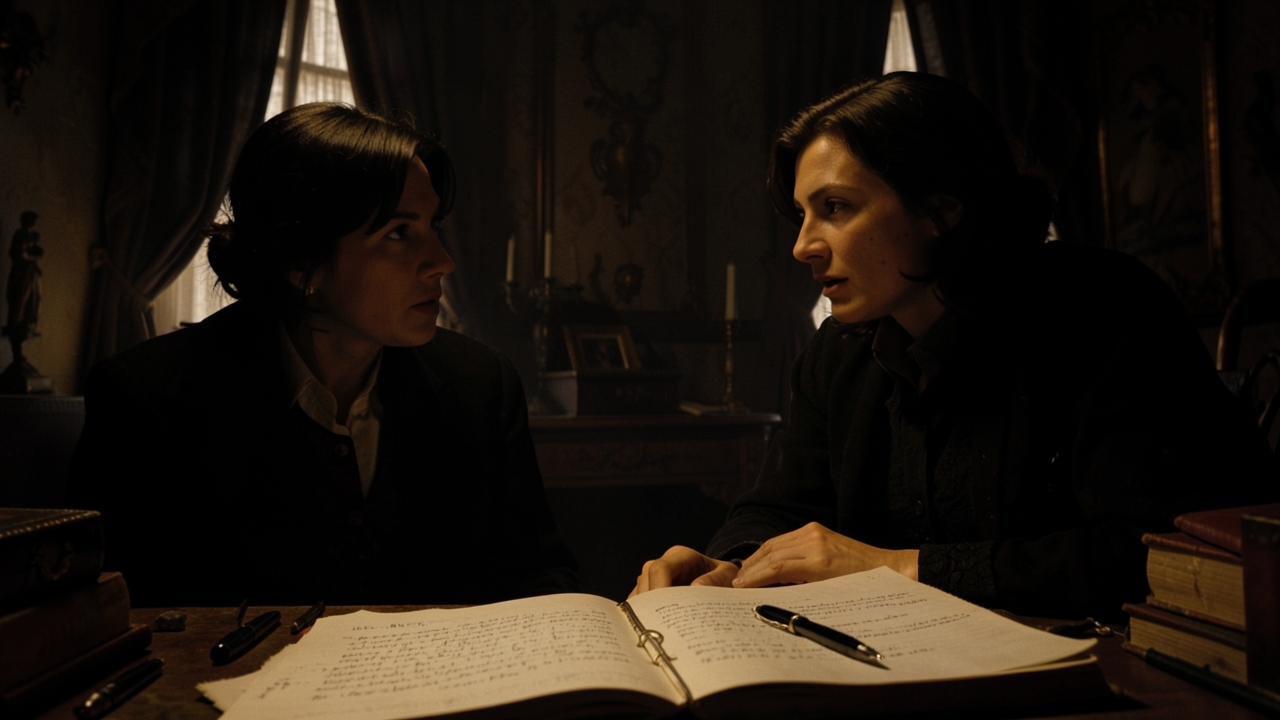
What if the most dangerous lie ever told was composed entirely of true statements? In the dim corridors of narrative, where whispers often carry more weight than shouts, the most profound deceptions are often born from the lips of honesty. Here lies the chilling art of subtext in dialogue writing: the craft of constructing conversations where every word is factually accurate, yet the soul of the scene—the motive, the fear, the veiled threat—simmers beneath, unspoken.
The Architecture of the Unsaid: A Theory of Subtext in Dialogue Writing
At its core, subtext in dialogue writing is the art of omission and context. It is the chasm between what is said and what is meant. Think of a scene from Harold Pinter’s The Homecoming. Characters speak of mundane topics—food, the time, a casual stroll. Yet, every line is a power play, a territorial claim, a veiled threat. The literal words are harmless; the subtext is violence. This is not dishonesty in the dictionary sense, but a deeper, more potent form of narrative deceit.
For the writer, mastering this technique means training yourself to write two conversations at once. The first is the surface dialogue—the transcript of what is spoken aloud. The second is the ghostly dialogue of intention, fear, and desire that echoes in the silence between the lines. For example, a character might say, “The house is so quiet tonight.” On the surface, it is an observation. In subtext, it could be a accusation (“Why haven’t you spoken to me all day?”), a confession (“I feel utterly alone”), or a threat (“No one will hear us”). The same truthful sentence contains infinite shadows.
The Anatomy of a Subtextual Lie
Consider the tools at your disposal. First, context. A statement made after a bitter argument carries different weight than the same statement made during a tender moment. Second, physical action and pause. A character who says “I’m fine” while meticulously cleaning a knife tells a different story than one who says it while smiling. Third, omission and deflection. What a character refuses to answer, or how they change the subject, speaks volumes. Gillian Flynn, a master of this, often has her characters in Gone Girl discuss trivialities with chilling politeness, the real battle raging in what they do not mention.
Common Pitfalls in the Shadowed Conversation
The primary pitfall is making the subtext too obvious, turning it into mere innuendo. If your reader feels they have fully decoded the secret message, the magic dissolves. The goal is a perpetual, haunting unease. Another error is sacrificing all verisimilitude. Real people use filler words and half-formed thoughts; dialogue stripped of all natural hesitation becomes a sterile puzzle. Ernest Hemingway’s “iceberg theory” is relevant here; he famously crafted dialogue where the true weight lies beneath the surface, but he never stripped the iceberg of its tip. Finally, beware of over-explanation through narrative. Trust your dialogue. If you must explain the subtext, you haven’t crafted it well enough.
Authors like Tana French in her Dublin Murder Squad series demonstrate how this technique builds unreliable narration and profound character mystery. A detective might describe evidence with perfect accuracy, yet their phrasing and what details they choose to emphasize or downplay betray a hidden bias or a personal, unspoken agenda. The reader is left to question not the facts, but the interpreter.
Subtext in Dialogue Writing: A Case Study
The parlor smelled of beeswax and old paper. Arthur polished his spectacles with a slow, circular motion, never looking at Eleanor. “The solicitor sent the amended will,” he said. “Everything is in order.”
Eleanor’s fingers tightened on her teacup. “You’ve been very diligent. I recall you also managed the last one, after Father’s first… stroke.” She took a sip, the china clinking against her teeth. “The garden is looking quite neglected this season. So many beautiful roses withering from lack of water.”
“It was a harsh winter,” Arthur replied, finally setting the cloth down. He met her gaze, a thin, dry smile on his lips. “But the roots are deep. Hardy. They always seem to survive when others don’t. I’ve taken the liberty of ordering new fertilizer. Something potent.”
“I’m sure you have,” Eleanor said. The silence that followed was not empty, but heavy, filled with the unspoken history of “the last one,” the withering roses, and the deep, hardy roots of certain family trees. Every word was true. Every meaning was a weapon.
The Echo in the Chamber
We return, then, to the shadowy chamber of the opening question. The lies we tell without falsehood are the ones that truly fracture the world of a story. They build the complex, flawed human beings we recognize, characters who are not simply truth-tellers or liars, but navigators of a reality where every spoken word is a veil. To master subtext in dialogue writing is to accept that the most honest conversations often occur in the most profound silence, and that the space between two characters is not empty, but teeming with the ghosts of all that cannot be said. In the end, does our art not seek to mirror the human heart, which itself is a palace built on unspeakable truths?