
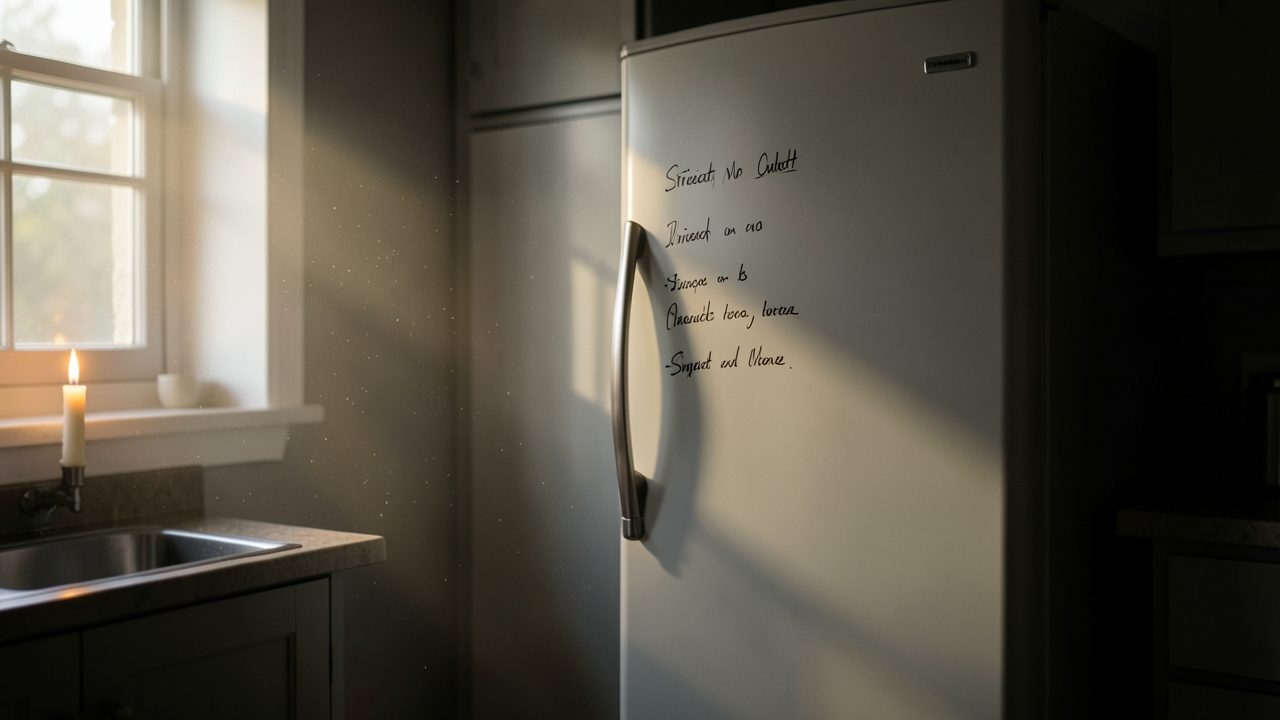
What if the truest confessions were never spoken aloud? What if they lay instead upon a scrap of paper, curling at the edges, taped to the cold white door of a refrigerator at midnight?
There is a peculiar cruelty in ordinary objects. A coffee tin. A carton of milk. A brand of bread preferred by one and despised by two. These are the small stones with which couples build their walls — and, occasionally, the tools with which they dismantle them. This grocery list writing prompt asks you to stage an entire war and its ceasefire upon a single handwritten page.
No dialogue. No narration. No trembling lips or averted eyes. Only items, crossed-out lines, and the thin marginal annotations of people who can no longer bear to look at one another directly.
Why This Grocery List Writing Prompt Cuts So Deep
Most writers reach for speeches when they feel the ache of a scene. They misunderstand the nature of grief and anger. Intense emotion rarely announces itself in complete sentences. It leaks sideways, through omission, through hostility disguised as domestic logistics.
Edgar Allan Poe understood this principle of deferred impact. In The Philosophy of Composition, he argued that every element of a tale must bend toward a single, preconceived effect. Nothing ornamental survives. Nothing extraneous. The grocery list enforces this discipline by force. You have a fixed surface. You have a fixed number of marks. Every stroke must earn its place.
Constraint as a Pressure Chamber
Constraint is not the enemy of expression. It is its furnace. Consider the sonnet, which flourishes precisely because it cannot sprawl. Consider the architecture of subtext in fiction, where what remains unsaid carries the weight of the spoken.
The grocery list forces subtext because it forbids direct address. Your characters cannot say “I miss you.” They must instead write the name of a wine purchased at a particular vineyard in a particular rain, and trust that the other will remember. The reader watches two people reaching across an impossible distance with trembling hands.
Meanwhile, the reader does the interpretive work. And a reader who decodes a meaning themselves will never forget that they found it.
Objects Carry What People Cannot
Domestic objects are never merely objects. They are repositories of accumulated grievance. Shirley Jackson knew this. In The Haunting of Hill House, the house itself becomes a mouth. But even her quieter works reveal how furniture and kitchens hold the residue of unhappy lives.
Meanwhile, in Rebecca, Daphne du Maurier turns a woman’s inability to arrange flowers into a study of annihilating insecurity. The marmalade jar becomes a totem. The blue dressing gown becomes a death sentence.
Your list inherits this lineage. When your character writes “olive oil — the green bottle, not the cheap one,” they are not shopping. They are indicting years of compromise.
Anatomy of the Emotional Arc on Paper
A scene without arc is merely a mood. And mood, however atmospheric, eventually exhausts itself. Your list must move. It must pass through distinct chambers, each colder and stranger than the last.
Here is the three-stage structure I recommend for this exercise.
Stage One: Resentment in Brand Names
Resentment thrives on specificity. Generic anger sounds theatrical. Particular anger sounds true.
So do not write “coffee.” Write the specific tin. Write the grocery-store brand one partner considers an insult to the household. Then have the other cross it out and restore their own. Now you have a battlefield drawn in ballpoint.
Tana French builds her mysteries on precisely this kind of domestic archaeology. In In the Woods, character emerges through the residue of shared history rather than through declaration. Let your list do the same.
Stage Two: Longing in the Additions
Longing announces itself through elaboration. A person who has stopped caring writes “wine.” A person who still aches writes “the wine from the vineyard near the coast, the one we drank the night it rained.”
Therefore, watch for the moment one character begins adding detail where none is needed. That is the moment the wall develops its first fracture. The other character may not cross the line out. Their silence becomes the most generous thing on the page.
Haruki Murakami routinely lets ordinary consumption carry unbearable nostalgia — wine, records, cats. In Kafka on the Shore, appetite and grief occupy the same mouth.
Stage Three: Forgiveness in the Small Erasure
Forgiveness in fiction must be understated or it curdles into sentiment. Grand gestures collapse under their own weight.
So let forgiveness arrive as a changed brand. Let one partner quietly stop crossing things out. Let a “Thank you” appear in the margin, then be half-erased, as though the writer lost their nerve halfway through the word.
The half-erased word is the whole scene. It contains the terror of repair.
Techniques for Writing the List Itself
Handwriting Is Characterization
If your scene appears as reproduced text, describe the hand. Describe pressure. Describe the angle of the letters.
Uppercase block letters suggest a person armored against interpretation. Loops and flourishes suggest someone still reaching for beauty. A sudden change in pen — blue to black, ballpoint to pencil — signals that a new self has arrived at the page.
In addition, let the physical damage speak. Coffee rings. A thumbprint. The ghost of a torn-off page. Objects endure what people confess.
The Annotation as Dialogue
The parenthetical note is your closest approximation of speech. Use it sparingly, and always with teeth.
Consider the difference between “pasta” and “pasta (not the shells — you know why).” The second invites an entire marriage into the reader’s imagination. However, resist explaining the reference. Mystery is oxygen. The moment you clarify, the scene suffocates.
Crossed-Out Words Are Never Truly Gone
This is the technique’s dark genius. A crossed-out word remains legible beneath the line. Deletion becomes visible history.
Therefore, sequence your crossings carefully. Strike through a brand and replace it with the rival. Strike through an apology and replace it with a demand. Then, in the final movement, strike through the demand and restore the apology. The reader watches a soul revise itself in real time.
For further study of restraint as a narrative engine, see these examples of showing versus telling, which demonstrate how omission builds pressure.
Common Pitfalls to Avoid
First, the list grows too long. A bloated list becomes a prop, not a scene. Cap it near twenty items. Scarcity breeds meaning.
Second, the annotations become speeches. If your characters write paragraphs, they are merely narrating in disguise. Keep every margin note under ten words.
Third, the ending arrives too cleanly. Perfect reconciliation feels fraudulent. Leave one item unresolved — a mystery purchase, a name neither will explain.
Finally, do not forget the setting. The list exists in a kitchen. Let the hum of the refrigerator enter. Let the tile feel cold. As the craft discussions at Literary Hub repeatedly affirm, atmosphere is not decoration. Atmosphere is meaning.
A Case Study: The Red Cap
What follows is a demonstration of the technique in practice. Watch the arc move from cold hostility toward something more fragile. Notice how little is actually said.
The list began, as such things do, with milk. Two percent, the carton with the blue cap, because she had never once trusted him to remember the red one. Beneath it he wrote a single word: bread. Sourdough, the good loaf, from the corner where the woman always remembered to slice it. For three days those two entries stood alone, a treaty between strangers dividing a hotel bill.
On the fourth morning, eggs appeared in his hand, crossed out twice before being rewritten larger. She answered beneath it, in the careful print she used for bills: still no eggs. He wrote eggs. fine. Then, in the margin, in a script the color of old bruises: the tin coffee is fine too. She did not annotate. She simply drew a clean line through the tin, and above it wrote the Colombian, the one you bought yourself last year when you stopped asking what I wanted. Nobody added milk that week.
By the second week the paper had begun to curl at the lower left corner, where her wrist rested when she wrote. He added chicken, then, beneath it and in smaller letters: thighs, not breasts, the way you like them. She left it untouched for two days, an act of grace or of exhaustion, he could not determine. Then she wrote wine. And beneath that, after a pause he could feel through the paper, the red from the vineyard near the coast. The one we drank the night it rained so hard the road disappeared.
He stood in the kitchen at one in the morning and read that line until the words stopped being words. He wrote, in the margin, in a hand he no longer recognized as his own: I kept the cork. Nothing else. He did not cross it out, though he touched the pen to the paper three times as though testing the depth of water. The refrigerator hummed. The list fluttered against the magnet shaped like a lemon, the one they had bought on the trip neither of them mentioned anymore.
In the morning she read it and did not move for a long while. Then she took the pen and crossed out blue cap. Beneath it she wrote, small and unsteady, as though the words were arriving from very far away: milk. the red one. please. In the margin, beside his confession about the cork, she added a single word and half-erased it. He would sit with that ghost for an hour before deciding, carefully, not to ask which word it had been. He added bread. whatever you want. They bought the wine that evening. Neither of them opened it.
Your Turn at the Fridge Door
Set a timer. Give yourself thirty minutes and a blank sheet. Do not plan the ending before you begin, for the page often knows more than the planner.
Begin with one item. Let resentment arrive in brand names. Let longing thicken the margins. Then find the smallest possible gesture of repair, and make it almost too small to notice.
When you finish, read the list aloud in the voice of each character. If any line sounds like narration rather than a grocery item, strike it. Ruthlessness is mercy.
If you hunger for further exercises in restraint, our gothic short story exercises offer similar pressure chambers for the imagination.
The Silence Between the Items
We return, then, to the cold white door and its small paper tenant. The list endures because it admits no performance. There is no audience in a kitchen at midnight. There is only the pen, the paper, and the unbearable vulnerability of wanting something from a person who may not deliver it.
That is the true work of this exercise: to compress an entire marriage into twenty words and a series of visible erasures. To prove that forgiveness can be no larger than the difference between two carton colors.
So tell me — if the paper on your own refrigerator could speak, what would it confess that you have never dared to write aloud?