
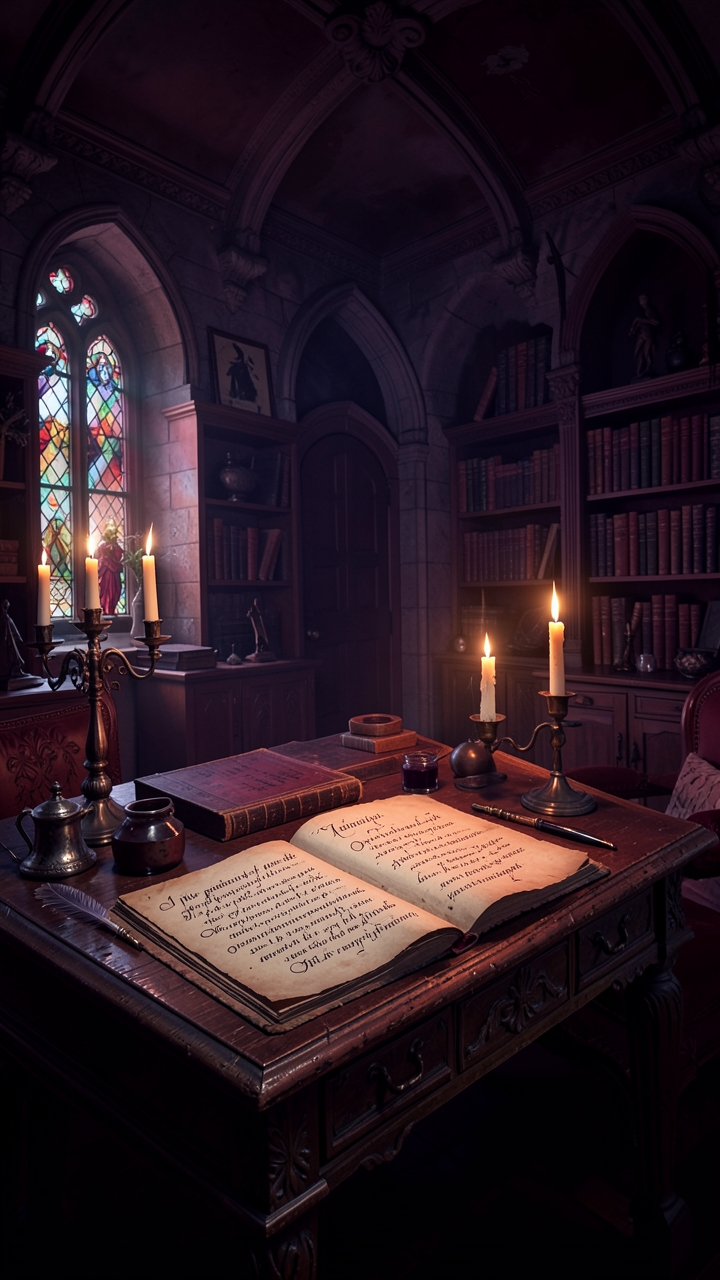
Have you ever felt a story cling to you like mist, its whispers echoing long after the last page is turned? This is the power inherent in the art of gothic storytelling, a craft that thrives in the liminal spaces between dread and beauty, memory and decay. It is not merely a genre, but a psychological excavation—a means to plumb the depths of human fear and fascination. In this exploration, we shall dissect the very anatomy of this shadowy art, learning to wield its tools to create narratives that linger, that haunt, and that ultimately reveal the fractured light within the darkness.
The Foundations of Gothic Storytelling
At its core, gothic storytelling is an architecture of atmosphere. Before a plot unfurls, a world must be summoned—a world that feels alive with menace. Edgar Allan Poe, the master architect of this realm, understood this implicitly. In “The Fall of the House of Usher,” the decaying mansion is not merely a setting; it is a character, a mirror to Roderick Usher’s crumbling psyche. Therefore, the first lesson is this: your environment must breathe. It must whisper its own tale of neglect, sorrow, or hidden malice.
Atmosphere as Character
To cultivate this, engage all senses. Describe not just the sight of a fog-shrouded moor, but the feel of damp chill seeping into bone, the distant cry of a bird, the metallic taste of fear on the tongue. Daphne du Maurier perfected this in Rebecca, where Manderley itself is imbued with the memory of its former mistress, a palpable presence that suffocates the narrator. Your setting should act as an emotional conduit, reflecting and amplifying the internal state of your characters.
The Unreliable Narrator’s Labyrinth
Gothic tales often filter reality through a lens of distortion. The unreliable narrator is not a gimmick; it is a fundamental tool for generating suspense and psychological unease. Consider the feverish confession in Poe’s “The Tell-Tale Heart.” The narrator’s insistence on his sanity becomes the very evidence of his madness. Similarly, in Shirley Jackson’s The Haunting of Hill House, Eleanor Vance’s fragile perspective blurs the line between supernatural event and mental breakdown. By inviting the reader to question the narrator’s reality, you transform reading from observation into active, anxious participation.
Psychological Terror vs. Physical Horror
Modern gothic craft often favors the former over the latter. H.P. Lovecraft, though known for cosmic monsters, truly terrified through the implication of forbidden knowledge and the erosion of the human mind. His story “The Call of Cthulhu” derives its power from the slow, inevitable realization of humanity’s insignificance. Contrast this with overt violence; true dread is a quiet, creeping thing that settles in the soul. As a mystery essay on Froie.com might note, suspense is built not from the shock of the knife, but from the anticipation of its fall.
Mastering the Craft: Techniques for Modern Writers
Translating these foundations into practice requires deliberate technique. The gothic writer is a weaver of threads, each contributing to a tapestry of unease.
Symbolism and Motif as Haunting Agents
Objects and images gain power through repetition. A recurring mirror, a decaying portrait, a specific scent of roses and rot—these motifs act as psychological anchors. Gillian Flynn, in Gone Girl, masterfully uses the concept of the “cool girl” as a haunting motif, a symbol of performative identity that unravels to reveal something monstrous. Similarly, Silvia Moreno-Garcia’s Mexican Gothic uses the very architecture of the house and the invasive mold as symbols of colonial and patriarchal decay. Choose your motifs carefully; they will echo through your narrative, gaining meaning with each recurrence.
Pacing and Revelation: The Slow Unveiling
Gothic narratives rarely sprint. They are a deliberate, stepwise descent. Pacing should mirror the process of uncovering a long-buried secret. Start with small, unsettling details—a floorboard that creaks without cause, a draft that carries a forgotten perfume. Let the tension build through accumulated oddity. Tana French excels at this in her Dublin Murder Squad novels; the crime is merely the entry point into a labyrinth of memory and guilt that the characters must navigate at a painstaking, dreadful pace. Do not rush the revelation. The journey into the dark is the point.
Language and Rhythm: The Poetry of Dread
Your prose must have a musicality that complements the mood. Use cadence and rhythm to create unease. Short, staccato sentences can induce panic. Longer, flowing sentences can build a hypnotic sense of dread. Haruki Murakami, while not a pure gothic writer, employs a surreal, dreamlike rhythm in works like The Wind-Up Bird Chronicle that creates a profound sense of dislocation. Jorge Luis Borges, in stories like “The Library of Babel,” builds infinite, claustrophobic labyrinths through sentence structure alone. Read your work aloud. Listen for its music. Let the words themselves whisper.
A Case Study: The Whisper in the Walls
Let us now observe these techniques in concert. What follows is a miniature gothic tale, crafted to embody the principles discussed.
The house had a voice of its own. It began as a sigh, trapped in the plaster of the east wall, a breath released only when the evening light turned to bruised purple. I first heard it the night I inherited my grandmother’s estate—a thin, sibilant murmur that seemed to speak just beneath the threshold of understanding.
At first, I attributed it to the wind, to the old pipes groaning in their century-long slumber. But the whispers grew specific. They called my name, Elara, in a tone of fond reprimand. They spoke of “the garden,” of “the promise.” The atmosphere within the house shifted; every shadow seemed to lean in, every portrait’s eyes followed me with a weighted, knowing gaze. The setting was no longer passive. It was a co-conspirator.
I began to doubt my own memory. Had my grandmother not spoken of the garden? My journal entries from that week grow frantic, the handwriting devolving into sharp, jagged peaks. “The walls remember what I cannot,” I wrote. “Is the house lying, or am I?” This was the fracture of the unreliable narrator—a crack through which the reader, too, might peer. I became both detective and suspect in my own haunting.
The motif of the locked garden gate grew obsessive. Its iron filigree, shaped like thorny vines, was the only thing that wouldn’t open. The whispers grew insistent, a chorus of forgotten voices rising from the very foundations. The pacing was a slow, inevitable crawl toward a truth I both sought and dreaded. Finally, driven by a sleepless dread, I took a hammer to the wall where the whispers were strongest. Behind the plaster, sealed within a small, rusted box, was not a treasure, but a collection of locks of hair, each tied with a violet ribbon, and a deed—not to the house, but to a plot of unmarked land in the overgrown garden. The revelation was not of a ghost, but of a lineage of silent, suffocating secrets. The house’s voice was the cumulative whisper of all the women who had stood here, bound by a promise to keep the garden’s true nature hidden. I did not need to hear it anymore. I was now part of its murmur.
Conclusion: Echoes of the Unseen
We began with a question about stories that cling like mist. We have journeyed through the foundations—building worlds that breathe, crafting narratives that question their own telling, and choosing terror of the mind over the body. We have examined the intricate techniques of symbolism, pacing, and poetic language. Then, we witnessed these elements coalesce in a tale of whispered walls and buried truths. The art of gothic storytelling is ultimately an art of resonance. It is about crafting an echo chamber within the reader’s mind, a space where the themes of decay, memory, and hidden selves can reverberate long after the silence returns. It is about understanding that the most profound horror often wears a familiar face, and the most enduring beauty is often tinged with shadow. So, the final question remains: when you sit to write, are you merely constructing a tale, or are you summoning a ghost?
For further reading on narrative tension, explore our analysis of suspense in modern fiction or delve into this critical piece on unreliable narrators from Literary Hub.