
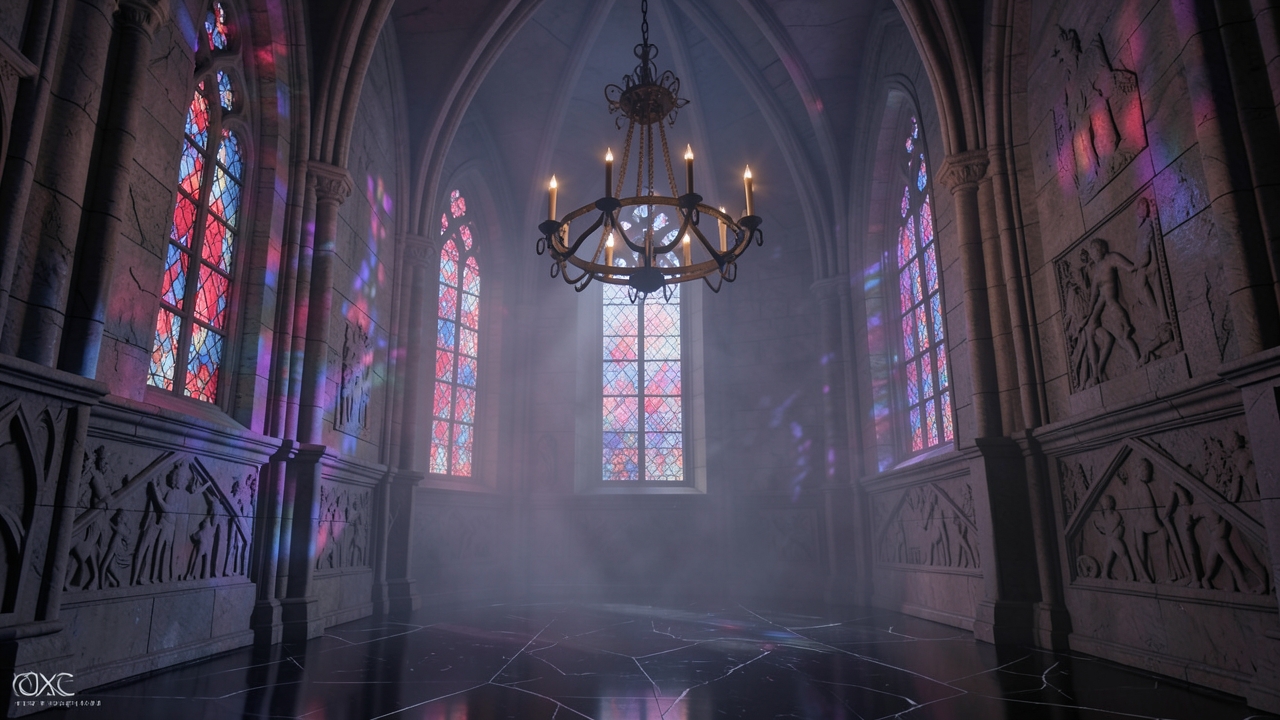
What if the true haunting was not of specters, but of the self? The walls do not need to bleed to tell a story of dread; they need only to reflect the fractures in a soul. This is the potent alchemy of the contemporary gothic setting: it transmutes the classic haunted house from a vessel of external evil into a mirror, a labyrinth, a prison constructed from the bricks of internalized trauma, societal expectation, or the silent hum of digital isolation.
The Architecture of the Inner World
The genius of classic gothic fiction, from Horace Walpole to Shirley Jackson, lay in the externalization of fear. The house itself was an antagonist. However, the contemporary gothic writer possesses a more nuanced tool. Here, the setting is not merely a place where terror happens; it is the terror, an architectural manifestation of a character’s psyche. To wield this power, one must master the art of symbolic geography.
Anatomy of a Symbolic Space
Consider Henry James’s The Turn of the Screw. The estate at Bly is less a haunted house and more a canvas for the governess’s spiraling anxiety. Its precise, manicured beauty becomes the backdrop against which her psyche unravels. Similarly, in Rebecca, Manderley is not merely dead; it is a mausoleum of Rebecca’s personality, constantly reshaping the narrator’s self-image. Therefore, every corridor, every locked room, every fading portrait in your story must serve as a metaphor. The basement is the subconscious; the attic, repressed memory; the locked door, a psychological defense.
As the Poetry Foundation notes on the “specter of place”, certain locales carry an inherent psychological weight. A writer’s task is to amplify this weight until it bends the narrative to its purpose.
Crafting a Contemporary Gothic Setting That Captivates
The Principle of Corrosive Detail
In Shirley Jackson’s The Haunting of Hill House, the house’s “not-sane” quality is conveyed not through cheap scares, but through subtle, corrosive details: a door that shuts with “a finality of sound,” walls that seem to sweat. For the contemporary writer, this means rejecting the purely antique. A psychological prison could be a sterile, minimalist smart home that adjusts its lighting to mirror a character’s mood swings. It could be a sprawling corporate campus where fluorescent lights hum a tune of existential dread. The key is to let the setting’s oppressive quality feel organic to the modern experience.
Digital Hauntings and Societal Walls
The 21st-century gothic setting expands beyond brick and mortar. The digital world is a vast, haunted house. A social media feed can become a hall of distorted mirrors, each post a reflection of societal pressure and personal inadequacy. Think of how the endless scroll creates a feeling of psychic entrapment. As explored in our article on the digital-age haunting, the threat is no longer a ghost in the machine, but the machine as a ghost in our heads. Consequently, a character’s “haunted house” might be their meticulously curated online persona, a prison of their own design.
Avoiding the Pitfalls of Cliché
The peril in this craft lies in laziness. The setting must not be mere decoration for the horror. For example, having a character feel “trapped” in a gothic mansion is generic. Having the mansion’s floorplan physically warp to mirror their growing agoraphobia is potent. In contrast, a passive setting is a dead setting. Furthermore, ensure the architecture of the psyche serves the character’s arc. Does the house crumble as they achieve catharsis? Does the labyrinth of corridors finally present an exit when they confront their trauma? This integration separates the profound from the formulaic.
You can explore more foundational principles of atmosphere in our guide to crafting unsettling atmosphere.
A Case Study: The Chromatic Ward
The Chromatic Ward
Elias moved through the white hallway of the Ward. It was not a clean, healing white, but a white that absorbed sound and memory, a white that felt pressurized, like the deep ocean. Each room branched off the central spine: Room 7 (Memory Consolidation) was bathed in a pulsating blue light that felt like cold water in the skull; Room 12 (Pattern Recognition) was a dizzying lattice of black and gold wires. The Director had said the architecture was therapeutic, designed to rewire the brain. But Elias knew it was a map of his own failure, a labyrinth built from the schematics of his panic attacks.
The doors had no handles on the inside. They responded to biometrics, to the unique signature of a compliant mind. His door to Room 3 (Emotional Calibration) had become a flat, featureless slab since his last “episode.” He would stand before it, placing his palm against its cool surface, but the light stayed a stubborn red. It knew him too well. The Ward didn’t need chains; its prison was perfect understanding. It was his own neural pathways, rendered in drywall and light, and it was refusing to let him leave.
The Echoes That Remain
The contemporary gothic setting, then, is a dialogue between space and psyche. It is the understanding that a prison of the mind can build its walls from light and air as effectively as from stone. By transforming the haunted house trope into a landscape of internal struggle, writers tap into a deeper, more resonant fear: the dread of being utterly known by the architecture of our own suffering. When the setting and the soul become one, what external escape could ever truly free us? The door may open, but the labyrinth, we fear, walks out with us.
As the master of psychological unease, Shirley Jackson so expertly demonstrated, the most terrifying prisons are those we help to furnish, brick by silent brick.