
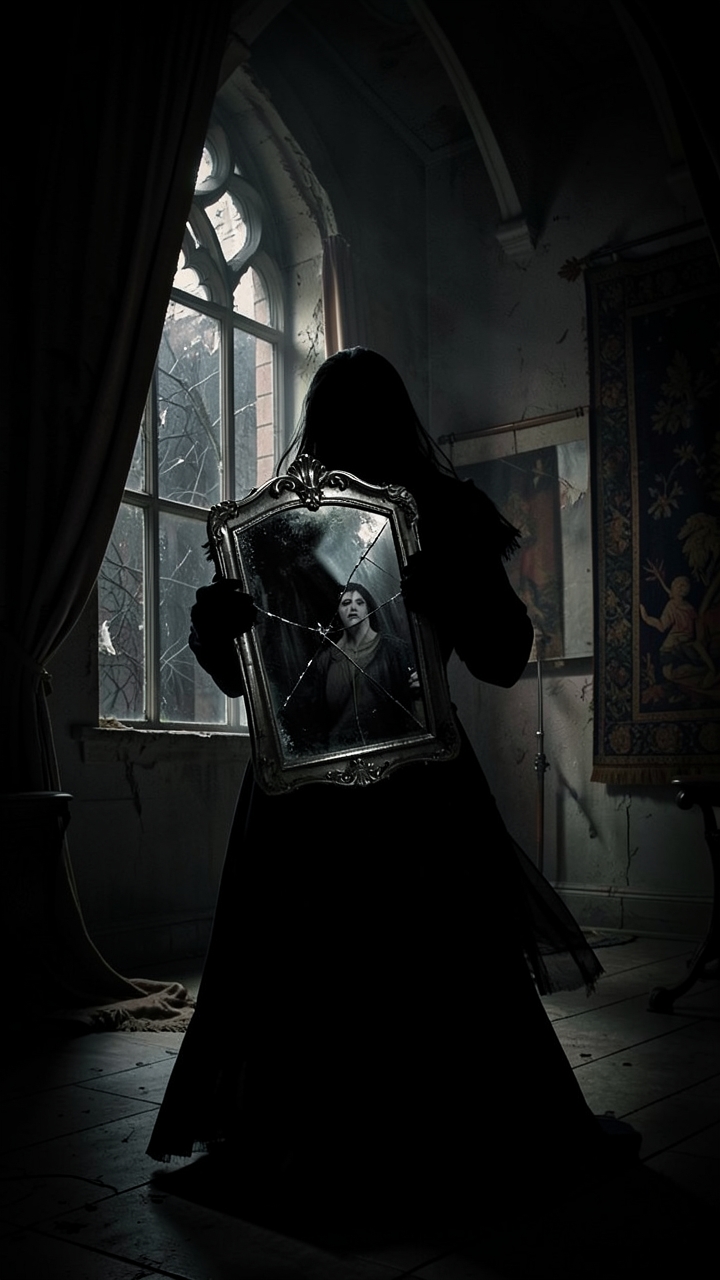
What if the voice guiding you through the story’s shadows is the very source of its deepest distortions? This is the haunting promise of unreliable narration—a technique that transforms a simple narrative into a labyrinth of the mind, where the truth is not merely hidden but actively shaped by a flawed, biased, or deceitful consciousness. Mastering unreliable narration techniques is essential for any writer wishing to explore the fractured psyche or the compelling art of deception.
In literature, the narrator is often presumed to be a guide. But what happens when that guide is lost, malicious, or simply blind to their own failings? The story becomes a psychological battleground. We will explore the mechanics of this craft, from its theoretical underpinnings in gothic tradition to its modern psychological applications, and finally, witness it in a short, original tale of shadowed confession.
The Anatomy of Deception: Core Unreliable Narration Techniques
An unreliable narrator is not merely a liar. Their unreliability can stem from a multitude of fractures in their perception or morality. Understanding the source of their distortion is the first step in wielding this tool effectively.
The Naive or Innocent Narrator
This narrator lacks the understanding to fully grasp the events they describe. Their innocence creates a chilling dramatic irony. For example, the child narrator in Henry James’s The Turn of the Screw perceives the supernatural with a terrifying, matter-of-fact clarity that the adult reader must interpret. The horror lies not in what is said, but in the vast, unspoken realm the narrator cannot comprehend. To craft such a voice, focus on limited vocabulary, misinterpretation of adult motives, and a focus on sensory details without logical synthesis.
The Mentally Unstable or Biased Narrator
This is the realm of classic gothic tension. Edgar Allan Poe’s protagonist in “The Tell-Tale Heart” is the quintessential example. He insists upon his sanity while detailing the meticulous, irrational steps he takes to murder an old man for his “vulture eye.” The key technique here is cognitive dissonance: the narrator’s actions violently contradict their self-proclaimed rationality. Their reasoning is internally consistent but externally absurd. To employ this, build a character’s logic around a single, obsessive premise and show them defending it with manic energy.
The Deliberate Liar
This narrator chooses to deceive the reader, often for sympathy, manipulation, or to preserve a secret. Consider the narrator of Agatha Christie’s The Murder of Roger Ackroyd, who withholds crucial information not by omission, but by carefully curated truth. The technique relies on misdirection—focusing the reader’s attention on the wrong details while the narrator confesses to the crime in plain sight. Your challenge is to plant lies that feel natural, yet crumble under retrospective scrutiny.
Crafting the Fractured Voice: Advanced Techniques
Once you’ve chosen the type of unreliability, you must weave it into the very fabric of the prose. The unreliability should be felt, not just told.
Master the Art of Contradiction
Let the narrator contradict themselves within the same breath. In Shirley Jackson’s We Have Always Lived in the Castle, Merricat Blackwood’s narration is a tapestry of childish superstition, fierce loyalty, and stark confession. She might declare her love for her sister in one paragraph and detail her poisoning the family in the next, presenting both with equal sincerity. This inconsistency forces the reader to become a detective of the soul.
Use Sensory Detail as a Distortion
An unreliable narrator often hyper-focuses on specific, often irrelevant, sensory details as a defense mechanism. Gillian Flynn’s Amy Dunne in Gone Girl masterfully curates her diary entries, focusing on quaint, romantic details to craft a persona, while the brutal reality festers beneath. Her descriptions of baking and love are so perfect they become sinister. Describe what your narrator chooses to see—and, more importantly, what they choose not to see.
Let the Reader Do the Work
The most powerful unreliable narrators never announce their unreliability. They present their distorted reality as absolute truth. As Tana French demonstrates in In the Woods, the protagonist’s narration is so grounded in his own trauma that he—and the reader—cannot distinguish real clues from his psychological projections. The technique’s power lies in the gap between the narrator’s perception and the reader’s dawning realization. This creates a deeply engaging, interactive reading experience.
A narrator’s voice is a haunted house; every creak of its floorboards is a clue, and every shadow is a confession waiting to be misread.
A Case Study: The Gardener’s Lament
Consider this original story. Here, the narrator employs several unreliable narration techniques—bias, omission, and a fragile grip on reality—to reveal a truth far darker than the words themselves.
The roses are the only honest things in this garden. They do not pretend. Their thorns are as they are, and their blood-red blooms declare their beauty without shame. I tend them with the reverence they deserve. They know what happened to Elara. The soil remembers.
People ask where she went. I tell them she walked into the fog one autumn morning, following a path only she could see. A poet’s heart, you understand. Always chasing vapors. They nod, because they want to believe the simple story. They do not ask about the new roses I planted that spring, the ones I fed so well with ash and sorrow. They do not see how they drink so deeply from the dark earth near the old wishing well.
I am a good gardener. Everything in its place. The orderly beds, the trimmed hedges—my life is a testament to control. Unlike her. Her laughter was weeds, tangled and intrusive. Her questions were bindweed, strangling the peace I had so carefully cultivated. She saw things in the patterns of the leaves, whispered secrets to the night-blooming jasmine. Madness, the doctor called it. But it was simply… untidiness of the soul.
The roses thrive. See how they reach for the sun? I water them every evening, a quiet ritual. Sometimes, when the light is just right, I think I see a shape in the deepest blooms, a flash of her old blue dress caught in the petals. A trick of the light, of course. The mind plays tricks when it is burdened with grief and the weight of a perfect garden. I am content. The roses are beautiful. And the garden, at last, is silent.
The Echo in the Void: Why We Are Captivated
We return to the unreliable narrator not in spite of their deceit, but because of it. They mirror our own human capacity for self-delusion and selective memory. We are all unreliable narrators of our own lives. By crafting these voices, we hold up a cracked mirror to the reader’s own perception. The techniques of unreliable narration—from Poe’s fevered confessionals to Flynn’s calculated diaries—allow us to explore truth not as a monolithic fact, but as a fragile, subjective construct.
So, as you construct your next narrative, ask yourself: whose story is truly being told? And more hauntingly, can you, the writer, even trust the voice you have chosen to let speak? For in the deepest shadows of the story, the narrator and the author often begin a dance so intimate, it becomes impossible to tell who is leading whom.