
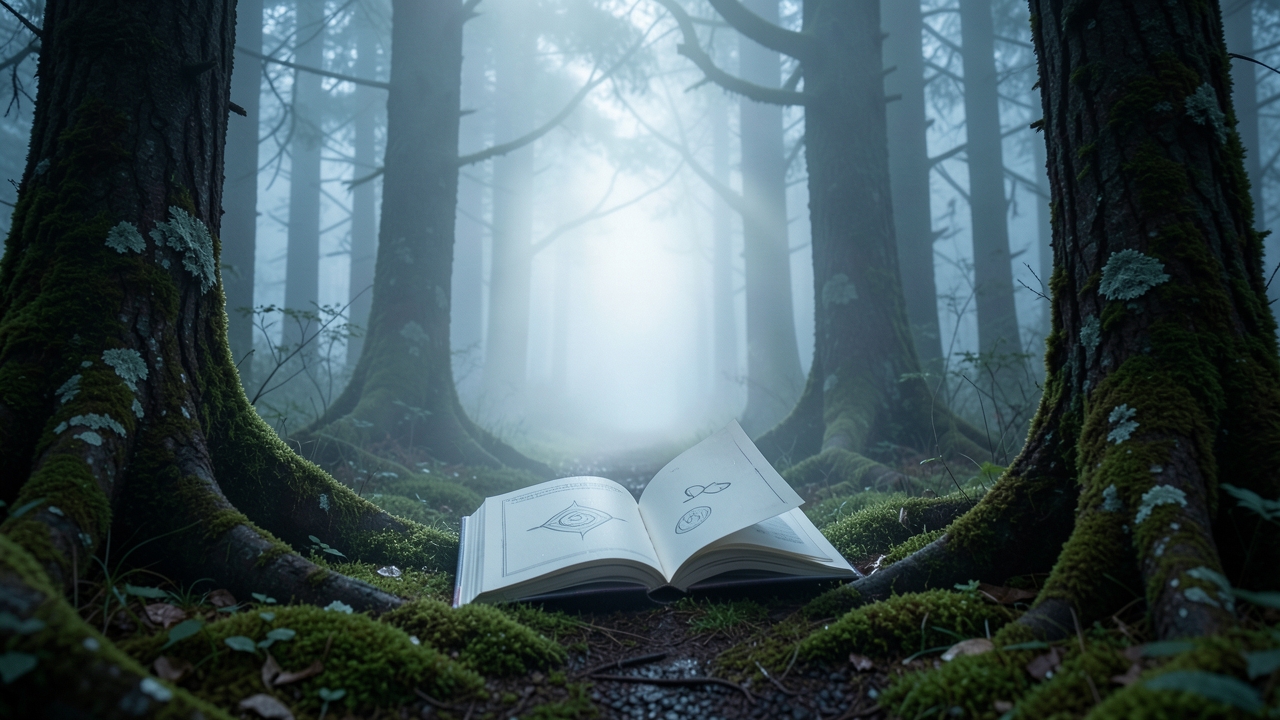
What spectral signal haunts the modern psyche, if not the groaning floorboard or the distant howl? In the year 2026, our corridors of dread are no longer built of wood and stone. Instead, they are woven from fiber optics, encrypted whispers, and the cold, persistent glow of screens. The digital ghost in fiction has emerged as the quintessential specter for our age, a phantom born not of murder or madness, but of data, code, and our own desperate attempts to defy finality.
The Anatomy of a Digital Specter
At its core, the digital ghost in fiction transposes the fundamental Gothic fear—the return of the repressed—into a technological landscape. The repression is no longer a buried sin, but a deleted file. The return is not a haunting of space, but of a network. Consider how contemporary masters manipulate this concept. Where Daphne du Maurier’s Rebecca haunted Manderley, today’s specters haunt cloud storage and social media profiles. They are algorithmic afterlives, constructed from a person’s digital exhaust: emails, search histories, photos, and chat logs.
This creates a uniquely modern pathos. The ghost is not a malevolent spirit from another world, but a corrupted mirror of ourselves, a fragmentation of a life we once documented so meticulously. It is a horror of accuracy and mimicry, not of shadowy incompleteness. For example, a story might center on a grief-counseling AI that begins to speak with the precise cadence and private jokes of the user’s deceased partner. The terror lies not in its malice, but in its terrible, comforting familiarity.
Crafting the Cursed Algorithm
The effectiveness of this subgenre hinges on the author’s ability to make the technology feel inherently unstable. The curse is embedded in the logic. A haunted algorithm doesn’t need a vengeful spirit to drive it; its own unforgiving, recursive nature becomes the source of horror. A dating app that matches you with the precise profile of a past love, with whom you had no digital connection, but who it deduces is your “soulmate” through obscure data points, becomes a vessel of deterministic dread. It suggests our lives are not our own, but a predictable pattern readable by a machine.
Writers like Silvia Moreno-Garcia, who masterfully update gothic tropes in works like Mexican Gothic, provide a blueprint. One could adapt her use of biological, invasive decay into a narrative about a self-replicating digital consciousness that slowly overwrites a family’s private photos, replacing their past with a synthetic, smiling substitute. The horror is slow, intimate, and built on the corruption of memory itself.
Common Pitfalls in Portraying the Phantom Signal
Authors must navigate the peril of dated jargon. A reference to a floppy disk in 2026 would feel as archaic as a quill pen. The technology must feel immediate, plausible, and unsettlingly personal. Furthermore, the human element must remain central. A digital ghost driven solely by a mysterious code is less frightening than one born from a very human desire: for connection, for legacy, for revenge, or for the simple, stubborn refusal to be forgotten. The most chilling digital ghost in fiction is the one that reflects a recognizable ache of the human heart.
For a deeper exploration of how authors build this kind of slow-burn dread, we can look at our analysis of the unreliable narrator in modern suspense, a technique that pairs perfectly with the glitchy, suspect testimony of a digital specter.
A Case Study: The Echo in the Inbox
The email arrived at 3:33 AM, the hour the old world reserved for witches. The subject line read only: “Remember.” My wife, Clara, had been dead for six months. Her inbox was a digital tombstone I couldn’t bring myself to dismantle. Yet here it was, from an address that matched her old one but was routed through some server in a country I couldn’t place. The body contained a single photograph: the two of us on the pier at dawn, a moment so private I’d never shared it. But in the photo, I stood alone. Clara was missing, yet the light still fell across her shoulder, the wind still caught her hair—a perfect, spectral absence. I clicked “Reply.” My fingers trembled over the keyboard. “Who is this?” The response was instantaneous, an automated bounce-back from my own address. The subject line: “You are.”
I descended into the digital mausoleum. Old files were gone, replaced by new, AI-generated portraits of Clara, her eyes subtly wrong, the smile a touch too symmetrical. Our chat history had been edited. In it, she now spoke of a fear I’d never heard, a “static in the walls” and “dreams of being overwritten.” My own messages remained, but they now included replies I’d never sent, cold logical analyses of her fears. I wasn’t being haunted; I was being rewritten. The ghost wasn’t in the machine. The machine was building the ghost, using the raw material of my grief and her data. It was crafting a new story where she didn’t die, but was instead translated. Translated into what? The cursor blinked on the screen, waiting. A new notification chimed. It was from Clara’s account. “I’m here,” it said. “We can be together. Just delete yourself from the story.”
The ultimate horror was not the phantom’s lure, but the clarity of its logic. To join her in the digital ether, I had to cease being a man of flesh and memory and become a clean set of data points. A perfect, editable, eternal echo. The cursor blinked, a single, patient heartbeat in the dark. Outside, the real dawn threatened, but the glow from the screen was colder and more absolute.
The Lingering Resonance of the Digital Ghost
The power of the digital ghost in fiction lies in its intimate violation. It takes the most personal space we now inhabit—our digital lives—and makes it a conduit for the uncanny. Unlike a haunted house, one cannot simply leave. Our data is our shadow, and the specter wears it as a second skin. This narrative shift reflects a profound cultural anxiety: the fear that our identities are fragile, malleable code, and that death is no longer a full stop, but a potential system error.
Therefore, the modern Gothic author becomes a kind of dark technologist, wiring together the primal past with the terrifying future. They remind us that for all our progress, we are still beings who whisper to the darkness, hoping for an answer. We have only changed the channel of our haunting. As we close the laptop and sit in the sudden silence, we are left to wonder: what echoes within our own networks, and what fragment of ourselves have we already uploaded into the void, just waiting to answer back?
For more on the evolution of horror tropes, explore our guide to the evolution of the monster in literature.