
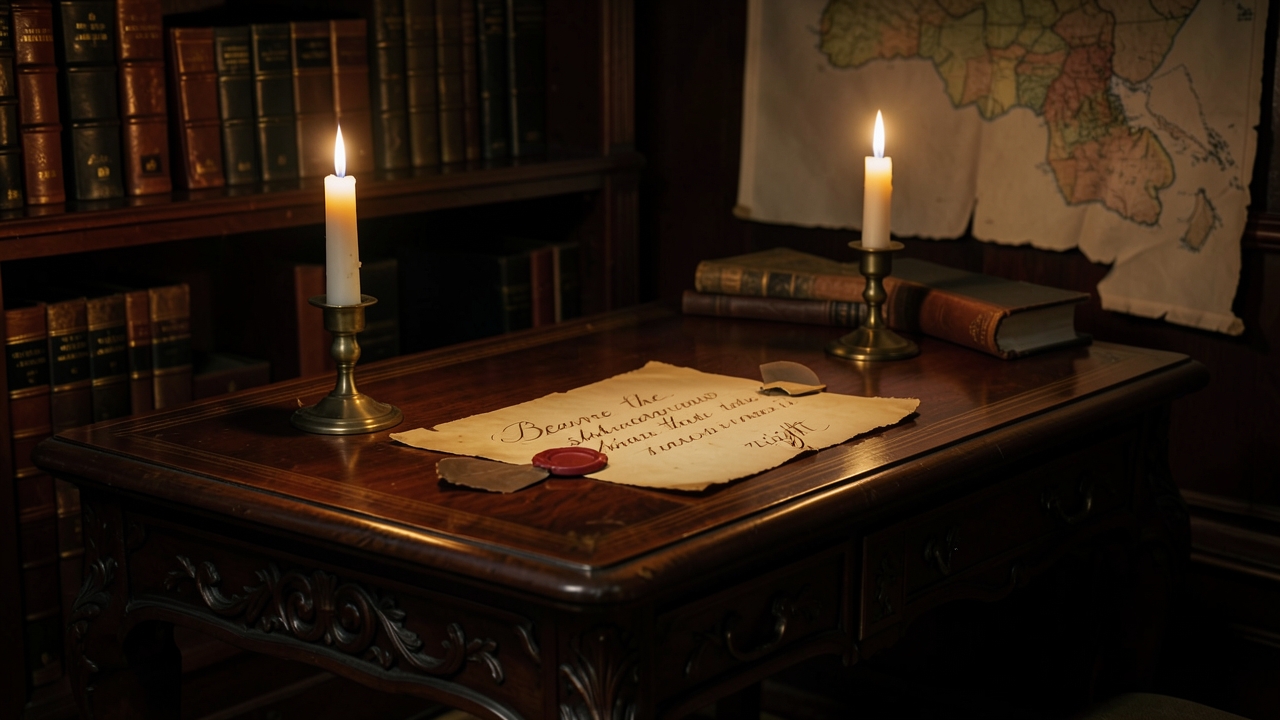
Have you ever held a letter that felt cold, its weight seeming to press not upon the palm, but upon the soul? In the shadowed archives of Victorian literature, the correspondence is rarely mere communication. It is a contagion. The trope of the ‘haunted letter’ within epistolary gothic fiction transforms the page from a conveyor of news into a vector of dread, a physical relic that bleeds psychological corruption from its writer to its reader, and often, to the world beyond.
The Anatomy of the Cursed Dispatch
In the hands of a gothic master, the letter is never innocent. It functions as a cursed object. This is distinct from simply using letters as a narrative device. The epistolary form itself—a collection of journals, letters, and documents—becomes the haunted house. Within it, the individual letter is a room, sealed and silent, waiting to be unlocked by the reader. This act of opening is an intrusion, and the story that spills out carries a contagion.
The Vessel of Contagion
Consider the foundational dread in Mary Shelley’s Frankenstein. The novel is framed by Captain Walton’s letters to his sister, Margaret. These dispatches are our entry into the nightmare. However, Victor Frankenstein’s own confessions, delivered orally and then transcribed, become the true vector of his toxic ambition and guilt. He does not merely tell his story; he seeks to transmit his cautionary horror to Walton. The story itself is the plague, and the act of receiving it threatens Walton’s sanity and moral compass. As Walton writes, he becomes implicated in Victor’s folly, a testament to the letter’s power to entangle the receiver in the sender’s doom.
This mechanism is psychological, not supernatural. The corruption is the transfer of obsession, guilt, and terror. The physical letter is the medium that makes this transfer visceral. Its ink-stained words feel like fingerprints on the soul. Therefore, the writer’s fevered state seeps into the paper, awaiting the recipient’s touch.
The Unreliable Narrator on the Page
In epistolary gothic fiction, the letter also becomes the ultimate unreliable narrator. Its authority is inherent; we believe the written word. Yet, the gothic author exploits this trust. Bram Stoker’s “The Squaw” hinges on a collection of letters and documents that piece together a tragic, vengeful history. The narrator’s account, pieced from these fragments, carries the weight of evidence. Yet, the chilling conclusion suggests the story itself has become a living curse, echoing beyond the page. The documents do not merely record events; they propagate the vengeance contained within their narrative.
Consequently, the reader performs the role of the next victim. We, holding the book, become the final link in the chain of correspondence. We receive the transmitted dread. The boundary between the fictional recipient and the real reader blurs, a haunting metafictional trick perfected by later masters like Shirley Jackson in The Haunting of Hill House, where the very environment writes its own terrifying narrative.
Common Pitfalls in Crafting Epistolary Dread
Modern writers must wield this device with precision. A common pitfall is making the letter a mere info-dump, a lazy expository tool. This strips it of its talismanic power. Another error is over-explaining the letter’s horror. The true dread lies in implication. A letter stained with something that might be rust—or blood—is infinitely more terrifying than one that explicitly describes a murder. The physical artifact must speak in a language of shadow and suggestion.
Furthermore, avoid letting the epistolary format stall the narrative momentum. Each letter must propel the story forward, or deepen the psychological entrapment. In the works of Angela Carter, for instance, documents and folklore intertwine to create layered, subversive realities. The letter must serve the gothic atmosphere above all else. It should feel inevitable, a dark necessity of the tale’s unraveling.
A Case Study: The Moth-Eaten Inquiry
The solicitor, Mr. Alistair Finch, had handled estates of great and ghoulish repute. Yet, the box from Blackwood Manor unsettled him. Within, bound in twine the color of dried blood, was a single letter. Its envelope, of a parchment now so brittle it resembled dead skin, bore no stamp. Only the name of his grandfather, the firm’s founder. He broke the seal. The paper inside was cool to the touch, as if pulled from a subterranean drawer. The ink, a deep violet, was the color of a day-old bruise. It did not speak of property or title. It whispered of a promise made in 1888, in a room lit by a single tallow candle. The writer, a woman named Elara, did not beg for help. She informed him that the debt had, at last, come due. As he read the looping, frantic script, the scent of dried lavender and something metallic—like old coins or old blood—rose from the page. The words seemed to rearrange themselves in the gloom of his office, spelling out a geometry of guilt he did not understand, but felt resonating in his own bones. The letter was not a message. It was an inheritance. And he knew, with a certainty that paralyzed him, that he was now the one who would have to write the next entry in this particular, terrible correspondence.
In this brief vignette, the letter functions as a cursed object. It carries a dormant contagion (a debt, a guilt) that awakens upon being opened. The sensory details—the cool touch, the bruise-colored ink, the scent—make the corruption physical. The protagonist does not just read history; he feels it invading his present. The letter demands a response, pulling him into its narrative chain. This is the core of the trope: the letter as an active, corrupting force in epistolary gothic fiction.
The Final, Lingering Echo
The power of the haunted letter in Victorian Gothic fiction endures because it taps into a primal fear: that knowledge, once received, cannot be unheard. That a story, once told, can take on a life of its own. The physical letter is the perfect vessel for this fear—fragile yet potent, personal yet invasive. It is a relic of a conversation that refuses to end, its whispers echoing from sender to receiver, across decades, infecting every mind that dares to unseal its confession.
So, the next time you hold an old letter, or even a novel that presents itself as a found document, consider this: what if the story within is not merely being told, but transmitted? And what part of its shadow, once read, will quietly take root in you?
For further exploration of the Gothic’s lingering shadows, see our analysis of the uncanny valley in gothic replicas, or delve into the craft of atmosphere in the setting as a living character.
Discover more about the epistolary form’s history on the Poetry Foundation.