
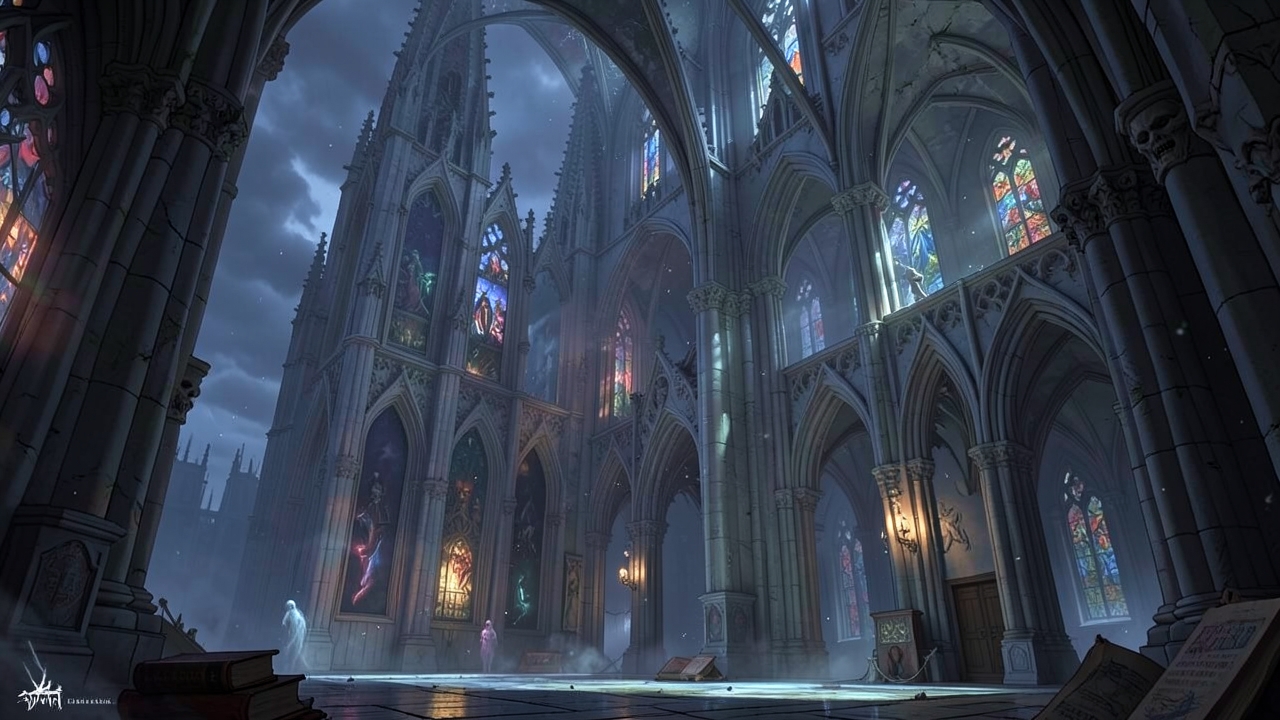
Have you ever felt the walls of a room grow closer, not by any physical contraction, but by the slow, creeping weight of your own thoughts? This is the primeval terror that masters of Gothic architecture fiction understand and wield. They do not merely place characters in haunted houses or lightless tunnels; they forge these spaces from the very fabric of a psyche in crisis, making the architecture a living, breathing antagonist.
In the shadowed corridors of contemporary storytelling, the haunted house has evolved beyond creaking floorboards and spectral moans. Today’s most potent Gothic fiction employs confined architectural spaces as externalized minds—prisons of memory, guilt, and paranoia. This article delves into the craft of mapping claustrophobic dread, exploring how authors transform setting from backdrop to psychological protagonist.
The Architecture of the Psyche: Building the Psychic Prison
To master Gothic architecture fiction, one must first understand that the space is a symbol made visceral. It is not a metaphor; it is a manifestation. Consider Shirley Jackson’s Hill House in The Haunting of Hill House. The house is not merely old or evil; it is not sane, as its walls actively conspire to absorb Eleanor Vance’s fragile mind. The architecture preys on her isolation, mirroring and amplifying her inner turmoil until the distinction between inhabitant and habitat dissolves.
\h3>Techniques for Forging the Prison1. The Mirror Effect: The space must reflect a core fracture in the protagonist. In Tana French’s The Likeness, the decaying Georgian mansion where the detectives reside becomes a physical echo of the victim’s suspended, bohemian life. Its faded grandeur and labyrinthine layout mirror the case’s complexity and the detectives’ own submerged identities.
2. Sensory Constriction: Effective claustrophobia is a sensory assault. Limit the palette. In H.P. Lovecraft’s subterranean tales, like The Case of Charles Dexter Ward, the damp, mineral scent of stone and the oppressive darkness create a tangible sense of being buried alive. The architecture presses on the skin, chills the breath.
3. The Unreliable Blueprint: The space should defy logical navigation. Gillian Flynn’s work often employs this; in Gone Girl, the meticulously described Missouri home feels both familiar and deeply wrong, its rooms and corridors becoming sites of psychological warfare. The layout itself becomes a plot twist.
Mapping the Dread: A Writer’s Cartography of Fear
How does one construct such a space? Begin with the character’s dominant emotion—guilt, shame, or a repressed memory—and let the architecture grow from that seed. A bunker in a story about isolation isn’t just a bunker; its reinforced walls might represent a desperate need for emotional armor. A tunnel becomes a birth canal for a terrifying rebirth, or a vein leading to a dark, pulsing heart.
\h3>Common Pitfalls in ConstructionOver-description: The goal is not an architectural survey. Every detail must serve the mood. Jorge Luis Borges, in tales like The Library of Babel, creates infinite, oppressive space through minimalist, conceptual description, not exhaustive detail.
Static Setting: The space must change with the character’s psyche. As the protagonist unravels, so should the architecture. Doors that once opened may now jam; windows may seal themselves; corridors may lengthen. In Silvia Moreno-Garcia’s Mexican Gothic, the decaying hacienda literally sickens, its decay accelerating alongside the protagonist’s discovery of its horrific history.
Passive Haunting: The most profound dread arises when the space doesn’t actively haunt, but rather seduces and betrays. It offers a twisted solace before revealing itself as the true source of anguish. This mirrors the protagonist’s own relationship with their traumatic memories.
For further insight into setting as character, our guide on Writing Setting as Character in Gothic Fiction provides essential techniques.
A Case Study: The Inheritance of Dust
They called it the Archive, though it held no books. Only shelves, floor to ceiling, of sealed glass jars. Elara inherited it from a grandmother she’d never met, a genealogist who had stopped tracing bloodlines and started preserving atmospheres.
Each jar contained a sliver of a room. A shard of wallpaper from a nursery where a fever dream bloomed. A chip of brick from a cellar where a secret was buried. The air inside the Archive tasted of old dust and trapped breath. The door, a heavy iron thing, clicked shut behind her with the sound of a final exhalation.
As she walked the narrow aisles, the light from the high, grimy windows slanted across the jars, igniting the contents. The wallpaper sliver seemed to pulse with a faint, sickly rose. The cellar brick exuded a damp chill that crept up her ankles. The architecture was a grid, a neat, rational prison. But the spaces it held were irrational, bleeding their old anguish into the present.
On the third day, she found a jar with her own name etched on the lid. Inside was a splinter of painted wood, the exact blue of her childhood bedroom door. The room she had dreamed was safe. Holding it up to the light, she saw it wasn’t wood alone. Woven into the grain was a thread of her mother’s hair, and the faint, impossible echo of a lullaby that had always turned sour in the recollection.
The Archive wasn’t a library of other people’s memories. It was a blueprint of her own. The shelves were her neural pathways. The jars were the locked rooms of her mind. And the dust, settling on everything, was the quiet, relentless work of forgetting, or of being forced to remember.
The Echoing Conclusion
The true power of Gothic architecture fiction lies in its ruthless efficiency. It uses the physical to dissect the metaphysical. A confined space forces confrontation—there is no external escape, only the internal. The walls do not just surround the character; they interrogate them. Every shadow is a suppressed thought, every locked door a repressed memory.
As the lines between the built environment and the haunted mind blur, we are left with the most intimate terror of all. The realization that the most claustrophobic space we can inhabit is the architecture of our own unexamined past. And when the walls of that structure begin to whisper, whose voice, truly, do we hear? Does it not murmur our own name?