
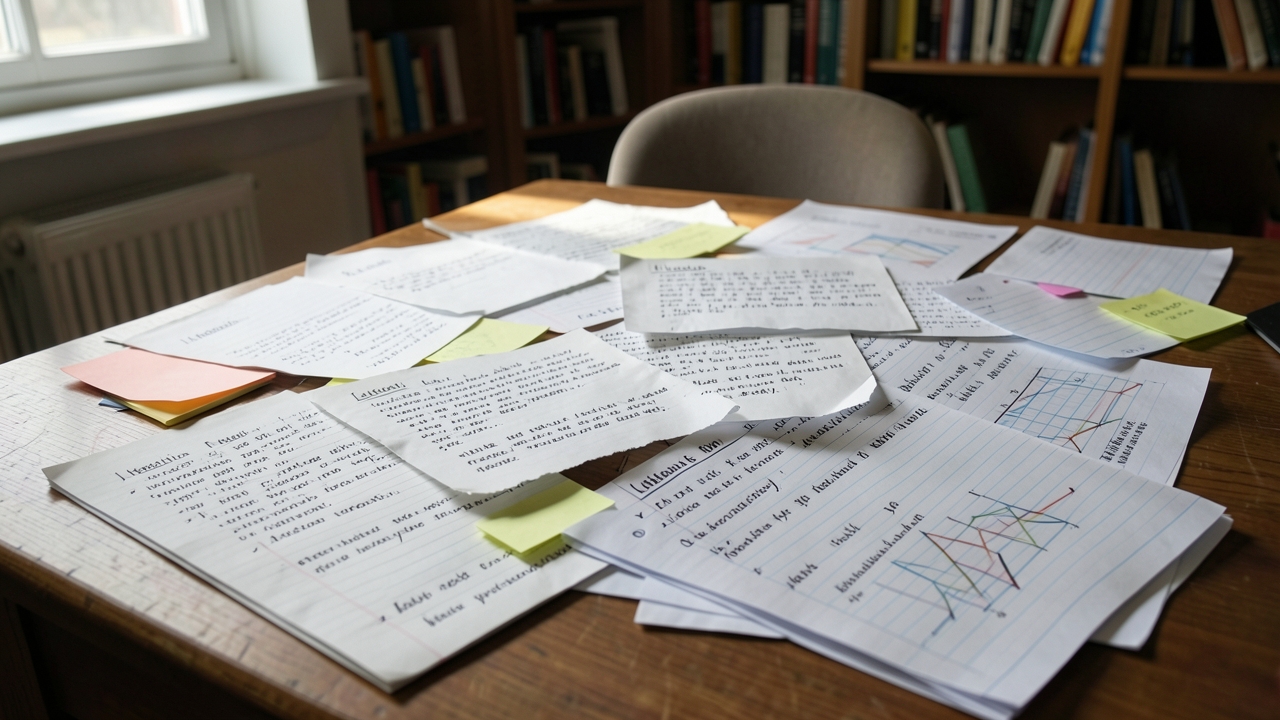
Do we not all fear the incoherent thought? The terror that our memories, our inquiries, our deepest feelings might exist only as scattered shards, refusing to form a neat, linear narrative. We are taught to build arguments like pillars, to structure essays as bridges from premise to conclusion. But what if the most profound truths are found not in the architecture of the whole, but in the poignant beauty of the pieces? What if the truest vessel for our intellectual and emotional wanderings is, in fact, the fragmented essay structure?
In 2009, Maggie Nelson published Bluets, a work that does not simply employ fragments but becomes one—a constellation of 240 numbered propositions, aphorisms, and vignettes that orbit the color blue, love, loss, and the philosophy of desire. It is a map of a mind in motion, and it offers a revolutionary model for writers seeking to weave research, memoir, and criticism into a cohesive, non-linear whole. To study its design is to receive an education in the potent, haunting logic of the disjunctive.
Anatomy of a Shard: The Theory of the Fragmented Essay
A fragmented essay structure is not an admission of failure, but a deliberate formal choice. It mirrors the associative, recursive nature of human thought and memory. Unlike a traditional essay, which asserts, the fragmented essay explores. It gathers, juxtaposes, and allows resonance to bloom in the spaces between ideas. As poet and critic Maggie Nelson demonstrates, this form is inherently philosophical; it enacts the process of inquiry rather than merely reporting its conclusions.
The Power of the Numbered Aphorism
Nelson’s use of numbering is crucial. It lends a deceptive order to the sprawl, a pseudo-scientific rigor to the personal. Each numbered fragment stands alone as a complete thought, yet gains new meaning in dialogue with its neighbors. Consider proposition 42: “I have enjoyed telling people that I am writing a book about blue, when what I really mean is that I am writing a book about love, or the lack thereof.” Here, a simple, aphoristic statement performs a sleight-of-hand, pivoting from the trivial to the profound. This technique allows the writer to pivot sharply between registers—from a factual aside about indigo dye to a searing admission of heartbreak—without the burden of transitional prose.
For the writer, the lesson is clear: the fragment can be a perfect, polished gem. It can hold a single, potent idea with the clarity and weight of a proverb. In this, Nelson stands in a lineage with masters of the aphorism, from Friedrich Nietzsche to her contemporary, the philosopher and writer Anne Carson, who also masterfully blends the essay, the poem, and the personal memoir.
Weaving the Trivium: Research, Memoir, Criticism
The genius of Bluets lies in how effortlessly it braids three distinct strands. The fragmented essay structure acts as a loom, allowing these threads to cross and bind without tangling.
First, there is research. Nelson delves into the science of color perception, the history of pigments, and the philosophy of aesthetics. Second, there is memoir: her own experiences with love and depression, often symbolized by blue. Third, there is criticism: she engages with artists like Yves Klein, composers like Anton Webern, and writers like Goethe. A traditional essay would segregate these elements. The fragmented form, however, places a fact about the physics of light directly beside a memory of a lover’s eyes, allowing the reader to feel the synaptic leap. The connection is not argued; it is demonstrated, creating a richer, more intuitive understanding.
This method finds echoes in other works of poetic nonfiction. One might look to the associative structure of a literary journal, or to the collage-like essays of John D’Agata, who similarly challenges the boundaries of factual narrative. The key is trust—trust in the reader to follow the intellectual and emotional thread you weave, even when it dips below the surface.
The Cohesive Wholeness of the Broken
How, then, does this scattered collection avoid feeling like a mere notebook dump? The answer lies in thematic cohesion and careful sequencing. Every fragment in Bluets, however disparate, is a facet of the central prism: the color blue. This thematic anchor allows for enormous latitude. One can jump from a personal confession to a historical footnote, and the reader’s mind, held by the theme, makes the connection.
The order of the fragments creates a subtle, emotional arc. Nelson arranges them not chronologically, but rhythmmically and emotionally. A fragment of stark despair might be followed by one of detached, aesthetic analysis, creating a dynamic push and pull that mimics the actual experience of processing complex feelings. It is the difference between a photograph album and a symphony; both tell a story, but one invites you to wander, while the other guides you through a landscape of sound and silence.
A Case Study: The Cartography of Dust
To illustrate the application of these principles, consider the following original micro-essay, constructed in the fragmented, aphoristic style.
1. The photograph is not the memory; it is the tombstone of a moment. We visit it, not to resurrect, but to pay respects.
2. In 1997, a team of astronomers discovered that the universe is not only expanding, but accelerating. This felt like a metaphor for the first week after you left. Everything moving away, faster and faster.
3. I read once that dust is mostly composed of human skin cells. I think of your sweater, left on the chair. The dust that settles upon it is an archive of our shared air, a quiet, granular haunting.
4. There is a species of jellyfish, Turritopsis dohrnii, that can revert to its juvenile state. It does not die; it simply begins again. I wonder if memory works this way in reverse—not to make us young, but to make the past perpetually, painfully present.
5. You once said my grief was beautiful. I did not know how to hold that. Grief as an aesthetic object. A sculpture of dust in the shape of a person who is no longer there.
6. To write is to make a map of the country of the self. But the country is made of dust. The map crumbles as you draw it.
Here, the fragments—personal, scientific, philosophical—circulate around a central void: absence. The numbered structure allows each statement to land with precision, while the sequence builds an emotional resonance no linear argument could achieve. The research (astronomy, biology) is not decorative; it becomes a language for articulating the inarticulable.
The Echo in the Chamber of Fragments
Maggie Nelson’s Bluets is more than a book; it is a permission slip. It grants us the courage to present our thoughts as they truly are: a constellation of bright points, held together by the gravity of a central, aching question. The fragmented essay structure does not simplify complexity; it honors it. It admits that the mind is not a highway, but a labyrinth, and that the truest inquiry often involves circling the same central mystery from ever-new, fractured angles.
So we are returned to our initial fear: the terror of incoherence. Perhaps the task of the writer is not to build a flawless bridge over the chasm, but to meticulously catalog the stones at its bottom, to show how each shard, in its unique fracture, holds its own reflection of the light. In the end, is not the mosaic of the broken pieces a more honest, and more hauntingly beautiful, representation of a life than any polished, monolithic narrative?