
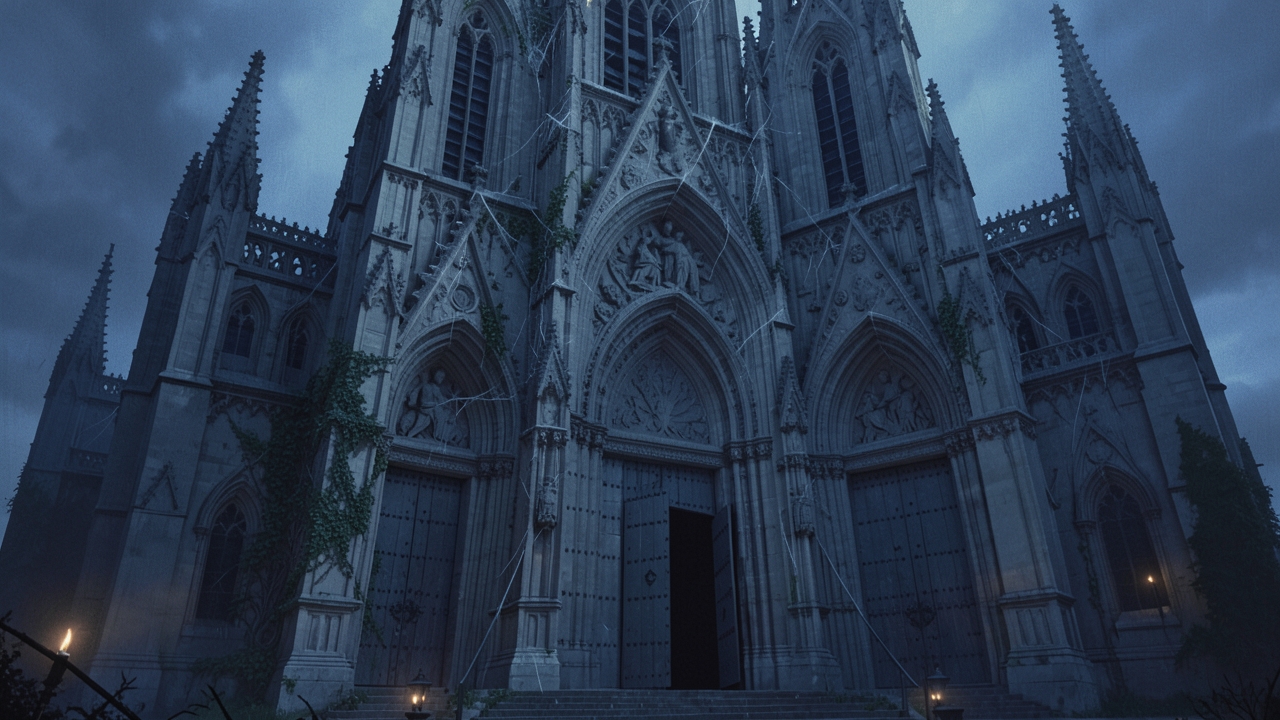
In the shadowed corridors of the human psyche, what truly haunts us? Is it the clamor of a confession, the shriek of a revelation, or is it, rather, the profound, calculated gothic silence tension that stretches between heartbeats? In 2026’s landscape of dark fiction, the most formidable architectures of dread are built not from cacophony, but from a deliberate, almost reverent, void. This article explores the masterful use of sensory absence as the primary tool for crafting atmospheric terror.
The Theory of Absent Voices: Why Silence Screams Louder
Traditional haunted house tropes often rely on dialogue to communicate horror—a ghost’s plea, a victim’s scream. Yet, the masters of the genre understand a more potent truth. Silence is not the absence of story; it is a story’s most pregnant pause. It forces the reader to fill the vacuum with their own deepest fears. Consider Edgar Allan Poe’s “The Fall of the House of Usher.” The true horror unfolds in the unspoken tension between Roderick and Madeline, in the static of the house’s very atmosphere, long before the final, ghastly reunion.
Anatomy of an Unspoken Threat
To engineer gothic silence tension, a writer must first understand its anatomy. It is not mere quiet. It is an active silence—a held breath, a listened-for footstep that never arrives, a conversation frozen mid-sentence. For example, Shirley Jackson in The Haunting of Hill House masterfully uses the absence of Eleanor’s mother’s voice, a silence that has shaped her entire existence. The house amplifies this personal void, turning silence into a malevolent presence.
In addition, this technique leverages a fundamental human fear: the unknown. When dialogue ceases, the narrative frame becomes a blank canvas for the imagination. H.P. Lovecraft often withheld the direct description of his cosmic entities, allowing the protagonist’s terrified silence and broken monologue to imply horrors beyond language. The reader’s mind, in its frantic attempt to understand, constructs something far more personal and terrifying than any described monster.
Crafting the Void: Techniques for Modern Authors
How, then, does one wield this weapon of absence? The craft lies in meticulous staging and sensory redirection. You must build the silence before you can shatter it, or worse, let it remain.
The Overture of Stillness
Before the dread can truly descend, the world must be stilled. Daphne du Maurier’s Rebecca opens with the famous line, “Last night I dreamt I went to Manderley again.” The entire narrative is steeped in the oppressive silence of the dead Rebecca’s legacy. To replicate this, focus on hyper-specific sensory details that highlight what is not there. Describe the creak of a floorboard that stops. Note the clock whose ticking has ceased. Highlight the dust settling in a sunbeam where conversation once lived. This creates a soundscape defined by its missing elements.
Redirecting the Senses
When you remove auditory stimuli through silence, you amplify others. The texture of velvet on a chair, the chill of glass, the scent of decaying paper—these become deafening. Modern masters like Tana French in The Witch Elm often linger on tactile and visual minutiae during moments of high psychological tension. The character’s focus on the grain of wood or the stain on a ceiling becomes a transfixed meditation, a visual scream against the silent backdrop of unspoken suspicion.
The Dialogue That Isn’t
One of the most potent forms of gothic silence tension occurs in the aftermath of dialogue. Gillian Flynn excels here. In Sharp Objects, the most chilling moments are often the quiet exchanges between Camille and her mother, Adora, where the subtext is a screaming indictment. The tension lives in the pause before the answer, in the change of subject, in the words that hang, unfinished, in the air. Write the conversation, then write the silence that swallows it whole.
Furthermore, as noted by literary critic Literary Hub, contemporary Gothic fiction is increasingly turning inward, making psychological silence—repressed memory, denial, trauma—a key source of atmospheric dread, a trend that aligns perfectly with this technique.
Common Pitfalls: The Pit of Empty Pages
However, this is a delicate alchemy. Misused, silence becomes mere emptiness, a failure of narrative. The pitfall lies in mistaking length for depth. Endless, unbroken paragraphs of nothing happening will lull, not unnerve. The tension must be charged. Every silent moment must be preceded by a reason for noise and followed by the consequence of its absence. It must feel like a held breath the reader cannot release.
Another mistake is relying on silence without purpose. For this technique to serve gothic silence tension, the quiet must be character-driven. It should reflect a repression, a fear, a secret. As Angela Carter demonstrated in works like The Bloody Chamber, the most terrifying fairy-tale castles are filled not with monsters, but with the stifling silence of patriarchal expectation and unspoken violence.
Therefore, always tether your silences to a character’s internal state or a tangible, external threat. The silence should be a character in itself—an entity of dread that occupies the space between people.
A Case Study: The Last Archive of Mrs. Vane
I went to catalog her effects on a Tuesday. The Vane estate stood at the end of a lane where the birds had long since abandoned song. Inside, silence was not an absence but a substance, thick as velvet and smelling of camphor and regret. Dust motes danced in the single shaft of light from a grimy window, each a universe of forgotten moments. My task was simple: box the books, wrap the porcelain, quantify a life.
The first floor yielded to my intrusion with only the protest of settling timber. But the upper hallway, leading to her study, held a different quality of quiet. It was attentive. I could feel the weight of it against my eardrums, a pressure building. The air tasted of metallic anticipation. Before the study door, I paused. From within, I could hear nothing—not a creak, not a whisper, only the thunderous silence of my own blood in my veins. The doorknob was cold, a frost that bit through my glove. I turned it.
The room was as she had left it. A ledger open on the desk, a pen laid neatly beside it, its ink long dried to a black scab. A chair pushed back, as if someone had just risen. The silence here was different. It was not empty; it was full. It hummed with the resonance of a final, unspoken word. My eyes followed the implied gaze of the chair toward the tall bookshelf. There, a single volume was out of place, jutting forward an inch from its fellows. A dark blue spine, title worn away by anxious hands. As I reached for it, the silence in the room shifted. It condensed, gathering in the corner behind me, a cold spot where the light did not touch. I froze, hand outstretched. The only sound now was the frantic, brittle tap of my own heartbeat against the silence’s immense, listening architecture.
Conclusion: The Echo in the Empty Chamber
We began with a question of what truly haunts. The answer, as the architecture of gothic silence tension reveals, lies in what we cannot hear, in the void our narratives carefully curate. It is a dialogue with absence, a story told through the chilling shape of what remains unspoken. Modern dark fiction, in its most potent form, understands that the human imagination is the most elaborate haunted house of all, and that the most terrifying rooms are those furnished only with our own silent dread.
So, as you next venture into a dark tale, or craft your own, listen closely. In the pause between the last spoken word and the first scream of the soul, what does the silence whisper to you? And is it, perhaps, the sound of your own fear, finally given room to echo?
For further reading on the technical underpinnings of atmospheric writing, explore our guide on crafting effective foreshadowing. To delve deeper into the psychology of fear, our analysis of symbolism in gothic literature provides valuable context.
Additionally, the Poetry Foundation offers excellent resources on how poetic devices like caesura (a pause in meter) function similarly to create tension and emphasis in verse, a technique that directly informs prose rhythm.