
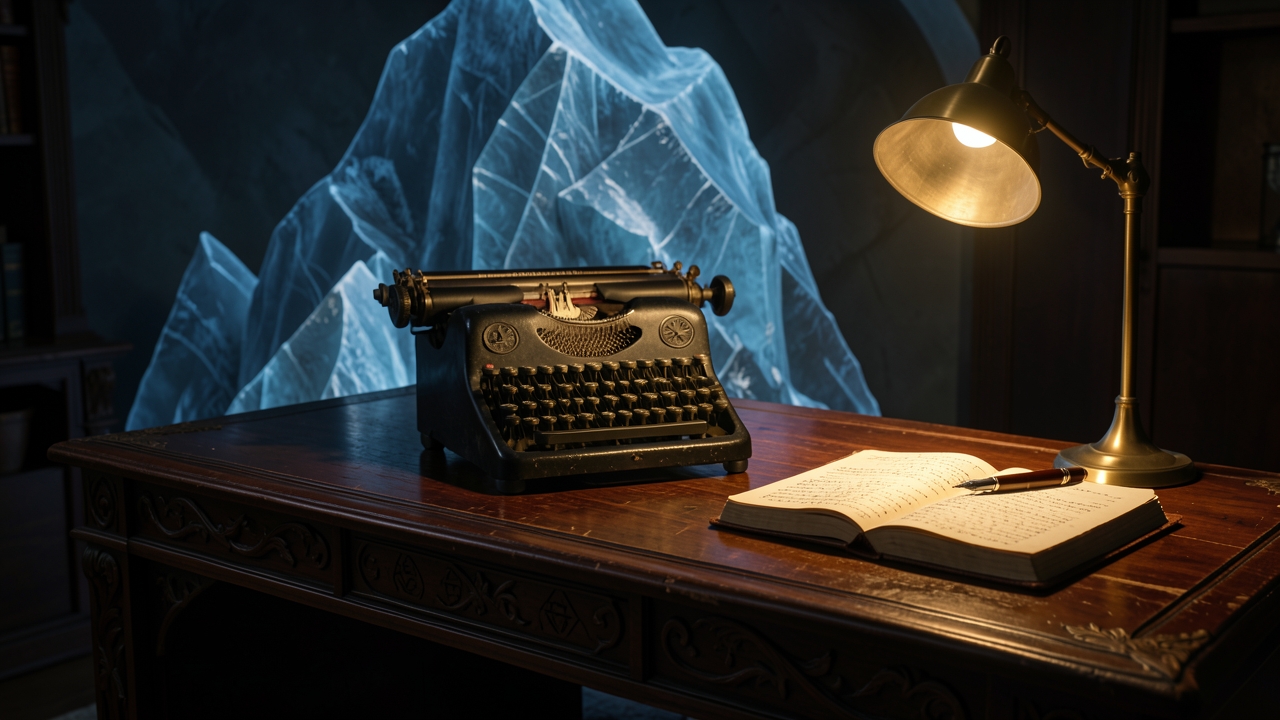
What secrets does a story carry when it never speaks them aloud? Consider the surface of deep water. It reflects the sky, conceals the mountain beneath. The reader feels its mass without ever seeing the stone. That is the ache at the heart of the iceberg theory flash fiction, and few writers have probed its depths as mercilessly as you might expect at such a small word count.
Hemingway built his legend on omission. Yet flash fiction compresses that omission to a pressure few forms survive. At five hundred words, every withheld detail becomes a live wire. Every silence must hum.
Why Flash Fiction Demands the Iceberg
First, understand the arithmetic of the form. A flash piece of five hundred words has roughly the capacity of a single scene, sometimes less. There is no room for prologue. There is no room for the tidy paragraph of backstory that novels permit. Consequently, the writer must smuggle history into gesture, into a single repeated word, into what a character refuses to say.
What Hemingway Actually Meant
In Death in the Afternoon, Hemingway wrote that “if a writer of prose knows enough about what he is writing about he may omit things that he knows and the reader, if the writer is writing truly enough, will have a feeling of those things as strongly as though the writer had stated them.”
Note the condition: writing truly enough. The theory is not a licence for vagueness. It is a contract of precision. In “Hills Like White Elephants,” the couple never utters the word abortion. Nevertheless, the entire story leans on it. The word “please” recurs in Jig’s mouth like a pulse. The dialogue circles and refuses. As a result, the reader supplies the wound that the prose never displays. You can read the story’s architecture through the Poetry Foundation’s portrait of Hemingway and see how the theory grew from a life spent distrusting ornament.
The Depth Ratio Shifts at 500 Words
Here is the crucial difference between the short story and flash. In a ten-page story, the submerged mass can sprawl. In flash, the iceberg must be narrow and vertical. It plunges far below a tiny surface. Therefore the writer chooses one hidden fact — one fracture — and lets it hold the entire structure.
Choose two hidden facts and the piece collapses into confusion. This is the discipline the form imposes. One secret. One waterline.
Techniques for Iceberg Theory Flash Fiction
Theory is a lantern. Craft is the hand that carries it. Here are the mechanics that contemporary flash writers use to make omission resonate rather than bewilder.
The Load-Bearing Detail
Every flash piece needs one physical object that carries the unseen weight. Not a symbol hammered flat. A detail so ordinary it seems careless, yet so precise that the reader cannot shake it.
In Tania Hershman’s spare fictions, an object often arrives without explanation and leaves a bruise. The trick is placement. Introduce the object early, mention it once more, then let it vanish. Its absence does the final work. For a deeper study of symbolic restraint, see our companion essay on building gothic atmosphere in short fiction, where objects similarly haunt by refusal.
The Title as Ninth Paragraph
In flash, the title is not a label. It is structure. It carries backstory the prose cannot afford.
Consider George Saunders’ “Sticks.” Two hundred and sixty-odd words, and the title does enormous submerged labor. The story’s pole, painted for holidays, accumulates a marriage, a family, a grief — all compressed into ritual. Without that anchoring noun, the piece would float away. Therefore, treat your title as the first chamber of the iceberg, carved from the same stone.
Dialogue That Refuses to Explain
Beginners use dialogue to inform. Masters use it to conceal. In flash, a character who explains is a character who spends the story’s only currency.
Write dialogue in which both speakers already know the facts. Then let them speak around them. The reader will lean forward, straining, and that leaning is the story’s engine. Daphne du Maurier understood this even at greater length; her Narrator in Rebecca asks questions she is terrified to have answered. Apply that same dread to two people at a kitchen table.
The Final Line as Waterline
The closing sentence of a flash piece must descend, not conclude. It should feel like the surface closing overhead.
Deb Olin Unferth’s micro-fictions often end on a flat, declarative beat that recontextualizes everything above it. Nothing dramatic happens in the final line. Yet the temperature of the whole piece drops. Aim for that chill. If your ending explains, delete it. If it argues, replace it with an image. Silence is the more eloquent inheritance.
The One-Sentence Backstory
Flash can afford exactly one overt statement of history, if it earns its place. Use a subordinate clause, a fragment, a half-line of white space.
“After the funeral” does more in three words than a paragraph of exposition. Meanwhile, the reader’s imagination rushes to fill the gap with something more personal than anything you could write. For further study of compression as a narrative weapon, revisit restraint in writing, where we examine what to cut and when.
Common Pitfalls: Confusion Versus Resonance
Withholding is not the same as hiding. Confusion arises when the reader cannot locate the story’s emotional coordinates. Resonance arises when they feel them without being shown the map.
The distinction is specificity. A flash piece that omits facts but anchors itself in concrete sensation — the temperature of a glass, the sound of a latch — will hold. A piece that omits facts while floating in abstraction will collapse.
Furthermore, distrust the ambiguous adjective. Words like dark, strange, and old announce mood instead of producing it. Replace them with nouns and verbs that make the mood inevitable. Shirley Jackson never told us Hill House was haunted; she told us the doors stood open and the angles were wrong.
A final warning: do not bury two secrets. Readers will sense a second shape under the water and dive after it. They will surface empty-handed, and they will blame your story. One secret. Deep, cold, and load-bearing.
A Case Study: The Quiet Ledger
What follows is an original flash piece of roughly three hundred words. It conceals a single submerged fact: the narrator’s brother died on the night of the fire, and the family has never spoken his name since. Notice how the prose never states it. Notice how the ledger, the title, and the final line carry the weight.
My father keeps the ledger on the kitchen shelf, beside the salt. Every November he takes it down and writes one line. I have never read the lines. I have watched him write them through the window for nineteen years, his shoulders bent the way a hinge bends, patient and rusted.
Tonight the house smells of wet leaves. My mother sets three places out of habit, then corrects herself, then does not correct herself. The third plate stays. On it she puts a slice of bread and a knife laid parallel to the table’s edge, the way he liked it, the way no one else at this table has ever liked anything.
I ask my father what he writes in November.
“The weather,” he says. He does not look up. His pen makes a sound like a small animal crossing a road at night.
I go to the window. Outside, the yard holds its breath. Somewhere past the fence the river moves over the stones it has been moving over since before any of us learned to be quiet. I press my forehead to the glass and fog it with my mouth, and for a moment the whole world is a white field with one dark shape in it, leaning, waiting to be written down.
The buried fact never surfaces. Yet the third plate, the nineteenth year, and the father’s evasive answer triangulate it perfectly. As a result, the reader performs the grief. The story’s true subject exists entirely below the waterline. That is the iceberg theory flash fiction at work — resonance purchased entirely by omission. For more examples of narrative sleight of hand, explore showing versus telling in mystery fiction.
The Discipline of Depth
Hemingway’s theory asks for two things at once: absolute knowledge and absolute restraint. The writer must know the whole mountain. Then the writer must trust the water.
At five hundred words, that trust is the entire craft. Write the backstory. Write the ten pages no one will see. Bury them. Then surface only the object, the gesture, the one unrepeatable silence. Contemporary flash writers from Kathy Fish to Amber Sparks to Lydia Davis work this seam daily, and their pieces endure precisely because they refuse to explain. As the literary conversation at LitHub continues to affirm, compression is not diminishment. It is pressure, and pressure is what turns carbon to diamond.
Closing: The Shape Beneath the Surface
We began with water. We end there too. The surface of a flash piece is small, glinting, easily mistaken for the whole. Beneath it waits everything the story could not afford to say — and everything the reader will, inevitably, feel.
So ask yourself, before you submit, before you sharpen a single line: what mountain are you carrying? And do you trust the sea enough to let it drown?