
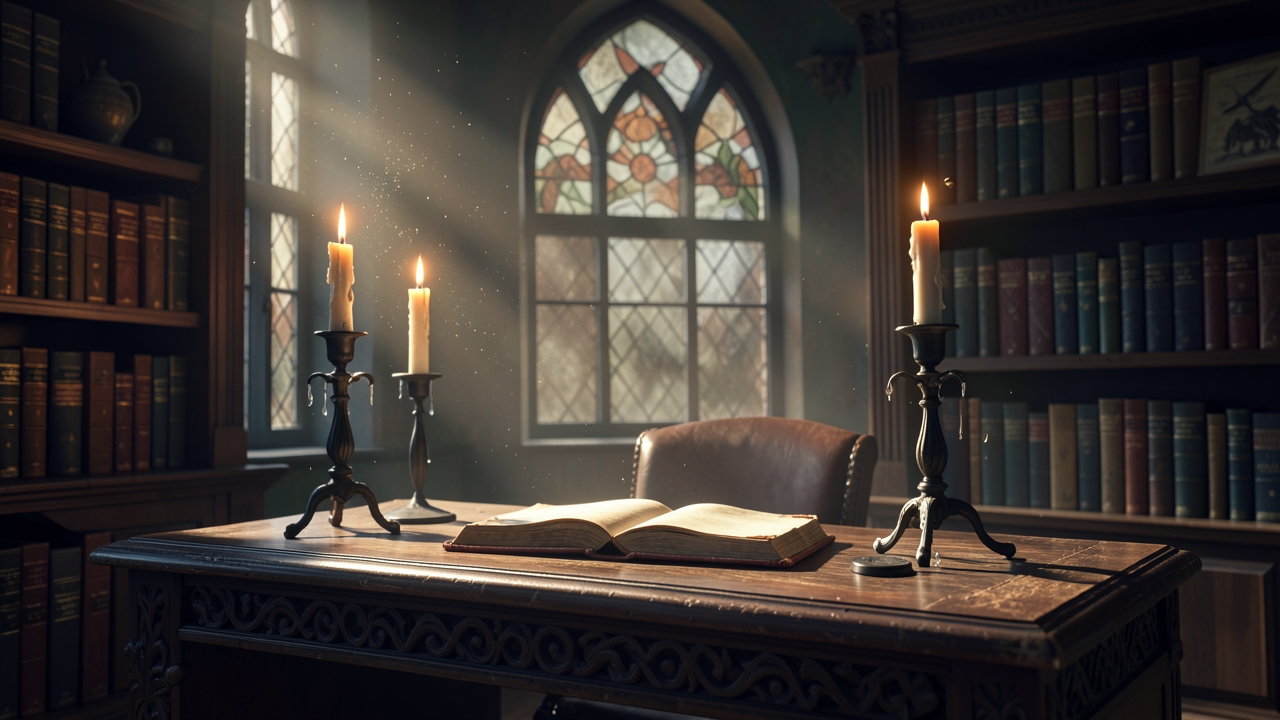
What if you already knew precisely how the story ended? Not vaguely. Not in spirit. But word for word, down to the final period that will fall like a coffin lid?
Most writers begin at the beginning and drift toward the dark, hoping an ending will materialize in the fog. Yet some of the most indelible fiction in the language was engineered backward. Edgar Allan Poe, that supreme architect of dread, insisted that every tale should be plotted toward a single premeditated effect. Read his essays on composition and you find a man who treated the ending not as a discovery, but as a sentence. He simply had to reach it alive. You can learn more about Poe’s philosophy of the single effect at the Poetry Foundation, and it remains the sharpest argument for working in reverse.
This week’s challenge is precisely that: a reverse outlining writing prompt. You will write a 500-word flash fiction scene by composing its last sentence first. Then you will build the machinery backward, sentence by sentence, until the beginning arrives like a door you forgot you had locked.
What Is a Reverse Outlining Writing Prompt?
A traditional outline maps a story forward: inciting incident, rising action, climax, resolution. Reverse outlining reverses the lens. You begin with the terminal image and ask a single, merciless question of every sentence you write: does this earn the ending I already possess?
The prompt works because it converts writing from wandering into excavation. You are no longer searching for the story. You are uncovering it, layer by layer, from the sediment upward. Nothing is decorative. Every detail must carry oxygen toward the final breath.
The Anatomy of the Terminal Sentence
A strong final line is not a twist. Twists are mechanics. Terminal sentences are gravity. Consider the closing of Shirley Jackson’s The Haunting of Hill House: “Hill House, not sane, stood by itself against its hills, holding darkness within.” That line does not surprise. It confirms. It seals what the novel has been whispering on every page. Jackson knew that line’s music long before she knew Eleanor Vance’s name.
Your final line must do at least two of three things. It must reframe something we believed. It must be inevitable in retrospect and impossible to predict. And it must be beautiful enough to survive being read twice, three, ten times. As a rule, prefer image to explanation. Prefer resonance to revelation.
Why the Last Sentence Changes Everything
Foreknowledge of the ending is not a constraint. It is a lantern. Once you carry it into the dark of the scene, you see the architecture that was always there.
Pacing Under Foreknowledge
When you know the destination, you learn to measure distance. A scene ending in betrayal needs different breath than a scene ending in forgiveness. Short sentences accelerate. Clauses lengthen, sag, and ache. In practice, the reverse outlining writing prompt teaches rhythm before it teaches plot.
Look at how Tana French structures her investigations. The revelation at the close of In the Woods recontextualizes every quiet conversation that preceded it. Nothing hurries. Everything accumulates. Because French writes toward a known fracture, she can afford patience. She knows exactly how much silence the ending will require.
Foreshadowing as a Contract with the Ending
Foreshadowing is a promise you make before you know you have made it. Working backward, the promise becomes deliberate. You plant the object, the gesture, the overheard phrase, knowing precisely which door it will open.
Daphne du Maurier was a master of this reverse architecture. In Rebecca, the final movement turns on what the narrator discovers about her own marriage. Du Maurier fills the novel with small, cold domestic details that feel merely atmospheric until the ending retroactively electrifies them. For a deeper technical treatment, see our guide to subtle foreshadowing techniques.
Subtext and the Unsaid
This is where the prompt earns its teeth. If the ending is a revelation, then everything before it must be a performance of ignorance. The characters must not know. The narration must half-know. The reader must suspect without being able to prove.
Gillian Flynn builds entire novels on this tension. Her narrators lie to themselves so convincingly that the final line lands like a trapdoor. Haruki Murakami, meanwhile, achieves the same effect through omission: whole rooms of meaning left dark, as in Kafka on the Shore. You can explore parallel techniques in our piece on show don’t tell exercises for gothic fiction.
Common Pitfalls of Working Backward
The method is seductive, and therefore dangerous. Three failures recur.
The wink. Narration that nudges the reader toward the ending. Avoid any sentence that seems aware of the surprise. Angela Carter’s fairy-tale retellings lean into theatrical irony, but that is a deliberate tonal contract. In realism, the wink kills suspense instantly.
The forced plant. Not every detail must be a clue. Over-seeding produces a garden of red herrings that exhausts trust. Choose three precise objects and let them breathe. Borges understood that a single symbol, correctly weighted, outweighs a hundred allegories.
The ornamental final line. A gorgeous sentence with no narrative duty is a gravestone in the wrong church. If the ending does not reframe the scene, it decorates. Delete it and find one that wounds.
How to Run the Reverse Outlining Writing Prompt
First. Write ten possible final lines. Not one. Ten. Push past your first instinct, which will always be a cliché wearing good shoes.
Second. Choose the line that frightens you slightly. Circle the image inside it. That image is your North Star.
Third. Write the paragraph immediately preceding the ending. Not the beginning. The paragraph before the last. Then write the one before that. Reverse-outline three or four paragraphs backward until you find the true opening gesture.
Fourth. Draft the full scene at 500 words or fewer. Read it aloud. Every sentence must either move toward the final image or conceal it.
Fifth. Ask of each line: would a first-time reader feel this was inevitable, and a second reader feel it was obvious? If both answers are yes, the prompt has done its work.
A Case Study: The Ledger of Small Mercies
Below is an original 500-word scene written by this method. The final line existed first: I had not been preserving the dead. I had been rehearsing my own disappearance. Everything above it was excavated backward from that confession.
The ledger was my mother’s, though she had never written a word in it. I filled the margins with other women’s sorrows, copied from condolence cards at the charity shop on Pell Street. I told myself I was an archivist.
Each evening I unlocked the narrow room above the bakery, set my candle on the blotter, and opened to the next blank page. The building exhaled its old bread smell. Below me, the ovens cooled with a ticking sound, like a clock deciding whether to continue.
My handwriting had changed in the last year. The letters leaned. I noticed it the week Mr. Aldiss died, the grocer whose wife wrote to me asking if I might keep his name “somewhere permanent.” I wrote it nine times on a single page. After that, every entry began to resemble the last.
On the fourteenth of November, a woman came to the shop with a card in her hand and no name on it. She was young. Her coat was too large. She asked whether I kept records of people who had gone rather than died.
I said that I did not.
She set the card upon my counter anyway. It was blank on the front and blank on the reverse, and she looked at me the way one looks at a door that ought to have opened. Then she left, and I carried the card upstairs, and I wrote what I always write when I do not know what else to write.
I wrote: she was here, and she was kind, and no one came for her.
The candle guttered. I did not move to shield it. I watched the wax pool into the gutter of the ledger and lift the ink, so that the final word rose and separated and swam alone across the paper, a small dark creature searching for its sentence.
I had not been preserving the dead. I had been rehearsing my own disappearance.
Notice what the backward construction supplied. The mother’s ledger becomes an inheritance of absence. The leaning handwriting foreshadows identity dissolving into subject matter. The blank card rhymes with the blank page. Nothing announces the ending. Everything converges on it.
Write Backward Into the Dark
A reverse outlining writing prompt does more than fix an ending. It teaches you to see the whole scene as an instrument tuned to a single note. When you know the note, you can hear every string that is slightly, unforgivably out of tune.
So take the last line you have been afraid to write. Set it down on the empty page like a stone in a grave you have not yet dug. Then begin, carefully, from beneath.
And when the first sentence arrives at last, will you recognize it as the beginning — or merely as the first lie you were willing to tell?